Every skincare brand begins with a promise. Clearer skin. Better hydration. A stronger barrier. A new ingredient that might become the next beauty obsession.
But between the promise and the bottle lies a considerably less glamorous world of chemistry, testing, regulation, stability and manufacturing precision.
That is where Skinlab Biochem Resources (M) Sdn Bhd has built its business.
The Malaysian skincare R&D, OEM and ODM manufacturer works behind the scenes for entrepreneurs, startups and established beauty companies, taking products from early-stage ideas through formulation, testing, regulatory support, packaging consultation and commercial production.
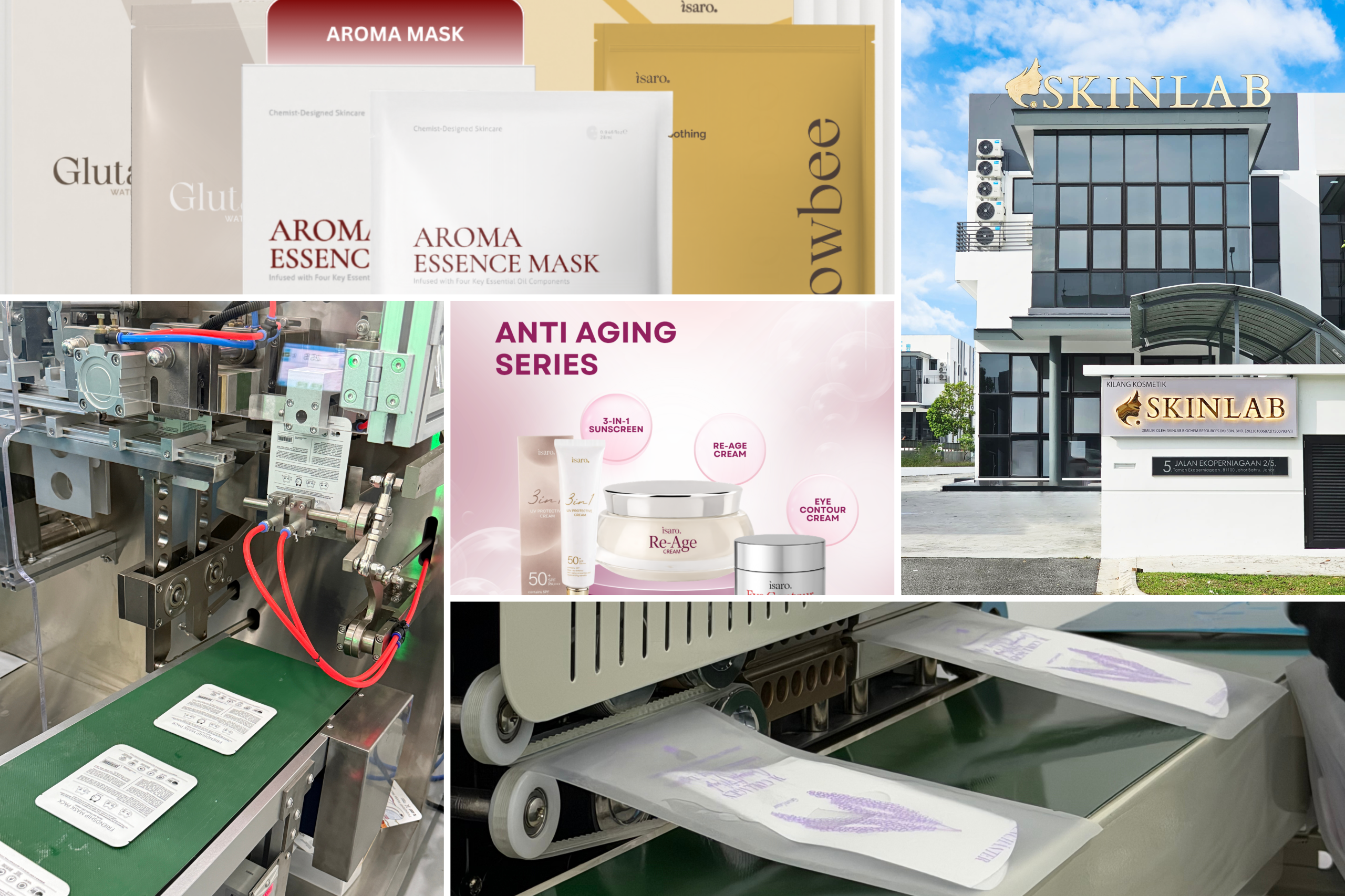
Its laboratory has developed more than 6,000 proprietary formulations in-house, spanning cleansers and serums to sunscreens, masks and specialised treatments.
For consumers, those formulations may eventually appear under somebody else’s brand.
For Skinlab, that is precisely the business.
The Hard Part Comes Before the Product
When Skinlab entered the market, one of the biggest barriers facing emerging beauty brands was access.
Manufacturing was largely geared towards volume. Smaller businesses with an idea—but without substantial capital, technical knowledge or large orders—could struggle to get started.
Skinlab responded with lower minimum quantities, customised formulation development and more comprehensive support.
But the problem has changed.
Launching a skincare brand has become easier. Building one that stands apart has not.
Consumers are more knowledgeable about ingredients. Regulatory expectations are increasing. Clean beauty, sustainability and transparency are influencing purchasing decisions, while brands face relentless pressure to introduce something new.
Skinlab’s role has consequently shifted from simply making products towards solving problems before they reach the factory floor.
Its R&D teams assess whether an idea is scientifically feasible, whether ingredients will interact as intended, whether a formulation will remain stable and whether the finished product can satisfy regulatory requirements.
Sometimes the most valuable answer is not yes.
The company has become more selective about projects, occasionally extending development timelines, recommending reformulation or declining work rather than compromising safety, stability or compliance.
In an industry built around launching the next product quickly, choosing to slow one down can itself be a competitive decision.
Why Water Matters
Some of Skinlab’s biggest investments are in things consumers will probably never know exist.
One is water.
Because water forms a significant component of many skincare formulations, Skinlab has invested in EDI, or electrodeionisation, water purification technology, providing a higher level of purification than conventional systems commonly used in manufacturing.
It has also developed specialised production equipment, including custom-engineered mixing tanks and ampoule machinery.
None makes for particularly glamorous beauty marketing.
Yet these are the systems that determine consistency between the sample that impressed a founder and the thousands of units eventually reaching consumers.
Skinlab’s competitive advantage therefore sits partly in what it calls the “invisible work”: formulation thinking, documentation, testing, risk prevention and translating technical realities for founders who may understand their customer better than they understand chemistry.
Malaysia as a Beauty Manufacturing Base
Now Skinlab is looking outward.
The company is targeting markets including ASEAN, the Middle East, the United States and Europe, benchmarking itself increasingly against international rather than solely Malaysian manufacturing standards.
Halal skincare could prove particularly important.
Skinlab operates a Halal-certified manufacturing facility and has built thousands of formulations prepared for halal assessment and development. Combined with its focus on alcohol-free formulations and natural and botanical ingredients, the capability gives it access to a beauty segment whose relevance extends well beyond Malaysia.
Its ambition is also becoming larger than skincare.
Skinlab ultimately wants to evolve into an integrated innovation platform, becoming involved earlier in product strategy rather than waiting for clients to arrive with finished briefs. Longer term, it is exploring adjacent categories including health supplements, health supplies and traditional medicine products.
That transition will demand stronger R&D, more specialised talent and better systems capable of scaling innovation without turning it into a production line.
There is a useful contradiction in Skinlab’s philosophy.
Beauty is an industry obsessed with what is new. Yet building products consumers can trust depends heavily on disciplines that are decidedly unexciting: testing carefully, documenting properly, manufacturing consistently and sometimes refusing to move faster.
The bottle may carry someone else’s name.
But what makes the product possible begins long before the label goes on.