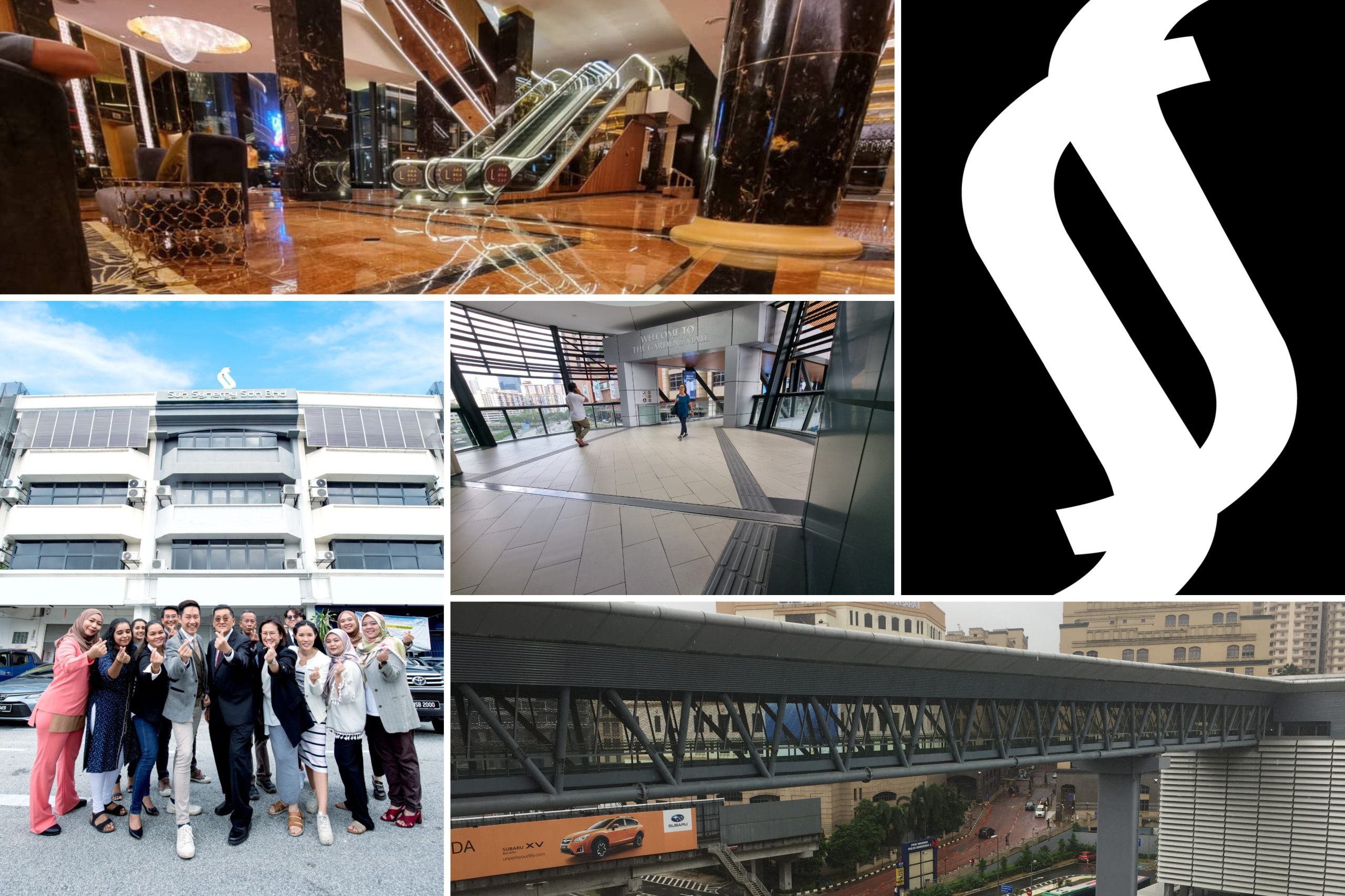
Landmark buildings are remembered for their height, design and presence on a skyline. Less visible are the components that help them withstand movement, accommodate foot traffic and remain usable over time. For Sun Synergy, those details form the foundation of a specialist distribution business.
Operating in Malaysia since 1999, the company supplies architectural building materials to architects, interior designers, contractors and specialist installers. Its portfolio includes Latham Australia’s mechanical expansion joints, Progress Profiles Italy’s tile installation accessories and profiles, and Vexcolt’s entrance flooring and tactile indicators.

Managing Director of Sun Synergy Sdn. Bhd. – Ng Cheong Foo
Its project references include the Petronas Twin Towers, Merdeka 118, TRX, Pavilion, IOI City Mall and Malaysia’s MRT and LRT networks. These projects illustrate the market it serves: buildings and infrastructure where technical performance must endure long after construction ends.
The underlying problem is straightforward. Buildings expand, contract and shift. Without properly designed joint systems, that movement can contribute to cracked finishes, water ingress and costly repairs. Entrance systems and tactile indicators address another practical requirement: helping people move safely and confidently through public spaces.
Sun Synergy says the market has changed substantially since engineered expansion joints first gained traction locally. Product awareness has improved, while cheaper alternatives have intensified competition. Availability alone offers little protection for a distributor.
Its response is to compete through technical advice. Reading architectural drawings, discussing movement requirements and helping consultants resolve details at the design stage create opportunities that a product catalogue cannot secure.
That approach also determines which opportunities it pursues. Projects offering early specification engagement receive attention and resources. Tenders decided almost entirely on price are less attractive, particularly where winning would undermine margins or relationships with established principals.
The financial record reflects that selective approach. Audited revenue rose from RM3.16 million in FY2022 to RM4.11 million in FY2023, before settling at RM4.00 million in FY2024. The company regards maintaining that position through commodity disruption, freight volatility and material cost pressures as a meaningful achievement.
Its next challenge is to broaden its offering without weakening its positioning. Sun Synergy is introducing cost-competitive Chinese product lines for budget-sensitive projects, while retaining its premium portfolio. Managing that balance will require clear product selection and consistent technical support.
The company sees infrastructure development and commercial fit-outs as sources of future demand. Accessibility and green building requirements are also influencing customer decisions. Converting those opportunities into sustainable earnings, however, depends on securing the right specifications early and maintaining the resources needed to support projects through completion and subsequent maintenance.
People remain a constraint. Technical sales staff must understand drawings and communicate credibly with consultants, skills the company says are difficult to recruit. It has sent employees to Latham Australia for factory training and plans further training with Progress Profiles Italy.
The business has consequently remained small and specialised, supported by MYOB for finance and Rework CRM for sales. Working capital demands equal attention: larger construction projects can bring longer payment cycles, making sales growth an incomplete measure of business health.
Accountability is another part of its proposition. Sun Synergy handles warranty and technical matters directly with its principals, giving customers one point of contact when problems arise. Directors remain personally accessible, an arrangement intended to simplify resolution across complex project teams.
Internally, its sustainability efforts are developing. Rooftop solar at its headquarters and electric vehicles used by three directors represent initial investments. The company acknowledges that a formal ESG policy and carbon baseline remain to be established.
Its regional ambition centres on Indonesia, Brunei and Thailand. Expansion, however, depends on building stronger foundations at home: more specification sales capability, financing suited to longer project cycles, and documented training, ESG and operating processes.
For a business built around managing movement, the next step requires careful preparation. Its ability to carry technical expertise across borders will matter as much as the products it takes with it. Regional growth will test whether its personal service model can operate consistently across a wider market.