tengku zafrul

Investment & Market Trends, News

MITI Focuses on Non-Traditional Partners to Diversify Trade, Says Tengku Zafrul

SAMARKAND: The Investment, Trade and Industry Ministry is diversifying trade efforts by focusing on non-traditional trading partners to address the challenges in the era of globalisation. Minister Tengku Datuk Seri Zafrul Abdul Aziz said that with geopolitical challenges reducing global trade, the ministry is focusing on countries such as those in Africa, South America and West Asia. “This is exactly our strategy. Our largest trading partner is China, followed by the US. We saw that global trade fell last year with the world’s biggest countries. However, (trade with) West Asian, African and South American countries increased. “That’s part of our diversifying policy in trade (focusing on non-traditional countries). We need to focus on diversifying our trade, not on traditional markets but on new ones because that’s (where) the growth will be. We have to plan now for the future,” Tengku Zafrul said at the Sil Road Samarkand Complex in Uzbekistan. The minister is in Uzbekistan to accompany Prime Minister Datuk Seri Anwar Ibrahim, who is on an official visit to 3 Central Asian countries from 14 to 19 May. Tengku Zafrul said the 3 countries (Uzbekistan, Kyrgyz Republic and Kazakhstan) are rapidly developing with faster and stronger gross domestic product (GDP) even though economies are still small compared with Malaysia’s. “Their economic growth is huge. We can also participate in economic growth, not only among large companies but also among SMEs,” he added. According to Tengku Zafrul, the trade commitment for Malaysian exports was about RM3.1 billion including RM700 million in Kyrgyzstan, RM1.7 billion in Kazakhstan and RM710 million in Uzbekistan. Malaysia-Kyrgyzstan trade volume reached US$36.35 million (RM162.3 billion) in 2023, a 312.6% rise from 2022 with Malaysian exports of US$36.09 million (RM161.1 million) in 2023. Malaysia’s total trade with Kazakhstan in 2023 amounted to US$104.2 million (RM474.5 million). Malaysian exports totalled US$102.2 million (RM465.6 million) and imports from Kazakhstan amounted to US$1.9 million (RM8.9 million). Malaysia-Uzbekistan trade volume reached US$94.03 million (RM451.1 million) in 2023, with Malaysian exports at US$93.6 million (RM449 million) and imports at US$414,518 (RM1.99 million). On investment cooperation, Tengku Zafrul said with Malaysia’s GDP 10 times larger than Kazakhstan’s 4 times larger than Uzbekistan’s, the Central Asian Countries are seeking Malaysia to invest in their countries instead of the other way around. — BERNAMA
News

MIDA-MOHE Collaboration to Develop More Skilled Talent for Global Market

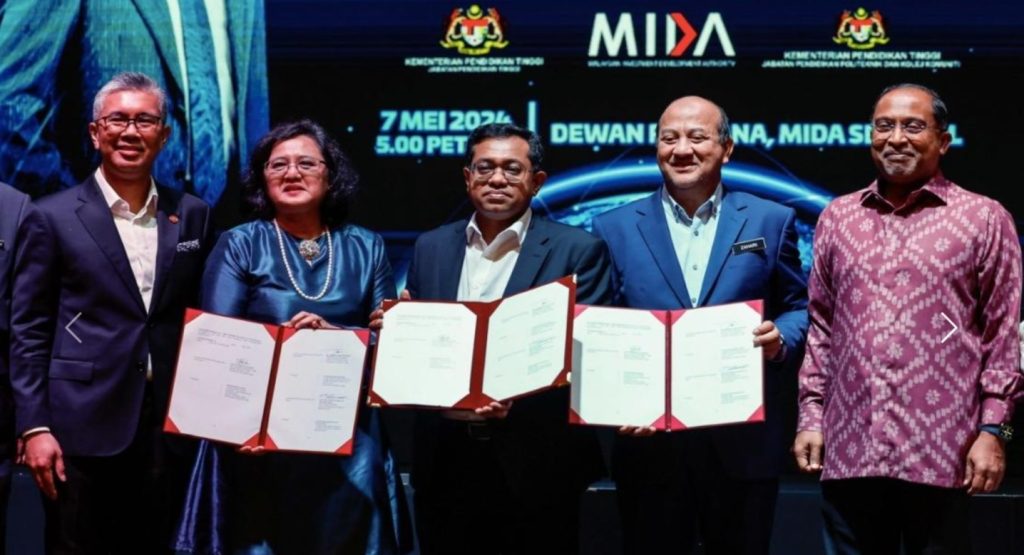
KUALA LUMPUR: The cooperation between the Malaysian Investment Development Authority (MIDA) and the Ministry of Higher Education (MOHE) can catalyse the country’s industrial growth, especially in supporting the development of more talent globally. Minister of Investment, Trade and Industry (MITI) Tengku Datuk Seri Zafrul Abdul Aziz said a trained and competitive workforce is key to the success of the New Industrial Master Plan (NIMP) 2030. “The shortage of skilled talent became a constant issue among our investors, both domestic and foreign. “Without a holistic solution on talent development and supply, Malaysia can never achieve the economic complexity, high-tech industrial ecosystem, net-zero target or the economic security envisaged by the NIMP 2030,” he said at the Memorandum of Understanding signing ceremony between MIDA and MOHE, to which the Minister of Higher Education Datuk Seri Zambry Abd Kadir was also present. According to Tengku Zafrul, the collaboration is in line with the aspirations of the MADANI Economy framework that aims to create graduates and skilled talent to crown Malaysia among the 30 largest economies in the world by 2033. He said that investment in the industrial sector is one of the most stable job creators for a country. “This is the kind of steady and enduring capital that Malaysia needs,” he said. Between 2021-2023, he noted that as many as 150,000 job opportunities were created through 2,386 approved manufacturing projects. Out of this, over 81% have already been implemented and most of those opportunities are for high-income skilled talents for Malaysians. “For manufacturing projects that were approved for that period, a total of 3,678 (over 83%) have been implemented, while 612 (14%) projects are at the planning stage,” he stated. Tengku Zafrul said that in 2023 alone, the project implementation rate shows that more than 63% (559 projects) have been implemented, covering projects in the production stage, factory construction or machine installation. “Typically, each project takes 18 to 24 months to implement. Almost 35% (309 projects) are at the planning stage including activities such as location determination and discussions with developers and consultants. “Only 1.25% (11 projects) have yet to be implemented and 4 other projects that cannot take place for certain reasons, including changes in investor strategy,” he explained. He added that the current rate is encouraging as this investment is unlike the capital market where funds can go in immediately, but can also be withdrawn in just a few hours. “When we ensure a robust talent pipeline, we will strengthen Malaysia’s industrial capacity and this is where we can push value proposition that Malaysia is where global starts,” Tengku Zafrul said, adding that Malaysia is where global companies can situate their regional hubs and where homegrown companies can grow into global champions. — BERNAMA

ESG, News

Measures Involving Trade and ESG Must Be Fair to Developing Countries – Tengku Zafrul

KUALA LUMPUR: Malaysia believes there is a need to revisit commitments to sustainable development, efficient global recourse and fair and balanced trade among countries, said the Ministry of Investment, Trade and Industry (MITI). Its minister Tengku Datuk Seri Zafrul Abdul Aziz said countries must have shared values which will result in trade policies that can contribute to equitable and sustainable development. “However, this should not be used as non-tariff measures to restrict trade flows. The proliferation of trade-related environmental measures such as the threat of environmental, social and governance (ESG) by developed countries is among the most important aspects of international trade,” Tengku Zafrul said during a meeting at the World Economic Forum held in Riyadh, Saudi Arabia. Tengku Zafrul said the proliferation of trade-related measures has emerged as potential protectionist tools that could unfairly discourage global production and trade, particularly to developing countries. “These measures can manifest as border instruments and compliance but they will undoubtedly be complicated and perhaps too costly for most developing country exporters,” he added. Tengku Zafrul stressed that leaving the matter unattended could potentially erode developing and least developing countries’ trade competitiveness and investment attractiveness. Citing a report by the World Trade Organisation, he highlighted that environmental goods and services face an average tariff of 4.3% along with numerous non-tariff measures. “The cost of compliance, including certification, can be prohibitively expensive, especially for small and medium enterprises from developing nations. “Such barriers necessitate a collaborative approach where developed countries not only impose these standards but also facilitate the means for compliance through technical and financial support,” he added. Tengku Zafrul went on to say that in light of the complexities posed by ESG standards as non-tariff barriers and the significant need for capacity building and fair trade policies, a comprehensive approach is essential to ensure both environmental sustainability and economic justice, particularly for developing nations. “Therefore, Malaysia supports and welcomes discussions on establishing effective multilateral rules on trade and sustainable development. “Our commitment is evident through initiatives such as the New Investment Policy, New Industrial Master Plan 2023, National Energy Transition Roadmap and the ESG Industry Framework, which are all aimed at achieving sustainable economic growth,” he said. — BERNAMA

Energy & Technology, News

MITI Maintains Target of 10k Charging Stations by 2025 Despite Setbacks

KUALA LUMPUR: A total 2,214 electric vehicle (EV) charging stations were installed as of 20 March 2024 as the Ministry of Investment, Trade and Industry (MITI) maintains its commitment to developing the EV charging infrastructure and reaching its target of 10,000 charging points by 2025. Under the Low Carbon Mobility Blueprint (LCMB) 2021-2023, 9,000 units of those charging points will be altering current (AC) chargers and 1,000 units will be direct current (DC) fast chargers. “Out of the 2,214 EV charging stations already installed, 1,741 AC chargers and 473 are DC fast chargers,” Investment, Trade and Industry Minister Tengku Datuk Seri Zafrul Abdul Aziz said during a press conference after announcing the ministry’s first-quarter 2024 report card. On the Electric Motorcycle Use Promotion Scheme (MARiiCas) programme, Tengku Zafrul said 1,995 applications were approved with rebates valued at RM4.8 million as of 31 March 2024. Earlier in January, he said that the government may not be able to meet the target of installing 10,000 charging stations around the country by next year. Having that in mind, Tengku Zafrul said that he and his Cabinet colleagues would re-examine if the target is feasible. “It seems that the target is quite aggressive because there are many issues that we need to address. “It involves agencies such as the Energy Commission, local authorities and other parties,” he said, adding that the procedures to install the charging stations needed to be streamlined as there had been complaints from equipment suppliers. “One of the main complaints was that it took a long time to get approval to set up a charging station. We need to make it seamless,” he commented. — BERNAMA

Scroll to Top

Subscribe
FREE Newsletter