The Malaysia Retailers Association (MRA) has launched the Retail ESG Standard (RES), a new sustainability framework designed to help retailers of all sizes assess, implement and strengthen their environmental, social and governance (ESG) practices.
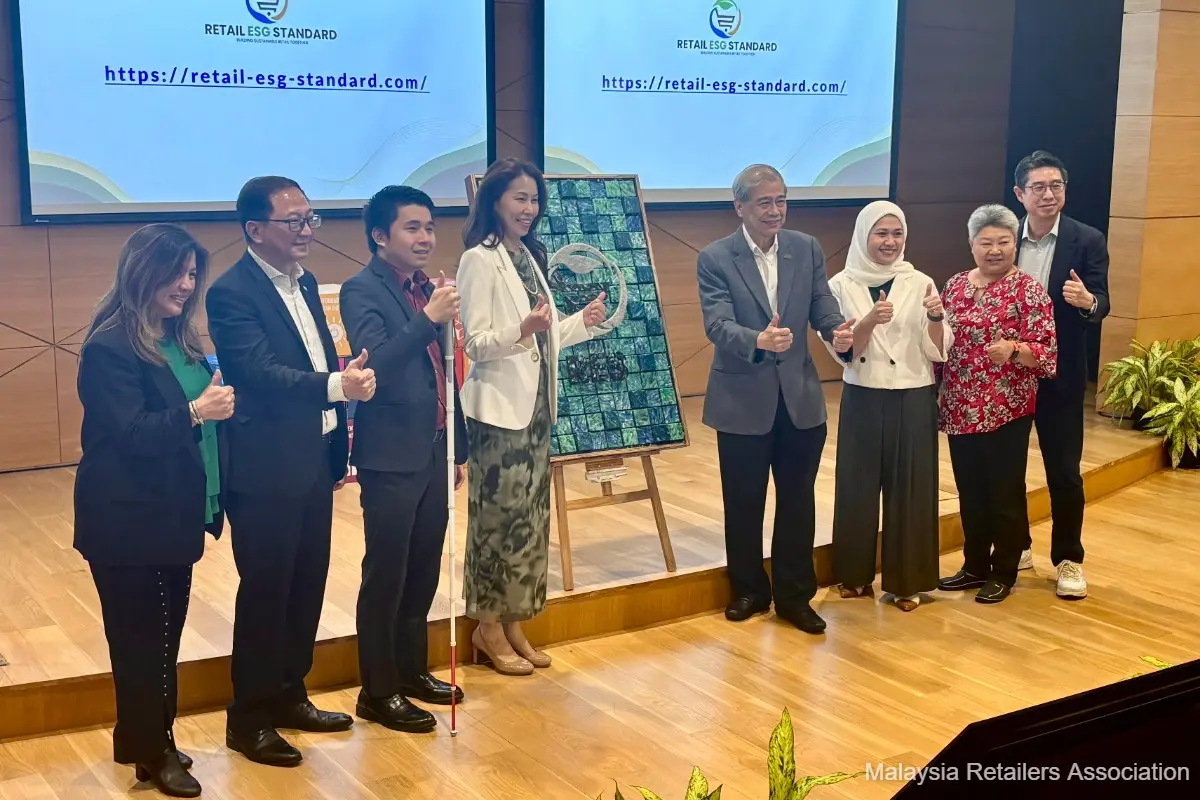
(From left) Parkson Malaysia chief operating officer Adeline Wong, MRA presidential advisor James Loke, Genashtim head of ESG services Tan Ee Beng, MRA chair for sustainability committee Molly Fong, MRA president Datuk Andrew Lim Tatt Keong, Aeon Co (M) Bhd head of sustainability Tengku Adrinna Tengku Azman, MRA general manager Evelyn Cheong and MRA council member Raymond Teo.
The initiative was unveiled at MRA’s Annual Sustainability Symposium, held at the Asian Institute of Chartered Bankers (AICB) Centre of Excellence, as part of the association’s efforts to promote responsible business practices and encourage greater sustainability adoption across Malaysia’s retail industry.
Developed specifically for the retail sector, the RES framework aims to address the lack of practical, industry-specific guidance available to retailers seeking to integrate ESG principles into their daily business operations.
The introduction of the framework comes amid growing expectations from consumers, investors, business partners and regulators for businesses to demonstrate greater accountability, transparency and commitment to sustainable practices.
Through RES, retailers can evaluate their existing ESG performance, identify areas requiring improvement and develop more structured approaches to managing sustainability-related responsibilities.
The framework also serves as a practical assessment tool, allowing businesses to monitor their progress, identify potential opportunities for innovation and ensure they remain informed about key sustainability requirements.
Molly Fong, Chair and Founder of the MRA Sustainability Committee, said the framework was developed to help retailers translate sustainability commitments into measurable business actions.
“The question is not whether ESG is important. The challenge is in turning sustainability ambitions into action and this is the gap that we wanted to address with the RES framework, to provide retailers with a comprehensive framework that is designed specifically for the retail industry,” she said.
Framework Focuses on Three Key ESG Pillars
The RES framework is structured around three core pillars — environmental, social and governance — with each covering five key sustainability areas relevant to retail operations.
Under the environmental pillar, retailers are assessed on greenhouse gas emissions, energy consumption, water usage, waste management and the adoption of sustainable and safe materials.
These areas are intended to help businesses better understand their environmental footprint and identify opportunities to improve resource efficiency while reducing their impact on the environment.
The social pillar focuses on labour and human rights, occupational health and safety, diversity, equity and inclusion (DEI), customer welfare and community engagement.
This component encourages retailers to strengthen workplace practices, promote employee well-being and maintain responsible relationships with customers and the communities in which they operate.
Meanwhile, the governance pillar examines corporate governance structures, business ethics and policies, risk management and reporting, supply chain screening, as well as data privacy and security.
Together, the three pillars provide retailers with a structured approach to assessing their sustainability performance while supporting stronger corporate responsibility and business resilience.
Aligned with International Sustainability Standards
To ensure relevance and consistency with established sustainability reporting practices, the RES framework has been developed in alignment with several internationally recognised standards and guidelines.
These include the International Financial Reporting Standards (IFRS) S1 and S2, the Sustainability Accounting Standards Board (SASB), Malaysia’s National Sustainability Reporting Framework (NSRF), B Corp standards and the Simplified ESG Disclosure Guide (SEDG).
By incorporating these references, the framework seeks to provide retailers with a practical foundation for understanding ESG expectations and preparing for evolving sustainability disclosure requirements.
One of the key features of RES is its accessibility, with the assessment platform made available free of charge to all retailers.
The initiative is intended to encourage wider participation, particularly among small and medium-sized retail businesses that may face challenges in allocating resources towards sustainability programmes.
Retailers seeking formal recognition of their ESG performance may also opt for an independent audit process, available at a fee, to obtain validated certification.
Fong emphasised that the framework was designed with the specific operational needs and challenges of the retail industry in mind.
“Rather than adopting a generic ESG framework, we designed RES specifically with the realities of retail businesses and the retail ecosystem in mind,” she said.
The initiative was developed through a collaboration between MRA and the ESG Business Institute, a global think tank and professional network focused on advancing responsible business practices and sustainable development.
MRA Recognises Sustainability Excellence Among Retailers
The launch of RES was held in conjunction with the inaugural MRA Sustainability Awards, which recognised retailers demonstrating strong commitments to sustainability and responsible business operations.
Aeon Co. (M) Bhd and Innature Bhd were jointly named recipients of the Sustainable Retailer of the Year award, recognising their contributions to advancing sustainability practices within the retail industry.
Katrin BJ Sdn Bhd received the Rising Star in Sustainable Retail award in recognition of its emerging efforts in adopting sustainable business practices.
Meanwhile, Parkson Corporation Sdn Bhd, Uniqlo (Malaysia) Sdn Bhd and MST Golf Sdn Bhd received merit recognition for their sustainability achievements.
The awards highlighted the growing importance of ESG integration within Malaysia’s retail sector and acknowledged companies taking steps to improve their environmental and social performance.
Through the introduction of the Retail ESG Standard and the MRA Sustainability Awards, the association aims to encourage more retailers to incorporate sustainability into their business strategies and operational practices.
The initiatives also reflect a broader effort to strengthen the Malaysian retail industry’s competitiveness and resilience as sustainability considerations become increasingly important to businesses, investors and consumers.