Author name: admin

ESG, News

EU, ASEAN Team Up to Boost Educational and Research Ties

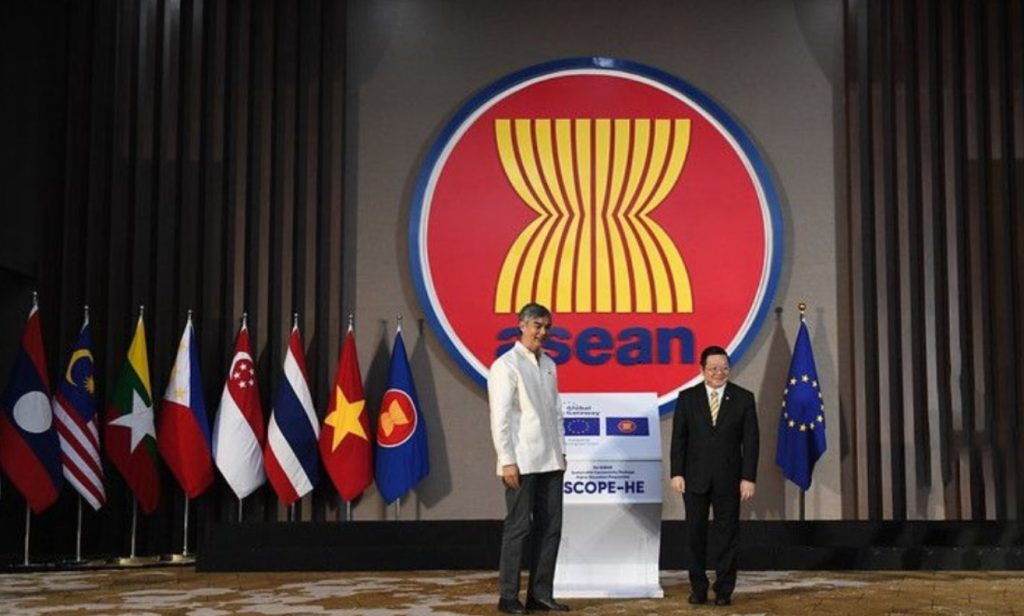
JAKARTA: ASEAN and the European Union (EU) have launched a US$10.17 million (€9.3 million) programme, the Sustainable Connectivity Package (SCOPE) in Higher Education, aimed at enhancing student and academic mobility in ASEAN and fostering EU-ASEAN cross-regional university networks in research. The programme, scheduled to run until January 2028, also aims to strengthen vocational education with a focus on the green transition, sustainability and digitalisation. The launching was officiated by ASEAN secretary-general Dr Kao Kim Hourn and Ambassador of the European Union to ASEAN Sujiro Seam at the ASEAN headquarters. “These partnerships not only empower our future leaders but also serve as bridges that close divides and create equitable opportunities for all,” Kao said. Meanwhile, Seam said the SCOPE in Higher Education project is part of the overall EU-ASEAN Sustainable Connectivity Package (scOPE) that was adopted by the EU in April 2023. “Southeast Asia is a key region and we want to further develop sustainable and trusted connections with ASEAN countries,” he said. This year, through the Erasmus Plus programme, the EU granted Erasmus Mundus Joint Master’s degree scholarships to more than 200 ASEAN students, allowing them to study in two or more European countries. From 2014 to 2023, nearly 12,000 ASEAN students and scholars participated in short-term studies and teaching in Europe, while around 6,000 European students and scholars came to ASEAN for similar opportunities. In research, the EU funded 90 grants through the Horizon Europe programme between 2021 and 2024, involving 109 institutions from ASEAN, with a total EU contribution of US$11.59 million. — BERNAMA

Energy & Technology, News

Solomon to Build Advanced Robotics Solutions Using NVIDIA Isaac Robotics Platform

TAIPEI: Solomon, a leader in advanced vision and robotics solutions, is excited to announce a collaboration with NVIDIA at COMPUTEX 2024. This collaboration focuses on integrating Solomon’s product offerings with the NVIDIA Isaac robotics platform to enhance Solomon’s 3D robotics vision and augmented intelligence solutions. “We are thrilled to integrate the NVIDIA Isaac platform into our products,” said Solomon CEO, Johnny Chen. “NVIDIA’s advanced AI and robotics tools will enhance our product capabilities in 3D machine vision, robotics control, and augmented intelligence, helping drive greater innovation in industrial automation,” he added. A key highlight of this collaboration is Solomon’s bin-picking system, enhanced by NVIDIA Isaac Manipulator accelerated libraries, which are based on NVIDIA Isaac ROS. It delivers 8 times faster path planning and execution and reduces path singularity occurrences by 50% compared to conventional algorithms. Combined with AccuPick’s advanced image recognition, these advancements enable smaller robot cells without compromising cycle time, essential for efficient bin picking in factories and order picking in logistics centres. The NVIDIA Isaac platform leverages generative AI to offer powerful foundational models for robotics. Solomon will continue to deliver innovative products and applications by incorporating multiple NVIDIA Isaac technologies, with the goal of bringing smarter automation to manufacturing, retail, logistics, and other sectors. “The era of AI robotics has arrived. To meet this demand, NVIDIA is building a full-stack, accelerated robotics platform to enable ecosystem leaders such as Solomon advance deployment of autonomous machines across the world’s largest industries,” said, NVIDIA Vice President of Robotics and Edge Computing, Deepu Talla.

ESG, News

Financial Services Industry Expected to Grow in China, Especially for Senior Care

China’s growing senior population is bringing tremendous business opportunities to the financial services industry, says Michael Guo, Co-CEO of Ping An Insurance (Group) Company of China, Ltd. According to Ping An Insurance (Group) Company of China, Ltd Co-Chief Executive Officer, Michael Guo, the ageing population in the country has a low awareness of the need to plan ahead financially for senior care. Because of this, senior care services in the China market are fragmented and lack unified standards. Realising this, Ping An is taking the lead of building an ‘integrated finance + health and senior care’ service system to provide professional financial advisory, family doctor and senior care concierge services. “China is ageing before becoming rich,” Guo said. “When China entered the phase of an ageing society in 1999, the gross domestic product (GDP) per capita was only US$1,000. In comparison, when developed countries in Europe and the US encountered ageing populations, their GDP per capita was approximately US$10,000.” “This shows that they had stronger financial capacity to support senior care. Today, the challenge in China is that the retirement replacement ratio is low and there is a lack of awareness of the importance of financial planning for senior care,” he explained. Guo also believes that as average life expectancy increases, people will attach greater importance to pensions and start planning earlier. Hence, the demand for capital preservation and appreciation, with the goal of building a ‘personal pension reserve’, will become the core demand of wealth management. Integrating Financial Products and Senior Care Currently, China’s insurance industry is aware of the market opportunities in wealth management for seniors and is working on designing “finance + senior care” products. However, Guo commented that the product types are too generic. “Fulfilling the needs of seniors cannot be done by simply adding senior care products together, but should be a comprehensive solution, which is organically combined and adjusted to meet the customised demand of the seniors at different stages of their lifecycles,” he added. For example, seniors who are relatively healthy may want more social interaction, travel, hobbies and learning, to maintain physical and mental health. Seniors with chronic diseases would require appropriate disease management, and for some, disability care services. To date, China’s senior care and healthcare services sector is still in its early stages, and some of the main challenges include service fragmentation, the uneven quality of services, processes, its costs, as well as a lack of unified standards and service monitoring systems. Being a senior care insurance solutions provider, Ping An integrates healthcare and senior care services with an aim to meet the different demands of senior customers in health, medication for chronic diseases, and senior care. Its products also include financial products that offer insurance protection, wealth appreciation, wealth inheritance, and healthcare and senior care services, such as chronic disease management, health management, medical consultations and rehabilitation, residence security, guardianship and entertainment. “The strength of Ping An lies in its ability to integrate providers into a comprehensive senior care service platform that can meet customers’ personalised needs,” said Guo. Today in China, 90% of seniors choose home-based senior care. Meanwhile, Ping An’s home-based senior care services include Ping An Health’s online diagnostic platform, which offers 24/7 treatment and consultation services. It has consolidated extensive offline healthcare service resources, including 100% coverage of the top 100 and 3A hospitals in China, nearly 50,000 in-house and contracted doctors, about 2,400 partner senior doctors, and 230,000 partner pharmacies. Integrating more than 100 suppliers, the in-home care offers a suite of 650 services and a 24/7 home-based concierge service in 54 cities, with more than 80,000 customers eligible for these benefits. Technological Empowerment of the Senior Care Industry Technological empowerment plays an important role in Ping An’s senior care strategy. For example, home-based senior care is supported by an artificial intelligence (AI)-driven concierge. Currently, AI has been fully implemented in 200 scenarios for online concierge customer interactions and support for human concierges. AI can offer further assistance to efficiently empower homecare workers and nurses, leading to greater efficiency and quality improvements. “The entire financial insurance industry can leverage its own financial data and combine it with the senior care industry to accumulate data and continue to explore the empowering and enhancing the role of data and technology,” Guo continued. Another key aspect of technology in senior care is data application. On this, Ping An possesses one of the world’s largest healthcare databases, including a disease database, prescription database, drug database, doctor and hospital database, and personal health database. The data – sourced from public sources, including the National Health Commission, National Healthcare Security Administration, and National Medical Products Administration – has already been used in scenarios such as health insurance underwriting and claims and assisting users to find information on diseases, drugs, hospitals, and doctors.

Investment & Market Trends, News

Datasea Enters into Sales Agreements, Expecting $62 Million in Sales

BEIJING: Datasea Inc., a Nevada corporation engaged in innovative businesses in high-tech intelligent acoustics and 5G-Artificial Intelligence multimodal communication technology in the United States and China, announced 3 sales agreements with its subsidiaries in China. The agreements reached a total value of approximately US$61.7 million that encompass two agreements for its 5G-AI communications segment, and one agreement for Datasea’s high-tech acoustic products segment. Datasea CEO Liu Zhixin commented, “We are pleased to enter into the new agreements as they are expected to increase new customer orders for both our 5G AI communications and acoustics products segments. We believe that both of our businesses are beginning to gain excellent traction due to their high value in the 5G communications and healthy living marketplaces. “In addition, we are confident that the two segments’ core AI functionality will drive further technological innovation and increased market share,” she Zhixin. Datasea’s three new sales agreements include the company’s Guozhong Haoze subsidiary signing a 5G AI Multimodal Communication Agreement with Shenzhen Juhaowan Technology Co., Ltd., an online lifestyle services and application service provider on 15 May 2024. According to the agreement, Juhaowan can purchase 5G multimodal communication delivery services from Guozhong Haoze over the course of 12 months which have an estimated total value of up to US$30 million. Another agreement was made on 13 May 2024, involving the company’s Heilongjiang Xunrui subsidiary that signed a 5G AI Multimodal Communication Agreement with Shenzhen Yuzhongqing Technology Co., Ltd., a firm primarily engaged in internet and related services. According to the agreement, Yuzhongqing can purchase 5G multimodal communication delivery services from Heilongjiang Xunrui over the course of 12 months which have an estimated total value of up to US$30 million. Finally, on 8 June 2024, the company’s Shuhai Jingwei subsidiary entered into an Acoustic Products Sales Agreement with Tianjin Qianli Culture Communication Co., Ltd., an internet promotion and marketing service provider, for the Company’s acoustic high-tech products. According to the agreement, Qianli Culture will purchase a total of approximately 20,000 units of the company’s “Tianer” and “Star Sleep” branded products, including air disinfection machines, restroom deodorization and disinfection devices, and sleep aids, by 31 December 2024, with the total contract amount reaching approximately US$1.7 million.

Investment & Market Trends, News

Boost Exports of Cars, Parts & Components to Make Malaysia Regional Auto Hub

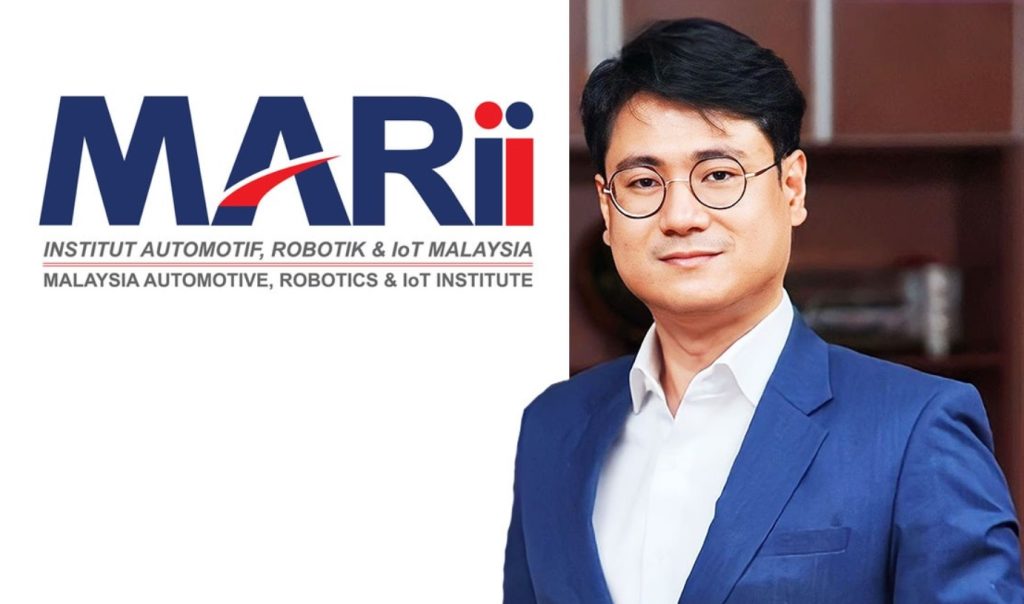
KUALA LUMPUR: Malaysia’s potential to become an automotive hub for ASEAN not only lies in strategies to boost car exports, it also hinges on the increased export of parts and components. To achieve this, Malaysian automotive and parts companies must persevere to increase exports of cars significantly, enabling parts to be sold at more competitive prices. Increased sales volumes can reduce production costs and subsequently, component prices, making them more competitive than those in regional and neighbouring countries where auto parts are cheaper due to the high sales volume. Car manufacturers, auto industry researchers and economists believe that these endeavours are crucial to establishing Malaysia as a regional automotive hub for ASEAN and taking advantage of the region’s close to 700 million consumer base. “We urge original equipment manufacturers (OEMs) to not only export cars but also parts and components, thereby enhancing the overall competitiveness of the Malaysian automotive industry,” said Azrul Reza Aziz, MARii Chief Executive Officer. He said this in response to reports that Malaysia’s supply chain costs are 30% higher than Chin’s and 10% costlier than Thailand’s. Azrul Reza pointed out that it is essential to recognise that these costs vary significantly, depending on each company’s cost structure, car model and supply chain ecosystem. He highlighted that companies may have different levels of maturity in their supply chains, which impacts their overall cost efficiency. Malaysia undoubtedly has a lot of catching up to do, as, despite marking significant growth, its record-high total production volume (TPV) was only 775,000 vehicles, compared to China’s TPV which stood at around 30 million vehicles and Thailand’s at 1.8 million vehicles. Azrul Reza said Malaysian companies must transform by embracing digital advancements, leveraging Industry 4.0 (IR4.0) technologies to address the challenges. This is crucial as the country aims for carbon neutrality by 2050, focusing on the development of electric vehicle (EV) components, autonomous vehicles (AV), and Internet of Things (loT) components. “Given the constraints on purchasing raw materials in bulk due to cost implications and the added expenses of stock handling and maintenance, digital solutions offer respite in terms of immediate insights and resolutions. “Furthermore, digital solutions enhance efficiency and effective improvements in research and development, notably through the utilisation of computer-aided engineering and additive manufacturing technologies,” he said. Meanwhile, Malaysian Automotive Association (MAA) president Mohd Shamsor Mohd Zain noted that China and Thailand’s domestic pool of population, vehicles, and maintenance networks are considerably larger than Malaysia’s. Their reduced reliance on exports means that their vendors are less vulnerable to fluctuating exchange rates. Similarly, such costs are largely driven by the push and pull of demand and supply, he said. “Although Malaysia has a relatively mature automotive supply chain, dating back more than 50 years, the cost of setting up, or refreshing component manufacturing with new technology is very high. “The most effective way to justify these investments is for Malaysia to position itself as an export hub,” he said. Mohd Shamsor said the local automotive industry needs to build its competencies in terms of quality, affordability and productivity in locally-produced parts by expanding the export volume and ramping up OEMs’ capacities. He added that manufacturers often have different perspectives on how their business models are structured and cost is only one consideration among many. — BERNAMA

ESG, News

SSM Launches ‘Corporate Code of Ethics’ Book

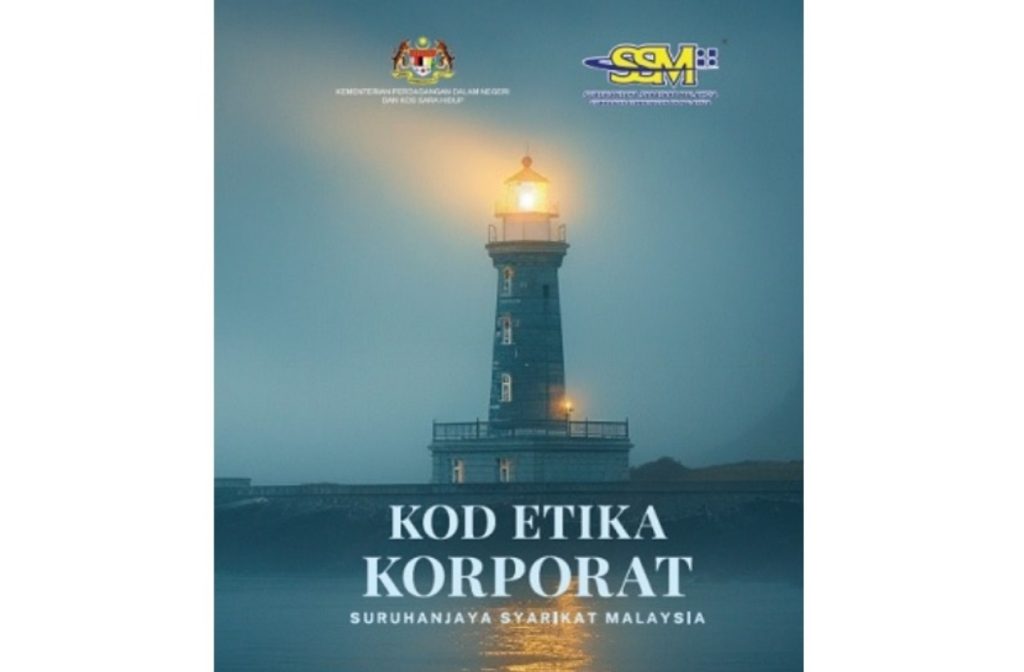
KUALA LUMPUR: The Companies Commission of Malaysia (SSM) has launched the ‘SSM Corporate Code of Ethics’ book to emphasise its steadfast commitment to integrity, ethics and anti-corruption practices. According to SSM, the book aims to support the application of best corporate governance practices among the commission members, its management, employees, sports and welfare club officers, cooperative board members, suppliers and stakeholders. Its Chief Executive Officer Datuk Nor Azimah Abdul Aziz said all SSM employees are committed to ensuring compliance with the laws governing business entities in Malaysia and corporate laws, as well as fostering positive developments in the corporate and business sectors. “This publication reinforces our pledge to maintain those values through responsible, transparent and ethical behaviour,” Nor Azimah said during the book launch. The book, which is in line with the National Anti-Corruption Strategy (NACS) 2024-2028, provides guidance on responsibilities and principles to enhance integrity and accountability in SSM. — BERNAMA

Energy & Technology, News

Proton Officially Announces Its First Malaysian EV Model, the e.MAS 7

KUALA LUMPUR: Proton Holdings Bhd announced its first-ever Malaysian electric vehicle (EV), Proton e.MAS 7, which marks the beginning of a new chapter in the country’s automotive history. The national automotive company said the e.MAS 7 underscores Proton’s commitment to the Malaysian government’s EV agenda which calls for national carmakers to introduce electric vehicles by 2025. “While the full launch will occur later in the year, the confirmation of the name and preview of this exciting new model highlights Proton’s proactive approach to leading the country’s automotive industry towards a more sustainable future,” Proton said. Since the announcement of the e.MAS brand name and the subsequent introduction of 18 Proton e.MAS outlets in June, the company said that Proton New Energy Technology Sdn Bhd (Pro-Net) has now expanded its reach to a total of 29 outlets. Pro-Net, a subsidiary of Proton, aims to have 25 Proton e.MAS showrooms operational before the public launch of the e.MAS 7. “Co-developed with Geely, the Proton e.MAS 7 is a C-segment sports utility vehicle (SUV) designed to cater to the needs of modern lifestyles offering ample space and utility,” it said. According to Proton, the e.MAS 7 has undergone rigorous testing with 700,000 manhours and 10 million kilometres of testing performed to verify its durability and reliability in ensuring that the vehicle is road-ready and safe.

Investment & Market Trends, News

Government Strives to Ease Cost of Living Amidst Economic Growth

KUALA LUMPUR: Despite the ringgit’s recent strengthening and a 5.8% economic growth in the second quarter, the government is still working to ease the cost of living burden, Prime Minister Datuk Seri Anwar Ibrahim said. He said with various measures taken, the inflation rate has been successfully controlled at 2%, and the national unemployment rate at 3.3%. “But am l satisfied? No, because we are still facing cost-of-living issues in some areas, which put pressure on everyday life,” he said at the National Cooperative Congress 2024 closing ceremony, which was attended by Entrepreneur Development and Cooperatives Minister Datuk Ewon Benedick, his deputy Datuk R Ramanan, Chief Secretary to the Government Tan Sri Mohd Zuki Ali and Angkasa president Datuk Seri Dr Abdul Fattah Abdullah. Anwar emphasised that the government is continually seeking solutions to the cost-of-living issue, including the Sumbangan Tunai Rahmah (STR) totalling RM10 billion to 9 million people. He also highlighted the government’s move to review the Public Service Remuneration System (SSPA) to raise civil servants’ salaries as an effort to alleviate living costs. “Next October, we will finalise the new remuneration system with significant salary increases for civil servants. We hope this will lead to more efficient work. Control and supervision will also be tougher, as the increase is not small. It is the highest in history, exceeding 15% he said. Anwar also called for national unity to elevate the country’s dignity and expressed his desire for the cooperative movement to become a pillar of economic growth. — BERNAMA

Investment & Market Trends, News

Selangor to Focus on Developing Service Sector in 5 Years

KUALA LUMPUR: The Selangor government will focus on the development of the service sector for this 5-year period, said Selangor Menteri Besar Datuk Seri Amirudin Shari. He said the development of a third port on Carey Island, Kuala Langat which is included in the plan is expected to drive higher economic growth in the state. “The transition to services based on online or digitalised service sector is one of the key strategies forward to drive the economy in Selangor and Malaysia in general,” he added. Amirudin also outlined some of Selangor’s unique features that are able to attract investors to the state and that Selangor’s position in the middle of Peninsular Malaysia, mega infrastructure such as the airport, seaport and highway network also developed more industrial areas that contributed to the economic growth of the state. “Selangor also produces more than 40,000 graduates from 150 higher education institutions every year who can meet the needs of the industry. “The Selangor government’s durable and agile policies and administration is also one of the unique features of this state,” he said at the Selangor ASEAN Business Conference (SABC). Amirudin said the First Selangor Plan (RS-1) which is the state’s development framework is expected to increase the rate of contribution to the state’s gross domestic product (GDP) up to 0.5% in the future. He said the matter was proven when Selangor managed to contribute 25.9% to Malaysia’s GDP with an increase of 0.4% in 2023, compared to the previous year. “Before RS-1 was presented, the contribution to GDP increase was only between 0.2% and 0.3%, but when it was launched, the contribution percentage (to GDP) increased to almost 0.5%. “This is because RS-1 is more in-depth in its planning, supported by manpower and infrastructure, so we are confident of being able to contribute RM500 billion within these few years,” he said. The dialogue session which was also attended by Penang Chief Minister Chow Kon Yeow discussed the strength of the two states to attract investment into the country. Meanwhile, Selangor State Investment, Trade and Mobility Committee chairman Ng Sze Han said SABC has served as a vital platform for ASEAN and global leaders to discuss important economic issues, explore trade opportunities, and form strategic partnerships. In his opening speech, he said SABC 2024 aimed to build on its past successes, where it attracted over 2,400 participants from all 10 ASEAN countries and beyond. — BERNAMA

Investment & Market Trends, News

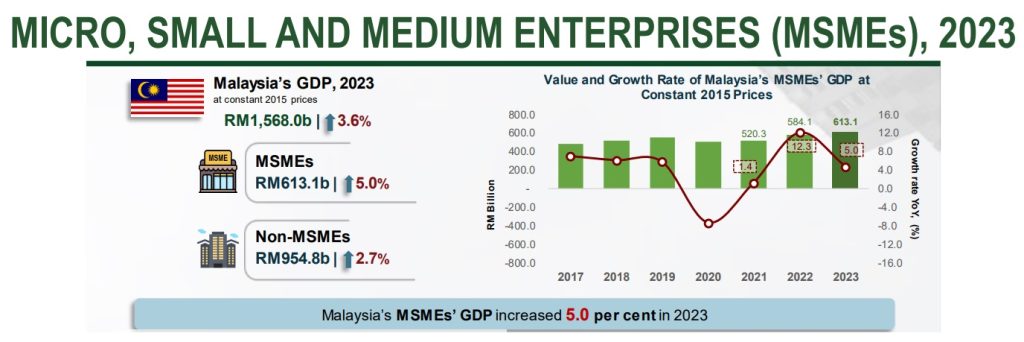
MSMEs Contribution to GDP Grew 5% in 2023, Added Value of RM613.1 Bil

The contribution to the gross domestic product (GDP) by micro, small and medium enterprises (MSMEs) grew by 5% in 2023, with a value-added of RM613.1 billion and contributing 39.1% to Malaysia’s economy, according to the Department of Statistics Malaysia (DOSM). MSMEs’ growth has surpassed Malaysia’s GDP growth of 3.6% in 2023. Chief Statistician Datuk Seri Dr Mohd Uzir Mahidin said that the services and manufacturing sectors are the main contributors, which comprises 84.8% of the MSMEs’ GDP. “The agriculture sector contributed 9.1% to MSMEs’ GDP, followed by the construction (4.5%) and mining and quarrying (0.5%) sectors,” he said in a statement. Mohd Uzir said the services sector increased 6.5% in 2023 from 17.2% in the preceding year. “The performance was supported by steady growth in the main sub-sectors, namely wholesale and retail trade, food and beverages and accommodation (5.7%), finance, insurance, real estate and business services (6.3%) and transportation and storage and information and communication (10.6%). The manufacturing sector recorded a growth of 1.5% (2022: 6%) and was influenced by positive growth in food, beverages and tobacco (5%) and non-metallic mineral products, basic metal and fabricated metal products (5.3) sub-sectors. The value added of MSMES in the agriculture sector increased 1.3% in 2023, higher than the 0.9% growth in the preceding year. The performance was supported by the rubber, oil palm, livestock & other agriculture (1.8%) and fishing (0.5%) sub-sectors. Meanwhile, MSMEs’ value added of construction, mining and quarrying sectors also expanded by 5.8% (2022: 5%) and 4.9% (2022: 10.7%), respectively. On another note, Mohd Uzir said exports of MSMEs stood at RM152.2 billion with a growth of 4.5% in 2023, slower than the 17.2% recorded in the preceding year. He said MSMEs’ employment continued to register an increase, albeit at a slower annual growth of 3.5% compared to 3.8% in 2022, to record a total of 7.86 million persons from 7.59 million persons in 2022. “Accordingly, the contribution of MSMEs employment to Malaysia’s employment in 2023 was 48.5%, which grew 0.3 percentage points from 48.2% in 2022,” he said. — BERNAMA

Scroll to Top

Subscribe
FREE Newsletter