News

News

APAC Leaders Focus on Digital Agility and Talent Amid Challenges

SINGAPORE: Amid rising economic uncertainty and intensifying global competition, senior executives across Asia Pacific (APAC) are sharpening their focus on digital transformation, resilient supply chains, and talent strategies to maintain competitiveness and drive sustainable growth, according to Forvis Mazars’ 2025 C-suite Barometer: Outlook 2025 – Cutting through competition. Based on insights from 1,706 global business leaders—including 171 from APAC across 15 industries—the report highlights how digital transformation continues to dominate boardroom priorities. More than one-third (35%) of APAC leaders identified technology transformation as their top strategic initiative, up one percentage point from last year. This comes as companies grapple with increasingly complex operating environments shaped by inflationary pressures, geopolitical shifts, and supply chain disruptions. Digital Agility and AI Adoption in Focus While digital transformation takes precedence, there is a growing emphasis on the transformative potential of artificial intelligence (AI). The report shows 44% of APAC executives expect generative AI to significantly impact their operations—closely mirroring global expectations. However, the region lags behind in readiness, with only 66% of APAC businesses reporting a defined technology strategy, compared to 76% globally. Kee Yin Lai, Partner, Technology, Digital & Sustainability Consulting at Forvis Mazars Singapore, said the push for digital solutions is fundamentally reshaping how APAC businesses operate. “Strategically leveraging structured data enables businesses to improve visibility, enhance decision-making, and build operational resilience. As AI matures, early adoption will be key to securing a competitive edge.” Securing Supply Chains as Expansion Plans Grow Supply chain optimisation is emerging as a business-critical priority. 36% of APAC executives cited supply chain instability as a top growth barrier—ten points above the global average. A further 28% are actively prioritising procurement and supply chain enhancement in their strategic plans, reflecting the region’s complex logistics landscape. As APAC companies accelerate international expansion—74% plan to scale operations globally within the next five years—supply chain setup remains a top operational hurdle. Establishing secure, localised networks is critical, particularly for firms entering new markets. In parallel, ESG reporting pressures have driven 44% of regional businesses to invest in responsible supply chain specialists, further underlining the long-term strategic value of robust procurement frameworks. Talent and Leadership Development Key to Long-Term Growth The report also highlights a widening talent gap, with 50% of APAC executives struggling to attract and retain skilled talent, especially in mid-level and managerial roles. This surpasses the global average of 43%, revealing a more acute talent crunch in the region. To address this, APAC businesses are investing in leadership development and flexible working models. Among those already offering hybrid work, 60% plan to adopt fully flexible arrangements, while 55% aim to reduce mandatory in-office days. Rick Chan, Managing Partner at Forvis Mazars Singapore, said, “Companies that embed flexibility and continuous learning into their culture will be better positioned to retain top talent and weather long-term challenges.” Shifting Attitudes on ESG Reporting Sustainability remains a strategic consideration, though the region has seen a notable decline in public ESG disclosures. Only 44% of companies in APAC published sustainability reports in 2025, down from 73% in 2024. However, integrated sustainability-financial reporting is on the rise, now adopted by 54% of APAC firms—a 14-point year-on-year increase. Chester Liew, Partner, Head of Risk Consulting & Sustainability, noted that while public-facing ESG reporting may be tapering, companies are embedding sustainability more deeply into financial planning. “This shift signals that businesses are moving from compliance-driven reporting to strategic ESG integration that supports long-term value creation.” Investment Outlook Reflects Caution, Not Retreat Investment sentiment has cooled slightly across the region, with only 55% of executives planning increased investments—down from 64% in 2024. Organic growth remains the most favoured growth strategy, followed by partnerships (35%) and alternative funding (20%). Despite the cautious investment outlook, APAC companies are optimistic about international growth. However, key barriers remain, including regulatory complexity, product-market fit, and localisation of supply chains. Resilience with a Cautious Optimism Looking ahead, 84% of APAC executives anticipate business growth in the next 12 months, though optimism has declined by seven points from the previous year and lags behind the global sentiment of 93%. The outlook reflects an increasingly pragmatic approach, as leaders double down on fundamentals—technology, talent, and operational agility—to navigate volatility and pursue long-term success.

News

Arup Appoints New Southeast Asia Head, Opens Office in Johor

Arup, a global sustainable development consultancy renowned for shaping some of Malaysia’s early landmarks, has appointed Lau Ching Luan as Southeast Asia Leader in a newly created Asia Pacific (APAC) region. Lau previously led Arup’s operations in Malaysia. At the same time, the firm announced its expansion into Johor, the southern state of Peninsular Malaysia, positioning itself to support the region’s growing role as a key economic corridor due to its proximity to Singapore. These developments form part of Arup’s broader expansion strategy in the APAC region, which accounts for 39% of global GDP and is projected to experience sustained growth over the next two decades. Lau’s new role supports a refreshed leadership structure aimed at enhancing the firm’s ability to contribute to sustainable development across the region. “I’m eager to continue the work of diversifying Arup’s business offering, leveraging the exciting opportunities emerging across Southeast Asia,” Lau said. “The rapid acceleration of urbanisation across Southeast Asian developing countries, coupled with increasing interest in sustainability services and decarbonisation, makes us perfectly placed to partner with clients and industry. Having developed innovative sustainable solutions in the Asia Pacific for more than six decades, our renewed focus in Southeast Asia will allow us to more seamlessly access the skills and expertise of our members, leading to better outcomes for our clients.” He added that the new Johor office signals the firm’s commitment to long-term growth in the region. “Recognised for development potential, the Johor-Singapore Special Economic Zone and Forest City Special Financial Zone offer significant opportunities in infrastructure, data centres, industrial parks and real estate. Having our people on the ground in Johor enables us to gain a deeper understanding of local market dynamics and deliver tailored solutions for our clients,” Lau said. Arup, which recently marked its 60th year in Malaysia, remains committed to creating a resilient and sustainable future through its multidisciplinary expertise. Recent projects in Johor include the Smart City Masterplan for Ibrahim Technopolis (IBTEC), the Public Transport Action Plan for Majlis Bandaraya Iskandar Puteri (MBIP), and acting as owner’s engineer for a 500MWac solar PV power plant.

News

BHPetrol to Build 30 New Rural Stations Nationwide

JOHOR BAHRU: Boustead Petroleum Marketing Sdn Bhd (BHPetrol), a subsidiary of Boustead Holdings Bhd and the Armed Forces Fund Board (LTAT), is set to build 30 new petrol stations in rural areas across Malaysia as part of a nationwide expansion strategy. According to BHPetrol CEO Azizul Azily Ahmad, each station is expected to cost approximately RM3 million, with the rollout scheduled over the next five years. The initiative is aimed at enhancing fuel accessibility and ensuring that subsidised fuel reaches eligible groups, especially defence personnel stationed in remote areas. “As a subsidiary of LTAT, BHPetrol continues to move forward proactively, in line with the government’s commitment to equitable access to subsidised fuel,” Azizul said during the launch of the new BHPetrol Bandar Seri Alam station in Johor Bahru on Sunday. The new station was officiated by Defence Minister Datuk Seri Mohamed Khaled Nordin. Expansion Objectives: Widen rural coverage for subsidised fuel access. Support national defence personnel operating in hard-to-reach locations. Reduce reliance on bottled fuel in rural communities. Ensure legal and safe fuel distribution across underserved areas. With the addition of the Bandar Seri Alam station, BHPetrol now operates 82 stations in Johor, strengthening its network in one of the key southern states. “The opening of this latest station is a proud milestone that further strengthens our support network for delivering subsidised fuel to the people,” Azizul added. The expansion reflects BHPetrol’s continued alignment with government policies focused on fuel equity and infrastructure development in strategic areas.

News

Jentayu Secures 40-Year PPA for RM2.8b Sabah Hydropower Project

KUALA LUMPUR: has inked a landmark 40-year power purchase agreement (PPA) through its 70%-owned unit Oriole Hydro Padas Sdn Bhd (OHP) with Sabah Electricity Sdn Bhd (SESB) for a 162MW run-of-river hydroelectric project at Hulu Sungai Padas in Sipitang, Sabah. The RM2.8 billion initiative is one of Sabah’s largest renewable energy investments and has secured all required land and resource approvals from the state government. The project operates under a build-own-operate-transfer (BOOT) structure, with commercial operations slated for June 1, 2029 — slightly later than the originally projected December 31, 2028. Once operational, the project is expected to contribute approximately RM300 million in annual recurring revenue to the group. Key PPA Terms: Annual Firm Energy Quantity (AFEQ): SESB will purchase up to 868,894MWh/year at 31.5 sen/kWh. Maximum Annual Allowable Quantity (MAAQ): Up to 950,222MWh, sold at the same rate on a willing-buyer, willing-seller basis. Excess output: Any generation above the MAAQ can be sold at eight sen/kWh, also based on mutual agreement. Renewable Energy Certificates (RECs): Valued up to RM10.1 million, with surplus value shared equally with SESB. The hydropower project employs a run-of-river cascading system, ensuring minimal environmental disruption while preserving natural river flow and surrounding ecosystems. Socio-Economic and Industrial Upside: Jobs: ~2,000 construction jobs and 150 high-skilled roles during operations. Talent pipeline: Jentayu is collaborating with local universities to develop skilled talent in clean energy. Local manufacturing: The group is exploring a JV with a global turbine manufacturer to set up a facility in Sabah, boosting the state’s role in the regional energy value chain. Executive Chairman Datuk Beroz Nikmal Mirdin emphasised the company’s commitment to “localising production and elevating Sabah’s status in the energy sector,” aligning with ambitions for a high-income, innovation-driven economy. EPC Contract Awarded The engineering, procurement, construction, and commissioning (EPCC) contract has been awarded to a consortium led by XD Power Transmission Sdn Bhd (a unit of China’s Xi’an Electric Engineering Co Ltd), PT Anhe Konstruksi Indonesia, and Jawat Johan Sdn Bhd. The award follows a transparent international tender launched in May 2023, which saw eight firms purchase tender documents and four final submissions. The special purpose vehicle, OHP, is owned 70% by Jentayu’s subsidiary, 20% by SESB subsidiaries, and 10% by Yayasan Sabah. Trading in Jentayu shares was temporarily halted on Monday for the announcement. As of 10:33 a.m., the stock was up 2% to 51 sen, bringing its market capitalisation to RM226.9 million. The counter has gained 18.6% year-to-date.

News

Japanese Rubber Futures Climb on Thai Supply Woes, US Tariff Exemptions

SINGAPORE: Japanese rubber futures rose sharply on Monday, buoyed by growing supply concerns from Thailand and a global sigh of relief following the US government’s decision to exempt key electronics from fresh tariffs. The Osaka Exchange (OSE) rubber contract for September delivery jumped 5.9 yen, or 1.98%, to 303.5 yen (US$2.13) per kg by 2:22 a.m. GMT. Similarly, gains were seen in China’s futures markets: The Shanghai Futures Exchange (SHFE) rubber contract for May delivery rose 310 yuan, or 2.09%, to 15,135 yuan (US$2,072.35) per metric ton. The most active butadiene rubber contract for May delivery increased 130 yuan, or 1.12%, to 11,765 yuan (US$1,610.92) per ton. The upward pressure follows weather warnings from Thailand’s Meteorological Department, which forecast thunderstorms and heavy rain in the south from April 14 to 19. The adverse weather is expected to impact rubber output, tightening supply from the world’s largest producer. Boosting global sentiment, US President Donald Trump’s administration announced tariff exemptions on smartphones, computers, and other electronics—key products in global trade. This move helped Japan’s Nikkei Index climb 2% and supported broader optimism in Asian markets. The Japanese yen weakened 0.2% to 143.79 per US dollar, improving the attractiveness of yen-denominated commodities for foreign investors. Despite the temporary reprieve in tariffs, analysts remain cautious. China’s economy appears to be slowing, with growth projections for 2025 expected to fall below last year’s pace, according to a Reuters poll. Uncertainty over long-term US-China trade relations continues to weigh on market sentiment. On the Singapore Exchange (SICOM), the May rubber contract last traded at 171 US cents per kg, up 0.9%.

News

Singapore Eases Monetary Policy Again as Growth Outlook Weakens

Singapore’s central bank has eased monetary policy for the second consecutive time, citing growing risks to the global economy and a weaker outlook for domestic growth in 2025. The Monetary Authority of Singapore (MAS) announced on Monday that it would reduce the slope of its exchange rate policy band — its primary tool for managing monetary conditions — while keeping the band’s width and centre unchanged. The move was widely anticipated by economists and follows a similar policy adjustment in January, ending a long pause that began in 2023. In its statement, MAS warned of “significant ramifications” for Singapore’s economy if global trade continues to deteriorate. “There are downside risks to Singapore’s economic outlook stemming from episodes of financial market volatility and a sharper-than-expected fall in final demand abroad,” it said. The warning comes as global uncertainty mounts, particularly in response to US President Donald Trump’s planned wave of tariffs. Trump reaffirmed over the weekend that levies on electronics would go ahead, despite a short-term exemption, fuelling volatility in financial markets and concern among trade-dependent nations like Singapore. Reflecting these concerns, Singapore’s Ministry of Trade and Industry has downgraded its 2025 growth forecast to a range of 0% to 2%, down from 1% to 3%. The economy expanded 3.8% year-on-year in the first quarter, falling short of expectations for a 4.5% increase. The MAS highlighted Singapore’s vulnerability due to its high dependence on global trade and integration with global supply chains. “Slowing global and regional trade as well as heightened policy uncertainty will weigh on the external-facing sectors, which could spill over into the domestic-oriented sectors,” the central bank stated. While Singapore was hit with a 10% US tariff — less severe than China’s 125% — the impact remains significant for its export-driven economy. Prime Minister Lawrence Wong has cautioned that growth may be “significantly impacted” and the risk of recession cannot be ruled out. Following the MAS decision, the Singapore dollar edged slightly higher. It has risen about 3.7% against the US dollar so far this year, second only to the Japanese yen among Asian currencies, as investors respond to tariff uncertainties. Selena Ling, Head of Research and Strategy at Oversea-Chinese Banking Corp, noted that further policy easing could be on the horizon. “Reciprocal tariffs are currently still in play, with sectoral tariffs possibly to come. So a further downshift in growth and inflation could prompt further monetary policy easing, but fiscal policy will also come into play,” she said. “A technical recession is possible.” Singapore manages monetary policy through its currency, allowing the Singapore dollar to move within an undisclosed trading band. The MAS can adjust the slope, centre, or width of the band to influence the pace of the currency’s appreciation or depreciation. Inflation pressures have cooled markedly in recent months. Core inflation — which excludes accommodation and private road transport costs — slowed to 0.6% in February, the lowest since June 2021. It marked the fifth consecutive month of easing. Looking ahead, MAS expects core inflation to average between 0.5% and 1.5% in 2025, down from its earlier forecast of 1% to 2%. The next core inflation data is scheduled for release on April 23.

News

Xi Jinping Pledges to Strengthen Strategic Partnership with Indonesia in Call with Prabowo

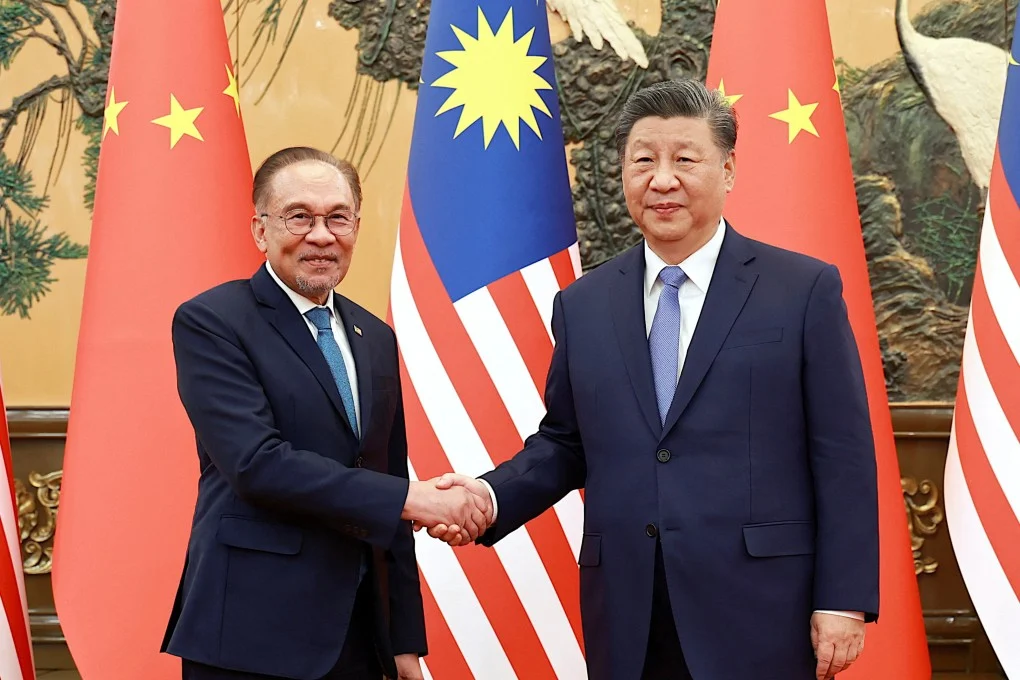
SHANGHAI: Chinese President Xi Jinping has pledged to further strengthen China’s strategic partnership with Indonesia in a phone conversation with Indonesian President Prabowo Subianto on Sunday, as reported by China’s state-run Xinhua News Agency. During the call, Xi highlighted the global significance and strategic importance of the bilateral partnership. The two leaders also exchanged congratulations on the 75th anniversary of diplomatic relations between their countries. Xi’s remarks come as Beijing seeks to rally other nations against the US’s import tariffs, which were recently announced by former President Donald Trump. As part of a broader diplomatic push, Xi is scheduled to visit several Southeast Asian nations, including Vietnam, Malaysia, and Cambodia, starting Monday, April 14. His visit aims to solidify ties with key neighbours as trade tensions between China and the US continue to rise.–REUTERS

Energy & Technology, News

Fahmi Gives Telcos 5pm Deadline to Resolve Internet Issues or Face Penalties

TAPAH: Communications Minister Fahmi Fadzil has given all telecommunication companies until 5pm today (Sunday) to submit concrete solutions to ongoing nationwide internet access issues or face firm enforcement action. Speaking during a visit to the National Information Dissemination Centre (Nadi) in Air Kuning, Perak, Fahmi said he had instructed Malaysian Communications and Multimedia Commission (MCMC) executive chairman Tan Sri Mohamad Salim Fateh Din to ensure telcos respond promptly to complaints of poor connectivity. “Telcos are quick to act when it comes to collecting outstanding bills, but when it comes to addressing service complaints, it can take months. I’ve had enough,” said Fahmi. “If no comprehensive and immediate solutions are submitted by 5pm today, MCMC will begin taking enforcement measures starting tomorrow.” Also present were Perak Communications, Multimedia and NGO Committee chairman Mohd Azlan Helmi and Barisan Nasional candidate for the Ayer Kuning state by-election, Dr Mohamad Yusri Bakir. Fahmi cited a drive test conducted by MCMC on 5 March, which revealed that many areas still fail to meet the Mandatory Standards on Quality of Service (MSQoS). The current minimum requirement of 7.5 Mbps will be increased to 10 Mbps in 2026. He noted that the internet access problem is widespread and not limited to Air Kuning, listing other affected areas including Belaga and Ulu Rajang in Sarawak, the new township of Serenia, outskirts of Tambun, Pangkor Island, and several Orang Asli settlements. Should telcos fail to resolve these issues, stricter enforcement – including heavier fines – will be imposed. Following amendments to the Communications and Multimedia Act effective 11 February, penalties have significantly increased, with fines potentially reaching millions of ringgit. Separately, Fahmi advised social media users to remain cautious when posting or campaigning online during the Ayer Kuning by-election period, particularly on sensitive 3R topics (race, religion, royalty). “Individuals found guilty of posting extreme or 3R-related content may face fines up to RM500,000, compounds of up to RM250,000, or imprisonment. I urge all parties to campaign responsibly,” he said, adding that no complaints had been received so far. When asked about Perikatan Nasional (PN) supporters sharing caricatures mocking Prime Minister Datuk Seri Anwar Ibrahim and DAP secretary-general Anthony Loke Siew Fook, Fahmi responded: “If that’s their style of campaigning, so be it. We prefer to campaign based on facts, ideas, and tangible offerings – not insults and mockery.”–BERNAMA

News

The impact of US tariffs on the cocoa market

SINGAPORE: As of April, Hedgepoint Global Markets will be monitoring and developing regular market analyses on the global cocoa market, expanding its portfolio of sectoral analyses focused on risks, trends and economic impacts on the commodity chain.   This move comes at a time of high volatility in the sector. Last week, US President Donald Trump’s announcement of new trade tariffs provoked immediate reactions on global markets.  After recording a four-week high, the cocoa market began to feel the effects of the recent trade measures announced by the United States. Global cocoa prices began to retreat amid increased volatility, contributing to a scenario of uncertainty that had already been developing in recent months.  Last Tuesday, cocoa futures contracts maturing in May 2025 fell by 3.8% in London and 3.7% in New York, signaling a correction in the market after the significant rise. If the tariffs are maintained, changes in trade flows and processing routes are expected, with North American buyers looking for cheaper alternatives.  As a result, the market is already projecting a possible reduction in cocoa grinding in the United States, which could put pressure on the commodity’s domestic prices in the coming months. The movement also reinforces fears of a global recession, as the effects of trade barriers spread through various production chains.    If the announced tariffs are maintained, it is likely that there will be adjustments to the flow of trade and cocoa processing routes in the coming months, as US buyers look for more economical alternatives for their operations.   Among the possibilities evaluated by the market are redirecting beans to countries close to the United States that have lower tariffs and installed grinding capacity – such as Canada, Mexico, Brazil and Ghana. In this way, it would be possible to meet US demand for cocoa beans, butter, liquor and powder from processing in other origins.          Given this scenario, a reduction in cocoa grinding in the United States is expected and, consequently, a possible rise in domestic prices in the coming months – not only for cocoa, but also for other products in the confectionery chain. This intensifies fears of a recession in the US economy and reinforces the prospect of a drop in demand for the commodity, a topic that has been discussed since the beginning of 2024, when prices for the bean reached historically high levels.  The so-called “Liberation Day” adds another element of pressure on a market that has already been operating under strong volatility in recent years. The recent drop in prices came just after the market recorded its highest rise in four weeks, supported by the forecast reduction in the Ivory Coast’s intermediate crop (April to September 2025) and the negative revision of the expected production for the 2024/25 crop in Ghana – the two main global producers.   Even so, this information was already priced in, and the market continues to point to a downward trend in the medium term, driven by expectations of a slowdown in demand, normalization of cocoa arrivals at ports and improved weather conditions in West Africa, with an increase in rainfall in recent weeks. 

News

US Tariff Suspension Could Lift Malaysia’s GDP

KUALA LUMPUR: The temporary suspension of tariffs by the Trump administration may provide a modest but meaningful boost to Malaysia’s gross domestic product (GDP), potentially lifting growth by between 0.2 and 0.8 percentage point (pp), according to CIMB Securities. The economic impact will depend on the duration of the pause and the outcome of the upcoming US-Malaysia trade talks scheduled for late April. Under a base case scenario where the United States maintains a reduced 10 per cent tariff for a 90-day period—from April 9 to July 8—before reinstating the original 24 per cent rate, Malaysia’s GDP could see an uplift of around 0.2 pp. “If the 10 per cent tariff is extended through the end of 2025, the upside could increase to 0.6 pp. In the most optimistic scenario—where tariffs are fully removed after July—the GDP growth boost could reach 0.8 pp, potentially lifting full-year growth to 4.8 per cent,” the firm noted. However, CIMB Securities added that this still falls short of its earlier forecast of 5.0 per cent for 2025, citing persistent trade uncertainties amid renewed global tensions. The bilateral US-Malaysia negotiations later this month are expected to play a critical role in shaping the economic outlook. The talks may address ongoing disputes regarding Malaysia’s existing tariffs on selected US imports, including agricultural products, alcohol, and motor vehicles. Broader issues such as Malaysia’s approved permit system, halal import regulations, and foreign ownership restrictions may also be discussed. In turn, Malaysia may consider increasing imports of US goods—particularly defence systems, aircraft, and capital equipment—as part of a broader effort to narrow the trade imbalance. CIMB Securities stated that if the talks yield positive outcomes, they could enhance strategic bilateral ties and support trade growth in the second half of the year. “Despite the potential upside, we are maintaining our 2025 GDP forecast at 4.0 per cent for now, given the unpredictable nature of the Trump administration’s trade policies and uncertainties surrounding the negotiations. A breakdown in talks could reignite trade tensions, dampen investor sentiment, and curb global trade flows,” the firm warned.–BUSINESS TIMES

Scroll to Top

Subscribe
FREE Newsletter