News

Investment & Market Trends, News

Xi Jinping’s Visit to Strengthen Trade and Regional Ties, Says Fahmi

KUALA LUMPUR: Communications Minister Fahmi Fadzil has expressed confidence that the upcoming visit by Chinese President Xi Jinping will significantly bolster Malaysia-China relations, particularly in trade and regional cooperation. Speaking ahead of Xi’s official visit from April 15 to 17, Fahmi said Malaysia views the engagement as a milestone moment, underpinned by strong economic ties and a shared vision for closer people-to-people and diplomatic relations. “China has long been Malaysia’s largest trading partner, and as Asean chair this year, we have a great deal to discuss,” said Fahmi, at the Asean-China Media and Think Tank Forum. “Not only will trade relations be strengthened, but we also expect to deepen cultural and community-level exchanges.” Fahmi noted that Malaysia hopes to use Xi’s visit to send a clear and consistent message of cooperation, especially in the face of rising geopolitical uncertainty. “Globalisation is under scrutiny and re-evaluation, particularly after recent announcements from the White House,” he said. “Malaysia believes that longstanding trade ties and multilateral collaboration are the way forward.” Prime Minister Anwar Ibrahim had also cautioned yesterday that the US’ increasingly adversarial stance toward China could have far-reaching implications for Malaysia’s economy and its role within Asean. Amidst growing economic tensions between the world’s two largest economies, the Biden administration has paused tariffs for 90 days but raised duties on Chinese imports to 125%, up from 104%, in response to China’s 84% retaliatory tariffs on US goods. China has been Malaysia’s top trading partner for 15 consecutive years, with bilateral trade reaching US$190.24 billion (RM856.08 billion). Key Malaysian exports include integrated circuits, palm oil, computers, and plastic products. “This visit comes at a critical time, and we hope to build on past achievements to unlock new opportunities for both nations,” Fahmi said.–FMT

News

Why Trump’s Made-in-America iPhone Dream Faces Impossible Odds

WASHINGTON: US President Donald Trump’s ambition to see iPhones manufactured on American soil is clashing with the stark realities of global supply chains and decades of industrial evolution. Although Apple Inc. has pledged to invest US$500 billion in the US over the next four years and the Trump administration plans to impose tariffs of up to 145% on Chinese imports, experts say the idea of domestically produced iPhones remains unrealistic in the foreseeable future. The US lacks the complex ecosystem that supports iPhone production—one that includes a vast network of specialised suppliers, engineering talent, and logistical infrastructure found in Asia, particularly China. “Boston is over 500,000 people. The whole city would need to stop everything and start assembling iPhones,” said Matthew Moore, a former Apple manufacturing engineer. “Millions of people are employed by the Apple supply chain in China.” The Scale Problem Apple’s Chinese manufacturing facilities are enormous. The Zhengzhou complex, dubbed “iPhone City,” employs hundreds of thousands and operates like a self-contained town—with dormitories, schools, gyms, and hospitals. Replicating such a setup in the US would be unprecedented. Meanwhile, Apple’s partners are building the world’s second-largest iPhone facility in India. The country is rapidly becoming a key production hub, now producing an estimated 35 million iPhones a year, enough to meet a large share of US demand. Skills Gap and Supply Chain Challenges Apple CEO Tim Cook has long argued that China’s advantage lies not in low labour costs, but in its concentration of skilled engineers and tooling experts. As early as 2017, Cook pointed out that the US lacked the number of tooling engineers needed even to fill a room, while China could fill football fields. Moreover, Apple’s complex supply chain relies on thousands of components and partners primarily based in Asia. Even the Mac Pro, assembled in Texas, relies on parts manufactured in China. Automation Isn’t the Answer – Yet While some suggest that Apple could sidestep labour shortages by building a fully automated, robotic plant in the US, industry experts say automation can’t yet match the adaptability or precision of human workers—especially when product designs and materials are constantly evolving. “You design the thing, rebuild the factory, and then you only have six months to sell it,” said a source familiar with Apple’s supply chain. “The pace of change makes it so much harder to automate.” Diversification, Not Repatriation Apple has been steadily reducing its reliance on China, shifting some production to countries like Vietnam, Malaysia, and Thailand—for devices like AirPods, Macs, and iPads. But for the iPhone, which sells over 220 million units annually and comes in multiple configurations, China’s scale remains unmatched. Even in India, Apple’s largest alternative production site, it has taken a decade to reach meaningful output levels. For now, while Indian-made iPhones are increasingly shipped to US shelves to circumvent tariffs, the dream of a fully American-made iPhone remains just that—a dream.–BLOOMBERG

News

Jack Ma: AI Should Empower, Not Replace, Humanity

HANGZHOU: Alibaba co-founder Jack Ma has reaffirmed his long-held view that artificial intelligence (AI) should serve human interests—not replace them. In a rare public appearance at Alibaba Group’s headquarters on Thursday, the Chinese tech mogul urged technologists to ensure AI remains a tool that empowers people rather than a force that threatens livelihoods. “We’re not trying to make machines more like humans,” Ma said. “We’re trying to make them understand humans—to think like us and do things we can’t.” Addressing employees at the company’s Hangzhou campus, Ma emphasised the ethical responsibility of developers to align AI advancements with human values and societal needs. He described AI not as a threat, but as a powerful enabler when used appropriately. “Technology isn’t just about conquering the stars and the oceans,” he said. “It’s about preserving the spark among all of us.” Alibaba, once best known for dominating China’s e-commerce market, has shifted its focus sharply towards AI innovation. Its Qwen AI model series has received industry recognition, positioning the company alongside global leaders such as OpenAI and China’s Deepseek. In February, Alibaba CEO Eddie Wu announced the company’s strategic pivot toward artificial general intelligence (AGI), aiming to develop AI systems with capabilities comparable to human intellect. Ma’s latest remarks come as China repositions its private sector to spur economic recovery. Once at odds with regulators over industry reform, Ma has recently resurfaced in both corporate and national forums. He joined other entrepreneurs in February for a high-profile meeting with Chinese President Xi Jinping to discuss technology and innovation—signalling renewed state support for private enterprise. Though Ma stepped back from public life in recent years, Thursday’s appearance rekindled echoes of his visionary leadership. His message was clear: the future of AI should be grounded in compassion, creativity, and service to humanity.–BLOOMBERG

News

Malaysia Proposes Tech Safeguard Pact to US to Protect Supply Chains

KUALA LUMPUR: Malaysia has proposed a technology safeguard agreement to the United States in an effort to reinforce investor confidence and protect the stability of global supply chains amid increasing trade tensions and tariff uncertainties. Investment, Trade and Industry Minister Tengku Datuk Seri Zafrul Abdul Aziz said the proposal aims to reassure both the US government and American companies operating in Malaysia, particularly those involved in semiconductor and electrical and electronics (E&E) manufacturing. “Many of the companies operating in Malaysia and exporting to the US are American-owned. We are working closely with these stakeholders, especially as semiconductors could potentially be impacted by upcoming tariff policies,” Zafrul said in an interview with CNBC on Friday. Semiconductors currently account for approximately 30% of Malaysia’s exports to the US, with another 30% comprising broader E&E products — sectors that are particularly vulnerable to shifts in global trade policies. Zafrul acknowledged that Malaysia’s open economy could face repercussions from the broader global tariff environment, particularly if the US implements new duties on Chinese imports or if there is further decoupling in critical technology sectors such as artificial intelligence and chip manufacturing. “We are studying the potential impact closely. Any tariff escalation, whether involving the US or China, affects not only direct trade but also multinational firms, including Malaysian companies integrated within global supply chains,” he said. He added that a forced decoupling between the US and China in high-tech industries would likely result in higher operational costs and supply chain disruptions — trends that are already becoming apparent. “With tariffs imposed on China and other parts of the world, we foresee further cost escalation. This, in turn, could dampen demand and impact global supply flows,” he noted. Malaysia’s pitch for a technology safeguard agreement comes at a time when governments and corporations are racing to mitigate geopolitical risks in the technology sector, particularly around semiconductors, which are central to everything from smartphones to advanced defence systems. Zafrul reiterated Malaysia’s commitment to fostering a stable, predictable investment environment and said such agreements could serve as a model for greater US-Malaysia collaboration in high-value industries. The country is also aligning its industrial policies, including the recently launched New Industrial Master Plan 2030, to build long-term resilience and competitiveness in advanced manufacturing and digital technologies.

Investment & Market Trends, News

China’s Chagee Pushes Ahead with US IPO Amid Market Volatility

Chinese bubble tea chain Chagee Holdings Ltd is moving forward with its plans to go public in the United States, aiming to raise up to US$411 million through an initial public offering (IPO), despite turbulent equity markets driven by renewed trade tensions between the US and China. According to a recent filing with the US Securities and Exchange Commission (SEC), the Shanghai-based company is offering 14.68 million American depositary shares (ADS), priced between US$26 and US$28 apiece. At the upper end of the range, Chagee would be valued at approximately US$3.3 billion. Several institutional investors have expressed interest in the IPO. Entities tied to CDH Investment Management Co, RWC Asset Management, Allianz Global Investors Asia Pacific Ltd, and ORIX Asia Asset Management Ltd have indicated potential commitments totalling US$205 million, signalling confidence in the company’s growth story. The IPO marks a bold move as other firms, including StubHub, Klarna, and eToro, have opted to delay listings amid market uncertainty. Airo Group Holdings Inc, an aerospace and defence firm, also launched its IPO on Thursday, targeting US$80 million. Chagee’s decision to proceed comes as the US-China trade dispute intensifies, with tariffs and geopolitical risks featured prominently among the risk disclosures in its SEC filing. The company highlighted that all of its products are manufactured in China and shipped globally, a model vulnerable to future policy escalations. The listing follows the recent successful IPO of domestic peer Mixue Group in Hong Kong, which became the city’s largest flotation of the year, riding on strong demand for bubble tea stocks. According to Chagee’s filing, the company operated 6,440 tea houses as of December 2024, reflecting an 83% year-on-year growth rate. Founded in 2017 by Junjie Zhang, who will retain 89% of the voting power post-offering, Chagee has rapidly scaled its presence and now positions itself as a major player in the global premium tea market. The IPO is being underwritten by Citigroup Inc, Morgan Stanley, Deutsche Bank AG, and China International Capital Corp (CICC). Chagee plans to list on the Nasdaq Global Select Market under the ticker symbol CHA.

News

Sapura Resources Files RM3.2 Million Suit Against Former MD Datuk Shahriman Shamsuddin

KUALA LUMPUR: Sapura Resources Bhd has taken legal action against its former managing director, Datuk Shahriman Shamsuddin, and three other parties, seeking more than RM3.2 million in damages for alleged breaches of fiduciary, statutory, and contractual duties, as well as conspiracy to injure the company and its subsidiaries. The suit follows an internal investigation concluded in March, with findings submitted to both Bursa Malaysia and the Companies Commission of Malaysia (SSM). A formal complaint was also filed with the SSM for potential violations of the Companies Act 2016, and a police report has been lodged as part of regulatory requirements. In a filing with Bursa on Thursday, Sapura Resources said the writ of summons was filed at the High Court of Malaya in Kuala Lumpur, naming Shahriman as the first defendant. The other defendants include former employees Syed Haroon Omar Alshatrie, Syed Muhammad Hasan Alsagoff, and Explorer Group Sdn Bhd. The claims relate to payments made for deposits to Malaysia Airports Holdings Bhd (MAHB), mutual separation schemes, consultancy fees, trip expenses, and legal costs. The company is also seeking general, aggravated, and equitable compensation for alleged losses, including foregone business opportunities such as a potential IPO valued at RM82.1 million. Shahriman was placed on garden leave in September 2024 when the investigation commenced and subsequently resigned from his position in October. He had served on Sapura Resources’ board since 2005, and was appointed managing director in 2007. The legal proceedings come amid a long-standing dispute between Shahriman and his brother, Tan Sri Shahril Shamsuddin, over their family’s investment entity, Sapura Holdings Sdn Bhd, where both hold equal stakes of 40.5%. A petition to wind up Sapura Holdings was filed by Shahriman in September 2024, marking a significant escalation in their ongoing feud. At the centre of the investigation is Shahriman’s alleged interest in Explorer Group, a company said to be in direct competition with Sapura Resources’ aviation units, Sapura Aero Sdn Bhd and DNest Aviation Sdn Bhd. He has served as a director of Explorer Group since 2019. Sapura Resources said further updates will be provided to Bursa Malaysia as material developments arise. The company’s shares remained unchanged at 25 sen on Thursday, giving it a market capitalisation of approximately RM65 million.

Energy & Technology, News

BNM, BOT Ink MoU to Enhance Cyber Resilience in Finance

Bank Negara Malaysia (BNM) and the Bank of Thailand (BOT) have formalised a Memorandum of Understanding (MoU) to deepen bilateral cooperation in cybersecurity and the mitigation of digital fraud threats across their respective financial sectors. The MoU lays the groundwork for enhanced collaboration between the two central banks, with a focus on information sharing, capacity building, and the exchange of best practices. It underscores a shared commitment to fortifying cyber resilience and improving the security infrastructure of both nations’ financial ecosystems. The agreement was signed by BNM Governor Dato’ Seri Abdul Rasheed Ghaffour and BOT Governor Dr. Sethaput Suthiwartnarueput. Dato’ Seri Abdul Rasheed stated that BNM remains steadfast in its efforts to strengthen the resilience of financial institutions and protect consumers from evolving cyber threats. “This partnership with the Bank of Thailand will significantly enhance our collaborative efforts in cybersecurity and digital fraud prevention,” he said. Dr. Sethaput echoed this sentiment, highlighting the growing need for cross-border collaboration in the face of increasingly complex cyber threats. “Through this partnership, we aim to strengthen the integrity and resilience of our financial systems, ultimately benefiting consumers in both countries,” he noted. This strategic alliance comes amid rising concerns over cyber risks in the region’s financial sector, signalling proactive measures by both central banks to address emerging challenges and ensure financial stability.

News

AmBank CFO Shafiq Abdul Jabbar Resigns, Expected to Join Maybank

AMMB Holdings Bhd (AmBank Group) has announced the resignation of its Group Chief Financial Officer (CFO), Shafiq Abdul Jabbar, effective 1 July 2025. According to a recent Bursa Malaysia filing, Shafiq will commence his garden leave starting 10 April. Industry sources indicate that Shafiq is expected to take on the role of Group CFO at Malayan Banking Bhd (Maybank), filling the vacancy left by Khalijah Ismail earlier this year. Khalijah’s departure in February followed an internal inquiry, with Maybank citing non-compliance with internal procedures. While she has disputed the circumstances of her exit, the bank confirmed that no financial losses were incurred. In the interim, Malique Firdaus Ahmad Sidique from Maybank’s Islamic banking division has been serving as acting CFO. Maybank has not issued an official statement regarding Shafiq’s potential appointment. AmBank Group Chief Executive Officer Jamie Ling will assume oversight of the finance division pending the appointment of a new CFO. Ling, who previously served as the Group CFO, is expected to provide continuity during the transition. Shafiq joined AmBank in February 2024 and brings extensive experience in financial leadership, having previously served as CFO at Astro Malaysia Holdings Bhd and CIMB Bank Bhd. The potential move signals a key leadership reshuffle among two of Malaysia’s major banking institutions and may have strategic implications for both financial groups moving forward.

News

Global Stocks Soar, But US-China Tensions Keep Markets on Edge

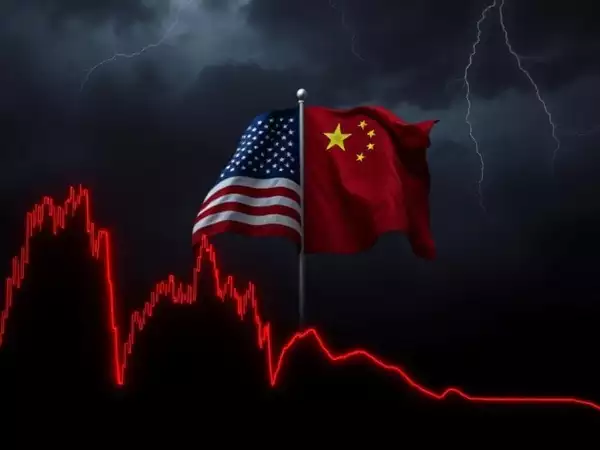
SINGAPORE:  Global stocks staged a strong rebound on Thursday, while bond markets stabilised following US President Donald Trump’s unexpected decision to pause newly imposed tariffs on dozens of countries for 90 days. The move offered markets temporary relief after a turbulent week marked by sharp selloffs and investor anxiety. Trump’s reversal came after a wave of financial market volatility triggered by his tariff announcement, which had wiped trillions off global equities and sparked fears of a global economic slowdown. Although the pause brought some calm, investors remain wary of the broader implications of US trade policy, especially as tensions with China continue to escalate. Market Reaction Mixed Following the announcement, European stock futures surged, with EUROSTOXX 50 and DAX futures gaining nearly 8%, and the FTSE futures up by 5.4%. In Asia, Japan’s Nikkei jumped over 8%, while China’s CSI300 rose 1%, and Hong Kong’s Hang Seng Index advanced 2.4%. However, the momentum faded somewhat in the US, where Wall Street futures pulled back. Nasdaq futures dropped more than 1%, and S&P 500 futures fell 0.8%, after both indexes saw their biggest daily percentage gains in over a decade on Wednesday. “The world, political and financial, is looking on with horror — not bemusement — at an administration that flip-flops on major policies like tariffs,” said Martin Whetton, Head of Financial Markets Strategy at Westpac. He criticised the inconsistency of the administration, noting the contrast between tariff reversals and unrelated executive actions. The US dollar also slipped, falling 0.8% against the yen and 0.6% versus the Swiss franc, both seen as safe haven currencies. Khoon Goh, Head of Asia Research at ANZ, described the rally as a “massive short-covering move” that offered the world some breathing room. “Markets were starting to price in the worst-case scenario. Now that the dust has settled, investors will reassess the direction,” he said. Not a Complete Reversal Despite the pause, Trump maintained a 10% blanket duty on almost all US imports. Additionally, existing duties on autos, steel, and aluminium remain in effect. The White House also confirmed a steep increase in tariffs on Chinese goods — from 104% to 125%. China responded swiftly, raising its own duties on US products to 84% and imposing new restrictions on 18 American companies, mainly in defence-related sectors. China Supply Chains in Focus Despite rising Sino-US tensions, investors are cautiously optimistic that the global trading system will hold — at least for now. “At least the relief is that global trade won’t grind to a complete halt,” said Wong Kok Hoong, Head of Equity Sales Trading at Maybank. He noted that companies still had room to adjust supply chain routes under the current 10% tariff structure. The “China + 1” strategy, where firms diversify production beyond China, remains intact, Wong added. However, the Chinese yuan fell to 7.3518 per US dollar — its lowest since December 2007 — as the People’s Bank of China set the midpoint at its weakest since September 2023. Bond Market Calms After Brutal Selloff The US bond market also showed signs of recovery. The benchmark 10-year Treasury yield eased to 4.29%, down from Wednesday’s high of 4.515%, a spike that had fuelled fears of instability in the world’s largest bond market. “Sticky inflation, a patient Fed, foreign buyer hesitation, and poor market liquidity are all pushing yields higher,” said Lawrence Gillum, Chief Fixed Income Strategist at LPL Financial. Minutes from the Federal Reserve’s mid-March meeting revealed that policymakers are unlikely to cut interest rates soon, citing expectations that tariffs could stoke inflation even as they pose risks to growth. As a result, markets have revised down expectations for rate cuts this year — now pricing in just 80 basis points compared to over 100 earlier in the week. Commodities and Safe Havens React Oil prices dipped as investors continued to digest the implications of worsening US-China trade tensions. Meanwhile, spot gold rose 1.5% to US$3,128.92 per ounce, reflecting the continued demand for safe haven assets.

News

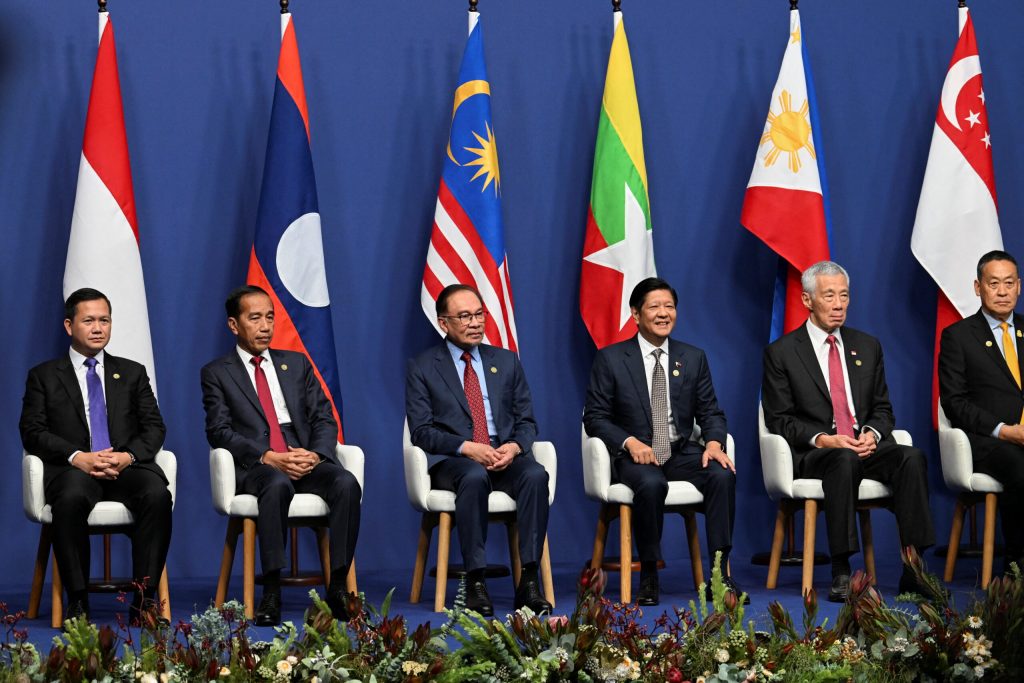
ASEAN Opts for Diplomacy Over Retaliation in Response to US Tariffs

ASEAN has announced it will not respond with retaliatory measures to the recent wave of tariffs imposed by US President Donald Trump, instead calling for open and constructive engagement to resolve trade tensions. In a joint statement issued following a meeting of ASEAN economic ministers in Kuala Lumpur, the 10-nation bloc reaffirmed its commitment to protecting regional economic interests while preserving strong and mutually beneficial relations with the United States. “ASEAN commits to not imposing any retaliatory measures in response to the US tariffs,” the statement read. “Open communication and collaboration will be crucial to ensuring a balanced and sustainable relationship.” The statement comes in the wake of sweeping US tariffs that triggered significant financial market turmoil, erasing trillions from global stock exchanges and raising concerns of a looming recession. Though President Trump has since announced a 90-day delay for many of the tariffs, he has maintained a 10% blanket duty on numerous imports and increased tariffs on Chinese goods to 125%. ASEAN ministers warned that the tariffs threaten to disrupt global trade and investment flows, strain supply chains, and negatively impact businesses and consumers worldwide—including within the US itself. They also cautioned that economic progress in the region could be compromised, especially given that the US was ASEAN’s largest foreign direct investor and second-largest trading partner in 2024. Malaysia’s Minister of Investment, Trade and Industry Tengku Zafrul Aziz echoed this sentiment earlier in the day, stating that while the temporary delay offers some relief, the ongoing unpredictability of US trade policy continues to cast a shadow over regional and global trade dynamics. In their statement, ASEAN leaders expressed their intention to work collaboratively with Washington through the ASEAN-US Trade and Investment Framework Agreement, aiming to find “mutually acceptable solutions” to shared concerns. These include facilitating two-way trade and investment, strengthening strategic economic ties, and enhancing supply chain resilience through digital innovation and technological cooperation. “ASEAN believes that an enhanced, robust, and forward-looking ASEAN-US economic cooperation framework will contribute to the prosperity of our people and the broader global economy,” the ministers said. They added that such a framework would support deeper regional supply chain integration, spur innovation, and reinforce the bloc’s position as a reliable partner in a secure and stable global trade ecosystem.

Scroll to Top

Subscribe
FREE Newsletter