News

News

Grab & MDEC Join Forces to Digitalise MSMEs

Grab Malaysia has signed a Memorandum of Understanding (MoU) with the Malaysia Digital Economy Corporation (MDEC) to drive the digitalisation of micro, small, and medium enterprises (MSMEs) across the country. This collaboration aligns with MDEC’s Business Digitalisation Initiative, which seeks to foster inclusive economic growth through increased technology adoption. As part of its commitment to empowering MSMEs, Grab Malaysia aims to provide businesses with digital tools that enhance their reach and operational efficiency. In 2023 alone, over 500,000 newly registered MSMEs across Southeast Asia gained consumer access through Grab’s platform, demonstrating the potential of digital integration in expanding market opportunities. In Malaysia, Grab’s merchant-partners significantly contributed to the nation’s economy, generating RM4.2 billion in GDP last year, according to a study by EconWorks. The company’s GrabMerchant app offers business owners valuable insights into customer behavior and operational performance, enabling data-driven decision-making and improved customer engagement. Adelene Foo, Managing Director of Grab Malaysia, emphasized the company’s commitment to supporting local businesses: “At Grab, we are dedicated to equipping MSMEs with the right tools, insights, and financial solutions to ensure sustainable growth. Our collaboration with MDEC strengthens these efforts, allowing us to reach and support even more businesses across Malaysia as they transition into the digital economy.” This partnership underscores Grab’s broader mission to foster economic resilience among small businesses. By working closely with MDEC and other strategic partners, Grab Malaysia aims to accelerate digital adoption, ensuring that more MSMEs can leverage technology to scale and thrive in an increasingly digital landscape.

News

MAG Secures 30 Boeing 737s, Eyes Fleet Expansion by 2030

SEPANG: Malaysia Aviation Group (MAG) has placed an order for 30 Boeing 737 aircraft, with deliveries set to be completed by 2030, Prime Minister Anwar Ibrahim announced. The order consists of 18 Boeing 737-8s and 12 Boeing 737-10s, reinforcing MAG’s commitment to modernizing its fleet and expanding its operational capabilities. The company, which operates Malaysia Airlines and Firefly, also holds an option to purchase an additional 30 aircraft from Boeing. Anwar highlighted the significance of this investment, describing it as a strategic move to enhance Malaysia’s global aviation standing and economic resilience. “This milestone is not just about modernising the fleet but also fortifying Malaysia’s position as a key player in global aviation,” he said. “It will improve travel, incorporate modern technology, enhance efficiency, and create jobs, while also driving tourism and strengthening related industries.” MAG’s managing director, Izham Ismail, confirmed that the aircraft will begin arriving as early as 2029, with all 30 planes delivered within two years. The deal also includes a price-lock option for an additional 30 aircraft, ensuring competitive pricing with minimal adjustments. Izham emphasized that the timing of the fleet expansion is crucial for maintaining Malaysia Airlines’ competitive edge. “Aviation market growth in ASEAN is projected at 5.6% over the next five years. Without fleet investments, we risk falling behind,” he said. “However, ordering too soon would be financially unsustainable.” MAG is currently transitioning to a newer fleet, phasing out its ageing Boeing 737-800s. The company has an existing lease order for 25 Boeing 737-8 aircraft, with 11 already delivered and the remaining set to arrive by 2027. This move comes after flight disruptions last year, which were attributed in part to delays in aircraft deliveries. MAG’s strategic fleet expansion aims to prevent similar issues while ensuring operational efficiency and market competitiveness.

News

Thailand Launch Propels SAMA to the Forefront of Asia’s Independent Marketing Network

BANGKOK: SAMA (Strategic Asia Marketing Alliance) has officially launched its Thailand chapter at SCB Next Tech, Siam Paragon, marking a significant milestone in the evolution of APAC’s creative industry. Following successful expansions in Indonesia, Malaysia, and Singapore, the Thailand launch underscores SAMA’s commitment to hyperlocalisation – a strategy brands increasingly rely on to forge authentic connections in one of the world’s most diverse regions. Approximately 50 marketing and branding agencies from across the region came together as part of the alliance. The expansion comes amid a rapidly growing digital advertising landscape, with the APAC digital advertising market expected to reach approximately $392.8 billion by 2030. In 2024, 64% of marketers in Thailand region rely on AI to streamline operations, from creative ideation to data analysis. As businesses strive for competitive differentiation, culturally attuned branding and regionally tailored strategies are becoming essential for success. SAMA brings together top-tier independent agencies with deep local expertise, enabling brands to access a unified approach to marketing, technology, and communications. This extensive network allows businesses to accelerate market entry, execute high-impact regional campaigns, and seamlessly navigate Southeast Asia’s fragmented markets. “Brands today need more than just local know-how, they need scalable, regionally cohesive strategies,” said Chan Leong Teng, Founder and Regional President of SAMA. “SAMA bridges that gap, equipping businesses with the insights, technology, and executional support to adapt campaigns for local audiences while maintaining strategic consistency across multiple countries. ” The launch event featured an expert panel discussion with marketing and business leaders, including Sutirapan Sakkawatra, Chief Customer Officer at SCBX; Pert Pongpiti Phasukyud, Founder and CEO of Ad Addict; and Vanchana Jitkarnngarn, President of SAMA Thailand and Chief Strategy Officer at Chamni’s Eye. The conversation highlighted the evolving challenges and opportunities in Thailand’s marketing landscape and the power of strategic collaboration in driving future growth. SAMA also unveiled its official logo, website, and social media platforms, reinforcing its commitment to fostering industry-wide connections and innovation. “With SAMA, businesses gain more than just marketing support; they tap into a trusted regional network that helps them navigate complex markets, engage local consumers effectively, and achieve sustainable growth across Asia,” said Jitkarnngarn. The event concluded with a networking session, providing industry leaders and businesses an opportunity to explore potential collaborations with SAMA’s leadership and founding members in Thailand. Looking ahead, SAMA plans to expand its footprint across Vietnam, the Philippines, Cambodia, and beyond, solidifying its position as a premier alliance for brands seeking to scale across APAC’s dynamic and diverse markets. SAMA is looking to grow its network of agencies by 50% by end of the year.

News

Cahya Mata’s RM1 Billion Phosphate Gamble Faces Meltdown

Cahya Mata Sarawak Bhd (CMSB) is once again under scrutiny as minority shareholders raise fresh concerns over its long-delayed phosphate venture and unresolved governance issues that continue to cast a shadow over the group’s strategic direction. The group’s phosphate operations, housed under Cahya Mata Phosphates Industries Sdn Bhd (CMPI), have been a consistent drag on CMSB’s financial performance. Despite a 48% increase in group profit before tax to RM190.1 million for the financial year ended Dec 31, 2024 (FY2024), the phosphate division posted a loss before tax (LBT) of RM96.8 million. While this marks an improvement from FY2023’s LBT of RM156.7 million, concerns remain over the division’s long-term viability. Adding to the confusion is CMPI’s Q4 FY2024 financials, which showed an operating profit of RM28.6 million despite the division generating no revenue in that quarter. Minority shareholders are calling for clarity and transparency on how this figure was derived, citing the need for more detailed disclosures. “The phosphate division had zero revenue for the quarter, yet reported a profit. Stakeholders deserve a full explanation,” a shareholder said. Originally announced in 2014 with an estimated capital expenditure of RM1.04 billion, CMSB’s integrated phosphate complex in Samalaju Industrial Park, Bintulu, was slated for completion in 2018. Construction was only finalised in late 2022, and commercial production has yet to commence. The group now expects to begin commissioning in the final quarter of 2025, according to its recent Bursa Malaysia filing. Compounding the issue is an ongoing dispute with Syarikat Sesco Bhd (Sesco) over the project’s power supply. In 2019, CMPI entered into a Power Purchase Agreement (PPA) with the state utility, which later became the subject of legal proceedings. As of December 2022, Sesco claimed RM266 million for electricity consumption and security shortfall charges. The matter escalated in 2023, when Sesco terminated power supply to the phosphate plant after the Court of Appeal dismissed CMPI’s request for a preservation order. The dispute has since evolved into a RM342.25 million counterclaim by Sesco. With no electricity for nearly 20 months, stakeholders now question the feasibility of CMSB’s plan to begin commissioning by Q4 2025. Arbitration hearings have been rescheduled to May 2025. Mounting Financial Strain According to CMPI’s most recent financial statement (FY2023), the subsidiary has net current liabilities of RM275 million, raising concerns over potential technical insolvency. This has sparked debate among shareholders about whether CMSB should continue to inject capital into the project or consider cutting its losses. Meanwhile, corporate governance concerns persist. The group has yet to appoint a new head of internal audit following the departure of Asril Rahman Abdul Hadi in October 2022—an important position that has remained vacant for more than two years. Shareholders argue that this raises questions about CMSB’s internal controls and risk oversight practices. “Leaving the internal audit function in acting hands for such a prolonged period sends the wrong message about the company’s commitment to transparency and accountability,” one shareholder remarked.   Mahmud Abu Bekir Taib – CMSB Deputy Chairman Adding fuel to the fire, CMSB Deputy Chairman Mahmud Abu Bekir Taib filed a lawsuit on March 6 seeking access to the group’s financial records, including those of CMPI and four other subsidiaries. Abu Bekir, who holds a 0.5% stake in the company, is demanding a detailed inspection of the books—a move that underscores mounting tensions within the board. The day after the lawsuit was filed, CMSB’s stock dropped as much as 8.17% to 95.5 sen—its lowest level in nearly a year—before closing at 99 sen, giving the group a market value of RM1.05 billion. Year to date, the stock is down 16%. With its Annual General Meeting (AGM) slated for May 23, CMSB’s board can expect pointed questions from shareholders about the future of the phosphate project, the company’s financial exposure, and the strength of its corporate governance. For now, the road to recovery remains uncertain—clouded by operational setbacks, unresolved disputes, and investor unease.

News

Borong Ranked 2nd Fastest-Growing Company in APAC

 KUALA LUMPURE: Borong, a leading Malaysian B2B technology eProcurement and eMarketplace company (formerly known as Dropee), has been ranked the 2nd fastest-growing company in the Asia-Pacific region in the Financial Times High-Growth Companies Asia-Pacific 2025 list. Compiled in partnership with Statista, the prestigious ranking honors companies that have achieved the highest compound annual growth rate (CAGR) in revenue from 2019 to 2023. Borong is the highest-ranked Malaysian company on this year’s list and one of only seven companies from Malaysia featured among the top 500 high-growth firms across 13 Asia-Pacific economies. The list includes companies from Japan, South Korea, India, Singapore, Australia, and more, spotlighting those that have demonstrated exceptional performance in times of economic volatility. Founded in 2017, Borong started with a mission to digitize traditional supply chains for underserved micro, small, and medium-sized enterprises (MSMEs). What began as a bootstrapped startup with just US$300,000 in revenue has since scaled rapidly to reach over US$51.33 million in revenue by 2023—representing an extraordinary compound annual growth rate. While the company’s roots are in empowering traditional retailers and wholesalers, Borong has also become a trusted digital supply chain partner for large multinational and Fortune 500 companies such as Petronas, Nestlé, Shell, and other global brands. Its B2B procurement platform enables enterprises to connect seamlessly with their downline distributors, dealers, and rural mom-and-pop stores—supporting both supply chain digitization and sustainability goals. The company continues to demonstrate a strong commitment to developing inclusive, technology-enabled infrastructure that supports and advances commerce. With a particular emphasis on underserved and traditionally overlooked segments, its efforts are centered on ensuring that the benefits of digital transformation are accessible to all, fostering equitable growth across the ecosystem. Borong’s solutions are used to manage distribution, procurement, and credit across thousands of retailers, wholesalers, and corporate supply chains throughout Malaysia and the broader Southeast Asian region. The company’s mission extends beyond digitization—it actively contributes to narrowing the income gap by empowering rural businesses and B40 communities through better access to goods, services, and financial tools. The Financial Times High-Growth Companies Asia-Pacific 2025 list is a widely respected benchmark of entrepreneurial success in the region. Companies were selected based on independent data and rigorous methodology that evaluated CAGR, absolute revenue growth, and transparency. With this latest recognition, Borong joins the ranks of regional leaders redefining how commerce is done in Asia-Pacific.

News

U Mobile Appoints Industry Veteran Kenneth Chang as Deputy CEO

U Mobile has announced the appointment of Kenneth Chang as its new Deputy Chief Executive Officer, effective 28 March 2025. With three decades of experience in the ICT and internet services sector, Chang, 52, brings deep industry knowledge to his new position. As one of U Mobile’s founding directors, he has been closely involved in shaping the company’s strategic direction since its early days, including playing a pivotal role in securing the company’s original 3G licence. Kenneth Chang – U Mobile, Deputy Chief Executive Officer In his new role, Chang will be responsible for key areas such as regulatory affairs, corporate strategy, communications, and sustainability. He will also spearhead engagement with critical stakeholders to help the company adapt to a rapidly evolving telecommunications landscape. Chang will continue serving as a director on U Mobile’s board—a role he has held since 2006—and has previously contributed as a member of the executive, audit, and remuneration committees. Welcoming the appointment, CEO Wong Heang Tuck said: “Kenneth has been a vital part of U Mobile’s journey since day one. His insight and leadership will be crucial as the company enters its next growth chapter, especially as we prepare to become a licensed 5G network facilities provider.” Outside of U Mobile, Chang is also the founder and executive director of Web Commerce Communications Limited and Qinetics Solutions Sdn Bhd, both of which are established players in internet infrastructure and enterprise technology across the Asia Pacific. He holds an honours degree in electronic engineering from the University of Southampton, UK.

News

Casino Under Fire: Genting’s Vegas Bet Pays Off with US$10.5M Fine – But at What Cost?

Genting Bhd’s flagship U.S. resort, Resorts World Las Vegas (RWLV), is likely to retain its coveted gaming licence—but not without coughing up a hefty US$10.5 million (RM46.4 million) penalty. The fine is part of a proposed settlement with the Nevada Gaming Control Board (NGCB) following explosive allegations of ties to organised crime and illegal gambling activity on its premises. Industry analysts believe RWLV’s decision to pay up and settle, rather than drag the issue into a full-blown hearing, signals a strategic move to contain damage and regain trust—both from regulators and high-rolling gamblers who may have quietly fled during the investigation. If the Nevada Gaming Commission approves the deal in its hearing this Thursday, it will go down as the second-largest fine in Nevada’s gaming history—a fact that underscores the gravity of the accusations. At the heart of the controversy is a scathing complaint filed in August 2024, in which the NGCB alleged that individuals linked to illegal bookmaking operations and organised crime had been spotted and allowed to gamble on RWLV’s casino floor. The board alleged this created an atmosphere conducive to money laundering and illicit activity. While RWLV hasn’t admitted wrongdoing, it has agreed to implement tighter anti-money laundering controls, undergo an independent compliance audit, and accept long-term regulatory scrutiny. The company also executed a top-down leadership overhaul, naming former MGM Resorts boss Jim Murren as chairman and bringing in heavyweights like ex-NGCB chair AG Burnett and former Malaysian investment banker Kong Han Tan to shore up its governance. Analysts from Maybank Investment Bank say the fine is manageable—amounting to less than 5% of Genting’s projected FY2025 earnings—but the reputational fallout may take longer to heal. Jim Murren – Former CEO of MGM Resorts International “Gamblers are a cautious bunch,” Maybank IB noted. “Even those with nothing to hide often steer clear of properties under investigation, fearing unnecessary exposure.” That fear may have already impacted RWLV’s bottom line. The resort’s Q4 FY2024 earnings before interest, taxes, depreciation, and amortisation (Ebitda) plummeted to around US$1.5 million (RM6.7 million)—a sharp dive from its previous quarterly average of US$48.8 million (RM216.3 million). CIMB Securities, while retaining a “buy” call on Genting, described the fine as falling “on the lower end” of expectations, which ranged anywhere from US$7.5 million to a jaw-dropping US$75 million. Meanwhile, Genting’s shares remain under pressure. The stock closed down 1.5% today at RM3.27, valuing the group at RM12.68 billion. It’s been a bruising year—down 15.1% year-to-date and nearly 32% lower than where it stood this time last year. The question now isn’t just whether RWLV can bounce back—it’s whether Genting can afford another scandal of this magnitude. One thing’s certain: in the high-stakes world of gaming, the house doesn’t always win

News

senangPay and Pine Labs Streamline Instalment Payment Plans for Malaysian Merchants

Malaysian businesses can now offer instalment payment options ranging from 3 to 24 months through a single, streamlined integration, thanks to a new partnership between senangPay and Pine Labs. senangPay, a local payment gateway under Indonesia’s DOKU, has joined forces with Pine Labs to launch an integrated Instalment Payment Plan (IPP) designed to make instalment offerings more accessible for merchants. The solution simplifies backend operations by connecting merchants to multiple major banks through one unified integration—eliminating the need for separate bank connections.     This initiative enables businesses using senangPay to offer flexible payment terms without managing multiple technical setups. Pine Labs, which provides a suite of online and offline digital payment solutions, affordability tools, embedded financial services, and credit processing systems, is enhancing its footprint in Malaysia with this collaboration. A pilot programme involving businesses across sectors—such as education, health and wellness, membership-based services, professional offerings, and e-commerce—was successfully carried out. Among the participants, fitness platform 1Fit App notably saw its transaction volume double after integrating the instalment feature. The timing of the rollout coincides with the upcoming Raya and mid-year sales seasons, where consumers typically look for budget-friendly purchasing options. Offering instalment plans is expected to help merchants attract more customers, especially for higher-ticket items, while also increasing average transaction values. (Left) Sharad Gulhar, Executive Vice President & Country Head – Malaysia, Pine Labs, (Right) Aaron Chin, CEO of senangPay. “As consumer interest in instalment payments continues to rise, businesses need smart solutions that offer greater financial flexibility. Our single-integration system with senangPay lets merchants enable IPP online without the complexity of individual bank integrations,” — Sharad Gulhar, Executive Vice President & Country Head – Malaysia, Pine Labs “At senangPay, we’re focused on delivering a robust digital payment ecosystem for businesses. By teaming up with Pine Labs, we’re giving our merchants a powerful tool to boost sales through instalment plans. This complements our existing services, which include e-wallets, BNPL, FPX, and card payments—further supporting local enterprises with seamless transaction solutions,” — Aaron Chin, CEO of senangPay

News

New Prudential Wealth Suite caters to growing high net worth segment

SINGAPORE: Prudential Singapore (“Prudential”) has launched the Prudential Wealth Suite (“Wealth Suite”). It is an exclusive space for the life insurer’s Private Client Advisors (PCAs) to serve their expanding pool of high net worth (HNW) customers who seek comprehensive wealth and financial planning services in Singapore. The Wealth Suite is located within the insurer’s main customer service centre at Prudential Tower in Raffles Place, and opened its doors on 17 March 2025. Prudential Singapore recently launched the Prudential Wealth Suite, an exclusive space for the life insurer’s Private Client Advisors such as Danny Susanto, Senior Executive Wealth Director, Prudential Financial Advisors Singapore (left) and Peiyi Tang, Master Financial Consultant, Prudential Singapore (middle), to serve the insurer’s expanding pool of high net worth customers. Prudential’s HNW business has grown in recent years, mirroring Singapore’s rise in prominence as a leading international financial centre. The company saw a 16 per cent increase in its number of HNW customers from 2023 to 2024, driven by its financial representatives and advisors, and sales rose by over 40 per cent within the same time period. With the millionaire population in Asia projected to more than double from 10 million in 2022 to 22 million in 2030,[1] Prudential anticipates leveraging this growth momentum to build on its HNW business. Mr Goh Theng Kiat, Chief Customer Officer, Prudential Singapore, said: “The Prudential Wealth Suite is part of Prudential’s strategy to support the continued growth of wealthy individuals in Singapore and the region, and it is designed to deliver seamless and convenient holistic advisory to our high net worth customers. “In tandem with the region’s growing pool of wealthy individuals who view Singapore as a global wealth hub, we anticipate that overseas customers will make up a significant portion of Prudential Wealth Suite users. These customers often have complex and globally connected portfolios, and appreciate Singapore’s strategic location for accessing Asian markets and a climate of stability in the country, making it their preferred location for wealth diversification solutions.” The Wealth Suite offers a private, by-appointment-only environment where HNW customers can discuss their insurance and wealth management requirements with their PCA in comfort. A special feature of the Wealth Suite is the presence of an in-house advisor who works together with PCAs to support HNW customers with more complex financial needs. Eligible HNW customers can additionally request to consult with an external panel of experts for tax and business advisory, legal and estate planning, fiduciary and trust services, family office advisory services as well as legacy giving. “Tax planning is an integral part of financial planning for high net worth individuals with complex wealth structures and estate planning needs. Many of our wealthy customers seek ongoing guidance on tax-related matters to optimise their financial planning strategies. Another priority is growing and preserving their wealth, so we are focused on ensuring that we have the right advisors and solutions to meet their unique needs,” said Mr Goh. In response to these priorities, Prudential offers a range of solutions from wealth accumulation to legacy planning for HNW customers, including its latest offering – PRUVantage Legacy Index – an indexed universal life insurance product designed to address HNW individuals’ protection and legacy planning needs. Prudential’s HNW customers also receive swift underwriting, priority service, and VIP medical services. In 2018, Prudential set up a team of 60 PCAs who are specially trained to support the unique needs of HNW individuals. This group has since grown over six-fold in strength to more than 380 PCAs today. There are stringent criteria for Prudential financial representatives to become a PCA, including being a Million Dollar Round Table (MDRT)[2] qualifier with at least three years of licensed financial advisor experience in the industry. “We invest in our Private Client Advisors to equip them with the knowledge and skills needed to deliver the highest level of advice and service to our growing clientele of high net worth customers. We now have more than 380 Private Client Advisors who are specially trained to advise our customers,” added Mr Goh. In addition to in-house training, Prudential fully funds the professional development of its PCAs through customised courses designed by the Wealth Management Institute (WMI), a leading centre for wealth and asset management education and research. Through the WMI training, PCAs gain expertise in wealth structuring areas such as asset protection, liquidity planning, wealth accumulation, and wealth preservation. About the Prudential Wealth Suite and Customer Service Centre The Wealth Suite is located within Prudential’s new customer service centre (CSC) at Prudential Tower (30 Cecil Street, Singapore 049712) and commenced operations on 17 March 2025. The location may be familiar to some customers who would have been served at the CSC when it was housed in Prudential Tower back in 1999. The CSC was moved to the Marina One building in 2018, before being relocated back to Prudential Tower in 2025. The CSC covers two floors at Prudential Tower, with the Wealth Suite situated on the mezzanine level. The entire CSC is constructed from eco-friendly, green-labelled materials, and is wheelchair-accessible. It offers a lounge-style environment with private servicing areas for customers. Besides serving customers in-person, the CSC offers video servicing for all customers for greater convenience. Customers can make a video servicing appointment easily on the Prudential Singapore website.


ESG, News

Maybank & TikTok Shop Aim for 25% Women-Led SME Growth by 2026

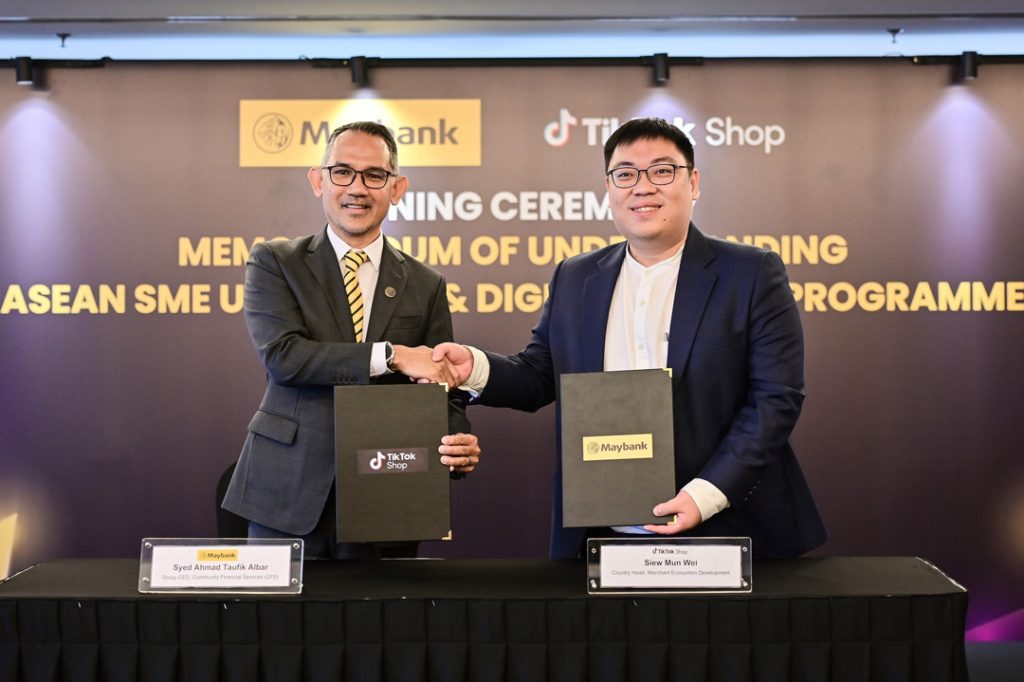
KUALA LUMPUR: Maybank and TikTok Shop Malaysia have partnered to introduce the ASEAN SME Upskilling and Digitalisation Programme, aiming to accelerate digital adoption among small and medium enterprises (SMEs) across the region. According to Bernama, the initiative will kick off in Malaysia next month with a pilot programme featuring webinars, workshops, and a six-month accelerator plan to help SMEs enhance their digital capabilities. Driving Digital Transformation for SMEs Maybank’s Group Chief Executive Officer of Community Financial Services, Syed Ahmad Taufik Albar, highlighted that the programme is designed to equip entrepreneurs with practical experience in digital solutions, content-driven e-commerce, and account management optimisation. These skills are critical for future-proofing businesses and driving long-term growth in an increasingly digital economy. As part of the first phase, Maybank will focus on supporting women entrepreneurs under its HERpower initiative. Currently, women-led SMEs account for 20% of the sector in Malaysia but continue to face challenges in securing funding and scaling their businesses. The bank aims to increase this share to at least 25% by 2026 through targeted financial solutions, mentorship, and business development support. Scaling SMEs from Local to Regional Markets TikTok Shop Malaysia’s Director of Strategic Partnerships, Nur Azre Abdul Aziz, emphasised that the platform will take both a qualitative and quantitative approach to SME development. Beyond enhancing social media visibility, TikTok Shop will provide resources to help businesses expand from local markets to the regional stage. The platform has already facilitated success stories, with SMEs transitioning from night market stalls to online sales, physical store expansions, and participation in major regional events like the ASEAN Investment and Business Summit. The partnership between Maybank and TikTok Shop Malaysia marks a significant step in bridging the digital gap for SMEs, equipping them with the necessary tools to thrive in a competitive digital landscape.

Scroll to Top

Subscribe
FREE Newsletter