Aaron Chong (Director – COO of Cloud Space).
1. Many organisations are still stuck at the pilot stage when it comes to AI. What are you seeing on the ground?
We are seeing a clear shift from experimentation to execution across the market. Over the past year, conversations have moved from “what AI can do” to “how quickly it can be deployed to deliver measurable outcomes”.
Based on our observations across engagements, approximately 70–80% of organisations are still in the pilot or early implementation stage, which highlights the gap between ambition and execution.
The challenge now is less about access to technology and more about integration. Many organisations have the tools, but aligning them with business processes and ensuring adoption across teams remains a key hurdle.
This highlights that many businesses have their AI “engine” started (pilot or early implementation stage), but the AI “gears” are not yet fully engaged or integrated with their respective business processes (advanced stage of AI integration).
2. Where are companies seeing the most immediate value from cloud and AI adoption?
The most immediate value is typically seen in operational efficiency. This includes areas such as automating repetitive processes, improving data accessibility, and enabling faster decision-making.
In our experience, organisations can achieve up to:
• 40% improvement in overall work efficiency or productivity across sectors
• 30% reduction in production time, particularly in the E&E manufacturing sector
• 80% increase in test execution speed, with significant impact in software development or when AI is effectively embedded into workflows
(Based on reports from IDC, PwC, and selected ASEAN market studies)
Cybersecurity and customer experience are also seeing strong returns, particularly where AI enhances accuracy and response speed in real-time environments.
3. Cloud Space has worked with a range of leading enterprises across different sectors. What do these engagements reveal about enterprise priorities today?
Enterprises are becoming significantly more outcome-driven. There is less interest in adopting technology for its own sake, and more focus on how it translates into measurable improvements.
This includes areas such as cost optimisation, scalability, and operational resilience. Organisations are looking for solutions that support long-term growth rather than short-term gains.
As a result, the role of implementation partners is evolving. Clients expect partners not only to deploy solutions, but also to guide them through the transformation process and ensure successful adoption.
4. How are enterprises approaching cybersecurity today?
Cybersecurity has moved firmly into the boardroom. It is no longer viewed as a purely technical function, but as a critical component of overall business resilience.
Organisations are increasingly adopting AI-driven approaches to enhance threat detection and response. This includes a shift towards more proactive and automated security operations.
The focus is now on transforming Security Operations Centres to improve response times and operational efficiency. This reflects a broader shift towards integrated, intelligence-led security frameworks.
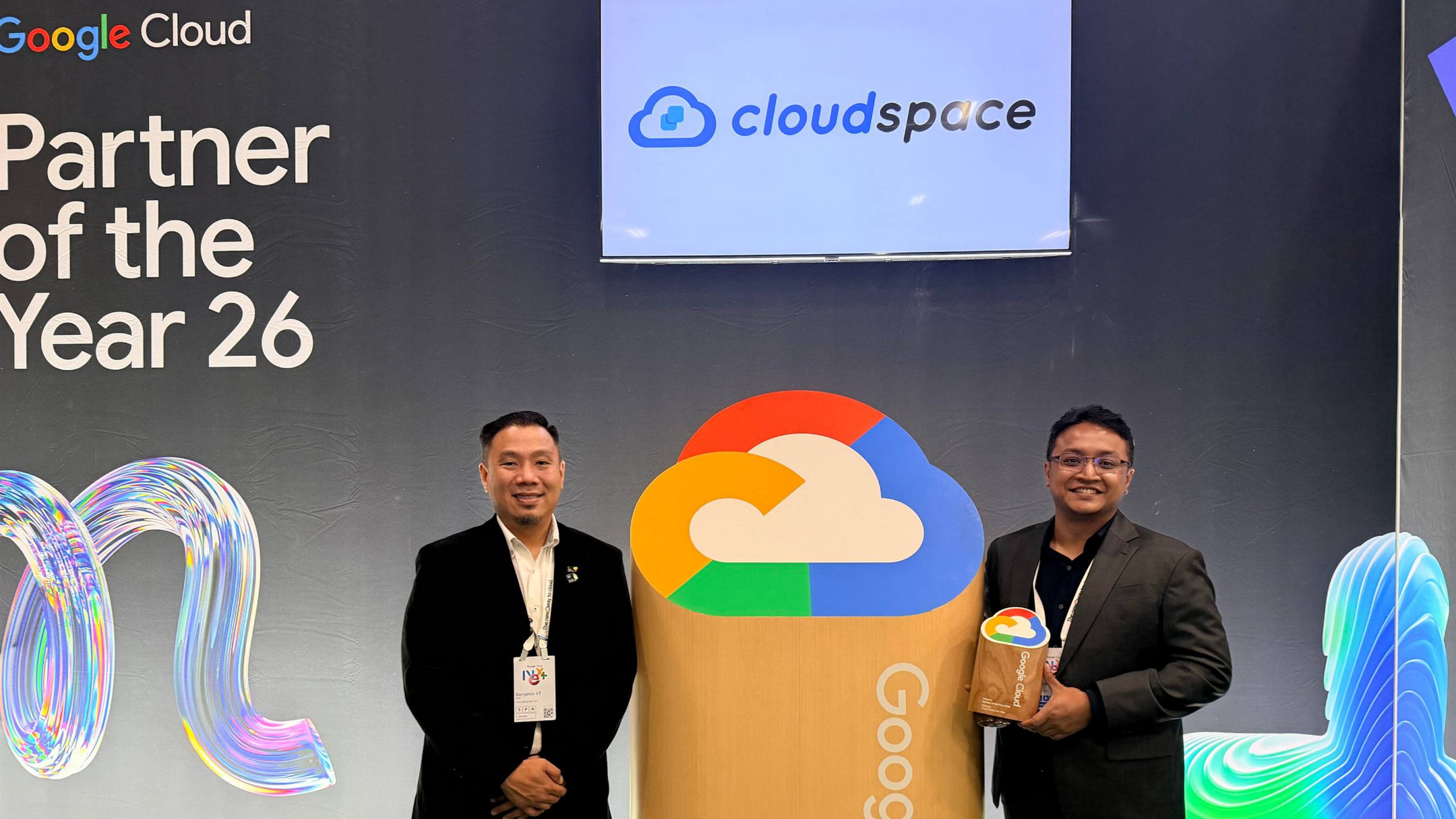
Cloud Space Named 2026 Google Cloud Partner of the Year for Malaysia (L-R: Benjamin Kok, Head of Data & Projects; Kishan Singh, Head of Sales).
5. Cloud Space was named the 2026 Google Cloud Partner of the Year for Malaysia. How does that recognition translate into business impact?
The recognition reinforces confidence among clients, particularly for large-scale and high-stakes projects. It signals that we have the capability to deliver consistently across different industries.
It also strengthens our position within the broader ecosystem, including our collaboration with Google Cloud. This enables us to access new technologies earlier and bring them to market more effectively, while supporting our customers in adopting and embedding them into their business processes.
At a broader level, it highlights the growing capability of Malaysian firms within the global cloud and AI landscape, which is an encouraging development for the industry.
6. Your team has grown from four to over 50 people in a short period. How do you maintain quality while scaling?
Maintaining quality starts with building a strong technical foundation. We invest heavily in developing expertise across cloud, data, security, and AI to ensure consistent delivery for our customers.
We are also deliberate in the type of projects we take on. Rather than scaling purely for volume, we focus on engagements where we can deliver meaningful impact.
This approach, anchored by our highly experienced talent and specialised technical expertise, allows us to grow sustainably while maintaining the highest standards of delivery. In a field where execution quality directly influences client outcomes, our focus remains on ensuring that every deployment translates into tangible, positive business impact.
7. How do you see the competitive landscape evolving in the next few years?
The market is likely to become more specialised. As technologies mature, clients will increasingly look for partners with deep expertise rather than generalist capabilities.
This is particularly true in areas such as AI, data, and cybersecurity, where implementation requires a high level of technical depth.
At the same time, competition will intensify as more players enter the market. Differentiation will depend on the ability to deliver consistent, measurable outcomes.
8. What challenges do organisations face when scaling AI initiatives?
One of the main challenges is integration. Many organisations operate with legacy systems, which makes it more complex to implement new technologies.
There is also a need to align AI initiatives with business objectives. Without clear direction, projects can become fragmented and fail to deliver meaningful outcomes.
Additionally, change management plays a critical role. Ensuring that teams understand and adopt new technologies is essential for long-term success.
9. What role do partners like Cloud Space play beyond implementation? Are you increasingly becoming strategic advisors?
The role of partners is evolving beyond implementation into a more strategic function. Organisations are seeking guidance not only on how to deploy technology, but also on how to align it with broader business objectives.
This includes areas such as identifying the right use cases, prioritising investments, and ensuring that solutions are scalable over time. In many cases, the challenge is not the technology itself, but how it integrates into existing operational processes and aligns with the organisation’s long-term strategy.
As a result, partners are increasingly expected to act as advisors who can bridge the gap between technical capabilities and business outcomes, rather than simply delivering projects.
10. What should organisations look for when choosing a cloud or AI partner today?
Organisations should look for partners with proven technical depth and a clear track record of delivering measurable outcomes. Experience across different industries and use cases is also an important consideration.
Equally important is the partner’s ability to understand the business context. Technology decisions should be aligned with organisational goals, rather than implemented in isolation.
Finally, organisations should prioritise partners who can support long-term adoption. This includes providing guidance on governance, scalability, and change management to ensure that solutions continue to deliver value over time.