Malaysia

News

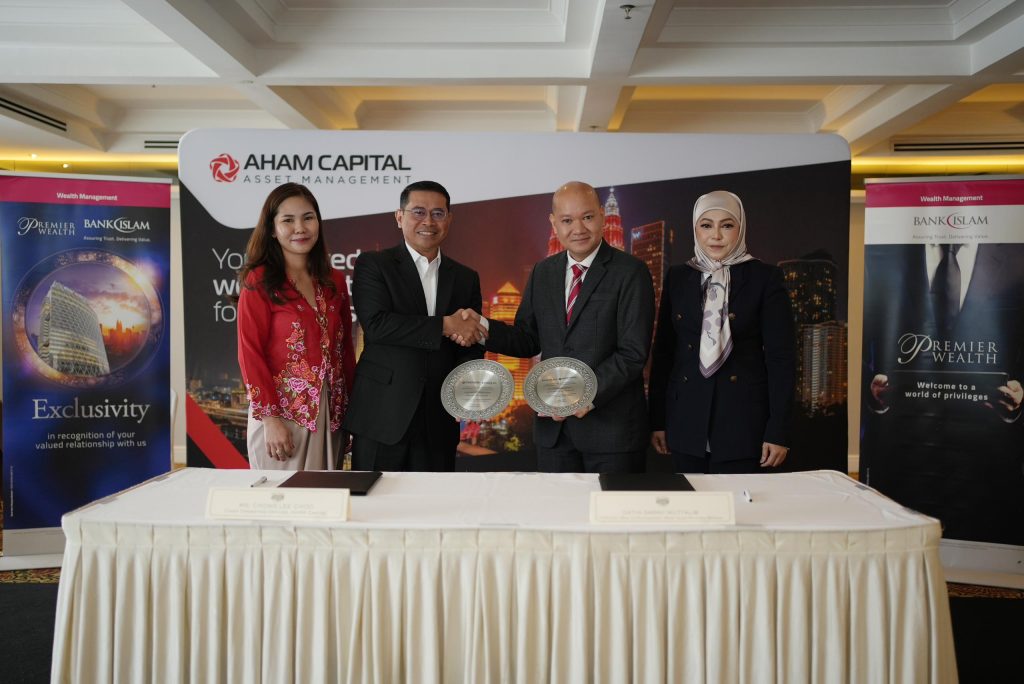
AHAM Capital Partners with Bank Islam to Expand Access to Shariah-Compliant Funds

AHAM Asset Management Berhad (“AHAM Capital”) and Bank Islam Malaysia Berhad (“Bank Islam”) today announced a strategic partnership through the signing of a Memorandum of Understanding (MOU), aimed at expanding the accessibility of Shariah-compliant investment solutions to a broader segment of Malaysian investors. Through this collaboration, AHAM Capital’s suite of Shariah-compliant funds will now be available through Bank Islam’s extensive distribution network, spanning over 100 branches across the country as well as its digital banking platforms. The partnership is a timely response given the rising demand for value-based investment in the country. As of end-2024, the Islamic capital market accounted for over 63% of the total capital market, with total Islamic assets under management (AUM) reaching RM246 billion. These figures underscore the sustained growth and resilience of Malaysia’s capital market as an Islamic finance hub in the region. Chong Lee Choo, Chief Operating Officer at AHAM Capital said, “This partnership reflects our shared commitment to expanding access to Shariah-compliant and values-based investing across Malaysia. Bank Islam’s robust distribution network makes them a strategic partner in reaching a broader segment of investors, enabling more Malaysians to access professionally managed solutions that align with their values. Through this collaboration, we aim to provide greater access to our diverse range of Shariah-compliant offerings spanning equities, sukuk, and multi-asset strategies to meet long-term investment goals.” “At the same time, we are seeing strong demand for Shariah-compliant and sustainable investments, not only from traditional investors, but also from a younger generation who are actively seeking to align their financial decisions with their values. Many are drawn to investments grounded in ethics, sustainability, and social purpose. “As the alignment between Shariah principles and Environmental, Social & Governance (ESG) considerations gain greater recognition, we believe this partnership is well-positioned to support the next wave of growth in values-based investing. Both frameworks emphasise ethical conduct, social responsibility, and long-term sustainability which are concerns increasingly prioritised by investors.” Lee Choo said. Datin Zaharah Abd Muttalib, Director, Wealth Management at Bank Islam said, “At Bank Islam, we take pride in offering Shariah-compliant financial solutions that help Malaysians grow their finances in ways that are meaningful and aligned with their values. This collaboration with AHAM Capital strengthens our commitment to ethical investing by expanding access to thematic, ESG, and gold-backed funds. “As more investors seek to align their financial choices with their values, Bank Islam is proud to be at the forefront of this shift. More than just a new offering, this partnership reflects our belief in creating a more inclusive and purposeful investment landscape for all Malaysians. It reinforces our commitment to building a future where faith, sustainability and financial resilience come together, and strengthens our position as a purpose-led Islamic bank that empowers customers to make informed and meaningful investment decisions.” To kickstart the collaboration, five (5) of AHAM Capital’s Shariah-compliant funds will be made available through Bank Islam’s distribution channels. These include: – AHAM Aiiman Growth Fund – Focuses on high-quality, Shariah-compliant equities listed in Malaysia, targeting long-term capital appreciation. AHAM Aiiman Quantum Fund – Provides exposure to growth opportunities in Malaysian small and mid-cap equities. AHAM Aiiman Global Thematic Mixed Asset Fund – A flexible multi-asset strategy seeking to capture global megatrends through a Shariah-compliant lens. AHAM Shariah Gold Tracker Fund – Offers exposure to gold through a Shariah-compliant structure, where each investment of the Fund is backed by physical gold. AHAM Aiiman ESG Income Plus Fund – A qualified Sustainable and Responsible Investment (SRI) Fund that aims to provide steady income by investing in sukuk. As part of the MOU, both institutions also plan to deepen collaboration to advance the adoption of Shariah and sustainable investing through investor education initiatives and potential product innovation to meet the diverse needs of investors.

Energy & Technology

RAW Energy and SEDC Energy Expand HTG Biomass Initiative in Sarawak

RAW Energy, a global leader in sustainable fuels, is poised to expand the cultivation of hybrid tropical grass (HTG) in Sarawak through its strategic partnership with SEDC Energy Sdn Bhd. The initiative aims to accelerate the adoption of renewable biomass fuel while engaging rural communities in the development process. The HTG, a sterile hybrid of Napier and Pearl millet grass, was first introduced to Malaysia in 2014 under special permit by RAW Energy’s founders. The grass is cultivated on large-scale farms in Bintulu, leveraging unproductive marginal land without displacing food crops. With its rapid growth cycle and high biomass yield, HTG thrives on tropical photosynthesis and rainfall, offering a scalable solution for clean energy production. RAW Energy has appointed SEDC Energy – a wholly owned subsidiary of the Sarawak State Economic Development Corporation (SEDC) – as the exclusive distributor of HTG pellets within Sarawak. These biomass pellets are designed to serve as a direct feedstock for thermal energy generation and will be supplied to power generation facilities and other industrial users seeking reliable, sustainable alternatives to fossil fuels. According to SEDC Energy chief executive officer Robert Hardin, the partnership will introduce HTG cultivation to rural communities in a phased manner. The initiative is aligned with Sarawak’s target to achieve Net Zero emissions by 2050, harnessing biomass technology to contribute meaningfully to the state’s renewable energy ambitions. “RAW Energy’s hybrid tropical grass does not compete with our food sources, which aligns with United Nations Sustainable Development Goal 15 – promoting the sustainable use of terrestrial ecosystems and halting land degradation,” said Hardin. RAW Energy group CEO Ramsay Wilson described the collaboration with SEDC Energy as a transformational step in the region’s renewable energy journey. “This marks the beginning of a new era for Sarawak. By embracing advanced biomass technology, SEDC Energy is setting an important precedent for global communities seeking to balance industrial progress with environmental stewardship,” said Wilson. Highlighting the performance advantages of HTG, Wilson noted that the pellets offer a carbon cycle measured in days rather than decades and a thermal energy content that exceeds that of conventional wood pellets. He emphasised the potential for HTG to replace coal and other traditional fuels, thanks to its superior ecological profile, energy efficiency and scalability. “With partners like RAW Energy, Sarawak is fostering a circular economy by converting agricultural by-products into valuable energy commodities,” he said. “This initiative is expected to stimulate further investment in green technology, strengthening the region’s economic and environmental resilience.” Wilson added that Sarawak is well-positioned to make a significant contribution to the global renewable energy conversation, showcasing how regional resources can be deployed for planetary benefit. -The Star

Energy & Technology

Sarawak Set to Host VoltAero’s Asia-Pacific Aircraft Assembly Hub

Sarawak is positioning itself as a strategic location for the final assembly of VoltAero’s Cassio family of hybrid-electric aircraft, following a tripartite agreement signed between the French aerospace manufacturer, SEDC Energy Sdn Bhd, and French engineering firm ACI Groupe. SEDC Energy, a wholly owned subsidiary of the Sarawak State Economic Development Corporation, formalised the collaboration through a Letter of Intent (LOI) signed in Rochefort, France, on 2 July 2025. The agreement aims to establish a dedicated aircraft assembly facility and innovation centre in Sarawak. In addition to the assembly plant, the collaboration encompasses the training of local technicians and engineers in both Malaysia and France, alongside the creation of a pilot training academy equipped with flight simulators. Key components of the partnership include technology transfer, the development of a local supply chain, and the establishment of maintenance capabilities. The parties will also engage in joint development of hydrogen propulsion systems and sustainable aviation fuels (SAF). As part of the agreement, the SEDC Energy–ACI Groupe joint venture will secure exclusive manufacturing and distribution rights for VoltAero’s Cassio aircraft across the Asia-Pacific region. Demonstration flights and deployment of mobile charging solutions at regional airports are planned to raise public awareness of hybrid-electric aviation technology. VoltAero’s Cassio aircraft family, currently under development, is intended for regional commercial operations, air taxi and charter services, as well as cargo, postal, and medical evacuation use. The aircraft lineup includes the Cassio 300 (four seats), Cassio 480 (six seats), and Cassio 600 (10 to 12 seats). Both SEDC Energy and ACI Groupe have expressed interest in acquiring an equity stake in VoltAero, signalling their commitment to becoming strategic investors and further strengthening the region’s capabilities in clean aviation technologies. VoltAero’s inaugural production line in Rochefort, inaugurated in November 2024, will serve as the foundation for expanding manufacturing operations into Malaysia. Jean Botti, VoltAero’s Chief Executive Officer and Chief Technical Officer, remarked that the collaboration marks a significant milestone for the company and the global shift towards low-emissions air transport. “Establishing a regional hub in Malaysia allows us to expand production, meet regional demand and transfer technology and skills to a key part of the world embracing sustainable aviation,” said Botti. Tan Sri Dr Abdul Aziz Husain, Chairman of SEDC Energy, noted that the initiative supports Malaysia’s ambition to become a regional leader in next-generation aviation manufacturing and clean energy development. “This supports regional ambitions to position Malaysia as a green aviation hub, aligned with national goals for decarbonisation, technology transfer and skilled workforce development,” he said. SEDC Energy is also progressing on a pilot SAF production plant with an initial capacity of 15,000 tonnes per annum, developed in partnership with Swiss technology company Sulzer. The facility will utilise Sulzer’s proprietary Bioflux technology. On 2 July, a memorandum of understanding was signed between SEDC Energy, Sulzer, and Singapore-based Apeiron Bioenergy to formalise the project. In addition, SEDC Energy is collaborating with Gentari, a clean energy provider, to jointly develop and manage the Sarawak H2 Hub in Bintulu. The hub will serve as the region’s centralised facility for green hydrogen production, standardisation, and distribution for downstream applications. Dr Abdul Aziz highlighted Sarawak’s unique position as a leader in sustainable technologies, reinforcing the state’s readiness to play a transformative role in aviation decarbonisation and energy innovation. ACI Groupe President and CEO Philippe Riviere echoed this sentiment, emphasising the strategic importance of the project. “This project reflects our shared belief in a clean, connected future and global air transport,” he said. -The Star

News

Sapura Energy Set for FY26 Earnings Rebound Following RM478 Million Loss in Q1

Sapura Energy Berhad is poised for a potential turnaround in the second quarter of its 2026 financial year (2QFY26), following a challenging start to FY26 marked by significant losses and project headwinds. BIMB Research, while maintaining a “hold” call on the stock, has revised its full-year earnings forecast downward by 18% in light of the group’s weaker-than-expected performance in the first quarter ended 30 April 2025 (1QFY26). The oil and gas group recorded a net loss of RM477.96 million in 1QFY26, a sharp reversal from a net profit of RM82.13 million during the corresponding period a year earlier. Revenue also declined markedly to RM801.37 million from RM1.18 billion previously, largely due to operational difficulties in delivering on an engineering, procurement, construction and installation (EPCI) contract in Angola. The engineering and construction segment bore the brunt of these issues, incurring RM304 million in foreseeable losses tied to the Angola project. Sapura’s order book also shrank, with its subsidiaries’ secured contracts falling to RM7.9 billion (from RM8.5 billion in 4QFY25), while joint ventures saw a decline to RM4.8 billion (from RM5.5 billion), reflecting slower replenishment. Drilling operations were similarly impacted, with asset utilisation weakening. Total drilling days dropped to 604 in 1QFY26, compared to 750 in 1QFY25 and 729 in 4QFY25, amid contract transitions for the T-17 and T-18 rigs. In contrast, the operations and maintenance division remained profitable, generating a pre-tax profit of RM20 million despite softer activity levels. Looking ahead, BIMB Research anticipates a recovery beginning in 2QFY26, underpinned by improving execution of the Angola project, which is slated for completion by December 2025. Enhanced rig utilisation and higher daily charter rates, as new contracts come into effect, are also expected to support earnings rebound. While the research house was caught off guard by another cost overrun in 1QFY26, Sapura management has guided that similar instances are not anticipated for the remainder of the financial year. Separately, the company received a key regulatory nod, as Bursa Malaysia approved its proposed regularisation plan. However, further regulatory milestones remain, including obtaining a waiver from the Securities Commission that would exempt Sapura from launching a mandatory general offer. This waiver is essential for the execution of its broader debt restructuring plan, which targets completion by August 2025. BIMB Research believes the group could potentially exit its PN17 status by the second half of 2026, subject to the successful delivery of two consecutive quarters of profitability. UOB Kay Hian Research (UOBKH Research) echoed this cautiously optimistic outlook, noting that Bursa’s green light signals the beginning of Sapura’s genuine recovery. The company is intensifying efforts to meet its restructuring deadline of August 2025, with a long-stop date set for 11 March 2026. As part of the restructuring initiative, Sapura plans to slash its total debt burden from RM10.8 billion to RM5.6 billion. This reclassified “sustainable debt” is expected to be equally allocated between its Brazilian joint venture, focused on pipelaying support vessels, and its drilling division. Repayment schedules are projected to range between RM200 million and RM700 million. -The Star

News

Agrobank Allocates RM50 Million for Microenterprise Financing Through AgroPintar

Agrobank has announced an allocation of RM50 million towards its Agro Pintar Niaga Programme (AgroPintar), aimed at enhancing access to microfinancing for small-scale entrepreneurs nationwide. In addition to this commitment, the bank has earmarked RM5 million in i-TEKAD matching grants to support the initiative. According to a statement released yesterday, Group President and Chief Executive Officer Datuk Tengku Ahmad Badli Shah Raja Hussin said the programme is designed to benefit over 4,000 microentrepreneurs, particularly those from low-income communities. AgroPintar will provide financial assistance through business and contract farming schemes, alongside capacity-building elements. “AgroPintar is a comprehensive programme offering more than just financing and i-TEKAD grants. It also features critical modules focused on entrepreneurship and business ethics,” he said during the programme’s official launch. Emphasising the importance of financial education, Tengku Ahmad Badli Shah highlighted that the programme includes training on financial management, credit risk control, and debt handling. He added that the overarching goal is to improve the competitiveness and decision-making abilities of participating microentrepreneurs. “Through structured guidance, participants will gain the necessary knowledge and tools to make sound business and financial decisions, ultimately improving their ability to manage various aspects of their operations effectively,” he explained. The programme’s impact will be monitored after six months to assess its effectiveness and identify areas for further improvement. This initiative aligns with Agrobank’s broader mission to cultivate resilient, forward-thinking and sustainable entrepreneurs. It is expected to contribute significantly to economic empowerment and social development across the microenterprise segment. AgroPintar is spearheaded by Agrobank’s Centre of Excellence (ACE) and Microfinance Division, reaffirming the institution’s commitment to empowering microentrepreneurs across Malaysia. In conjunction with the launch, Agrobank also introduced a new financial literacy video series developed in strategic collaboration with the Financial Education Network (FEN). The 12-episode series, featuring popular social media influencer Sir Asai, is targeted at school-aged children and is designed to make financial learning engaging and relatable. The initiative promotes financial awareness through the 3S approach — Spend, Save and Share — with the aim of instilling responsible money habits among the younger generation from an early age. -Bernama

News

EPF Yet to Engage in 2025 IPO Market as MMC Port Listing Looms

KUALA LUMPUR : The Employees Provident Fund (EPF), which manages RM1.25 trillion in assets, has yet to make a notable appearance in any of the 33 initial public offerings (IPOs) launched in 2025, despite a robust pipeline and growing market momentum. Bursa Malaysia has targeted 60 listings this year, with an estimated total market capitalisation of RM40.2 billion. EPF’s current restraint is particularly striking in light of its active role in 2024, where it took significant positions in several of the year’s largest IPOs. Last year, the pension fund emerged as a key institutional investor in Johor Plantations Group Bhd, Prolintas Infra Business Trust and 99 Speed Mart Retail Holdings Bhd — collectively accounting for RM20.32 billion or nearly 65% of total IPO market capitalisation in 2024. Track Record in High-Profile Offerings EPF’s investment in 99 Speed Mart began with a 5.02% stake acquired on 4 June, later increased to 5.10% as of 1 July. The convenience store chain, which listed in September 2024, was Malaysia’s largest IPO in seven years. Its shares rose 13.9% on debut, closing at RM1.88 compared to the IPO price of RM1.65. As of last Friday, the stock was trading at RM2.20 — a 33.3% increase since listing. The company was also fast-tracked into the FTSE Bursa Malaysia KLCI and adopted a dividend policy to distribute 50% of net profit biannually. Similarly, Johor Plantations Group Bhd saw EPF taking an initial 8.89% stake during its July 2024 debut, later raised to 10.23%. Shares opened at 83 sen and closed at 90 sen on the first day, and by 4 July 2025, were trading at RM1.20, marking a 44.6% gain. The group has pledged to pay out at least 50% of post-tax and minority interest profits as dividends annually. In March 2024, EPF acquired 6.18% of Prolintas Infra Business Trust at 95 sen per unit, increasing its stake to 7.87% by July. Although units last traded at 96 sen, the trust’s policy of distributing 90% of distributable income annually makes it a compelling option for income-focused investors. Cautious Stance Amid Mixed Market Performance This year’s IPO market has delivered uneven returns. The first seven listings posted gains ranging from 8.33% to 98.86%, led by Oriental Kopi Holdings Bhd. However, the market has since cooled, with several listings underperforming. Among the more prominent 2025 IPOs, Eco-Shop Marketing Bhd raised RM974 million in what was the country’s largest listing in eight months. Despite a 6% debut gain, its performance has been modest, with shares last trading at RM1.27. Analysts suggest EPF’s subdued participation may be deliberate. Bank Muamalat’s chief economist, Dr Mohd Afzanizam Abdul Rashid, points to heightened risk aversion amid global volatility and a likely shift towards fixed income to preserve capital and capitalise on rate cuts. He also noted that many of this year’s IPOs are relatively small in scale, limiting their relevance to a portfolio of EPF’s magnitude. Economist Geoffrey Williams echoes this view, stating that EPF’s decisions are guided by a strategic asset allocation framework that prioritises long-term value over short-term opportunities. He added that by stepping back from smaller IPOs, EPF may be allowing room for other institutional investors, thereby encouraging broader market participation and avoiding accusations of favouritism. Williams emphasised the importance of independence in EPF’s investment strategy, underscoring the need for decisions to be aligned with long-term goals and prevailing market dynamics. Focus Shifts to MMC Port’s Potential Blockbuster The second half of 2025 remains ripe with opportunity, with 27 more listings anticipated before year-end. Chief among them is the highly anticipated listing of MMC Port Holdings Bhd, expected to be Malaysia’s largest IPO in over a decade. Parent company MMC Corp has lodged a draft prospectus and is expected to divest up to 30% of its port business. The offering is likely to hit the market in late Q3 or early Q4. Should EPF decide to participate, its involvement would signal a major vote of confidence. Until then, its cautious posture continues to draw close scrutiny from market observers and institutional peers alike. -NST

News

BRICS Reaffirms Commitment to IMF Reform and Multilateral Trade Rules

The BRICS coalition has reaffirmed its collective stance in support of a rules-based multilateral trading system, condemning the imposition of unilateral, punitive and discriminatory protectionist measures, especially those framed under environmental pretences but misaligned with international law. Comprising Brazil, Russia, India, China and South Africa, the bloc used the 17th BRICS Summit in Rio de Janeiro to call for greater equity in global trade and adherence to international norms. The summit was convened under the theme “Strengthening Global South Cooperation for a More Inclusive and Sustainable Governance”, and culminated in the adoption of the 31-page Rio de Janeiro Declaration, which captured the strategic direction and outcomes of Brazil’s 2025 BRICS Presidency. In the area of global finance, BRICS reiterated the urgent need to enhance the representation of emerging and developing economies within international financial institutions. The declaration explicitly called for an increase in the International Monetary Fund (IMF) quota allocations for these countries, as well as strengthened equity participation in the World Bank. The bloc further advocated for deeper engagement on the use of local currencies in trade and investment, alongside enhanced interoperability among member states’ payment systems. To bolster financial integration, discussions have commenced on the establishment of a BRICS Multilateral Guarantees (BMG) initiative. The declaration also highlighted efforts to reinforce reinsurance capacities among member countries. Artificial Intelligence (AI) was identified as a transformative force with significant potential to advance inclusive development. BRICS underscored the necessity for a global governance framework for AI that mitigates associated risks and ensures equitable access and benefit-sharing. The bloc emphasised that such governance should be inclusive, respect national sovereignty, and prioritise the needs of developing nations, particularly those in the Global South. The United Nations was identified as the central platform for advancing these governance mechanisms. Indonesia was formally welcomed as a BRICS member, expanding the bloc’s footprint and reinforcing its role as a representative body for the Global South. In addition to the new membership, BRICS recognised Belarus, Bolivia, Kazakhstan, Cuba, Nigeria, Malaysia, Thailand, Vietnam, Uganda and Uzbekistan as partner countries. Since its inception as a strategic platform for political and diplomatic cooperation among developing nations, BRICS has broadened its reach significantly. Initially comprising Brazil, Russia, India and China, the group expanded to include South Africa in 2011, followed by Egypt, Ethiopia, Iran, Saudi Arabia and the United Arab Emirates in 2023, and Indonesia in 2025. -Bernama

Investment & Market Trends

MYStartup Accelerator Invests RM5.5 Million in Malaysian Startups to Fuel Innovation

Cradle Fund Sdn Bhd’s MYStartup Accelerator programme has channelled close to RM5.5 million into local startups across five cohorts, reinforcing its strategic role in nurturing Malaysia’s innovation landscape and supporting the nation’s ambitions to emerge as a regional technology leader. In a recent statement, Cradle confirmed that the initiative, which falls under the Ministry of Science, Technology and Innovation (MOSTI), is jointly managed with NEXEA, a venture capital and startup accelerator firm. Since inception, the programme has focused on accelerating the growth of promising startups, providing both capital and mentorship to early-stage enterprises. “Having completed five cohorts, we have gained meaningful insights into the needs of Malaysian startups. Our next goal is to expand our reach nationwide and ensure startups in all regions have equal access to growth opportunities,” said Cradle’s Group Chief Executive Officer, Norman Matthieu Vanhaecke. During the Cohort 5 Demo Day, startups showcased a range of innovative solutions spanning artificial intelligence (AI), aquaculture, electric vehicle (EV) infrastructure, and smart retail. From a competitive pool of 747 applicants, eight finalists were shortlisted. Of these, five were awarded cash prizes by Cradle, while four secured a combined RM800,000 in investment from NEXEA. Standout participants included Paix Tech, which leverages AI to automate enterprise utility payments; Ocean Rich Resources, a company specialising in scalable oyster farming systems; and Recharge Xolutions, which develops integrated EV charging and green energy solutions. Cradle noted that the MYStartup Accelerator continues to play a critical role in driving a tech-forward future for Malaysia by enabling startups with bold, sustainable, and innovative propositions. NEXEA, recognised for its extensive mentor network comprising accomplished entrepreneurs and C-suite executives, has been instrumental in scaling its portfolio companies—some of which have recorded annual growth of up to 16 times. Cradle, as the government’s key agency for early-stage startups, has supported over 1,100 tech-based ventures to date and maintains the highest commercialisation rate among grant providers in the public sector. -Bernama

News

Petronas Reinforces Commitment to Sabah’s Energy Expansion

Petroliam Nasional Berhad (Petronas), through Malaysia Petroleum Management (MPM), has formalised a series of strategic agreements with the Sabah state government, underscoring its commitment to advancing the region’s energy landscape. The announcements were made during the Sabah Oil, Gas & Energy Conference & Exhibition (SOGCE) 2025. In an official statement, the national oil company confirmed the handover of the Sabah Gas Strategy document. This strategic blueprint, developed in collaboration with the Sabah state government, outlines a long-term, structured framework to ensure reliable gas supply for the state’s growing domestic demand. Datuk Bacho Pilong, Senior Vice President of MPM, said the handover, along with other key milestones, reaffirms the organisation’s commitment to unlocking the full potential of Sabah’s energy resources in a responsible and sustainable manner. “We will continue working together to accelerate sustainable development, bolster energy security, and create long-term value for the benefit of both Sabah and the nation,” he said. The Sabah Gas Strategy was the result of joint efforts by Petronas, SMJ Energy Sdn Bhd, Sabah Energy Corporation Sdn Bhd, Sabah’s Energy Commission, and the Ministry of Industrial Development and Entrepreneurship. The initiative was guided by the Sabah Joint Coordination Committee. In further developments, Petronas signed a Technical Evaluation Agreement (TEA) with ConocoPhillips Malaysia New Ventures Ltd and PERTAMINA Hulu Energi for the Layang-Layang Basin. This agreement sets the stage for detailed subsurface studies, encompassing regional geological assessments and in-depth prospect analyses over a 44,500 square kilometre area offshore Sabah. Additionally, the company entered into a memorandum of understanding with DIALOG Resources Sdn Bhd to support the development of the Mutiara Cluster, located off Sabah’s east coast. To complement these initiatives, Petronas is also investing in seismic data acquisition programmes aimed at enhancing geological understanding and accelerating exploration activities across the region. These milestones collectively demonstrate Petronas’ sustained focus on collaborative, value-driven growth in support of Sabah’s long-term energy ambitions. -Bernama

News

MITI Finds Sufficient Evidence of Dumping in Steel Coil Imports

KUALA LUMPUR : The Ministry of Investment, Trade and Industry (MITI) has established sufficient evidence that imports of galvanised iron or steel coil and sheet products from China, South Korea and Vietnam were entering Malaysia at dumped prices, in violation of fair trade practices. In a statement released today, MITI confirmed that this preliminary determination was made under Section 23 of the Countervailing and Anti-Dumping Duties Act 1993, following a detailed investigation. As a result, the Malaysian government will impose a provisional anti-dumping duty, effective from 7 July 2025. The duties, which will take the form of a bank guarantee, correspond to the identified dumping margins and range between 3.86% and 57.90%. These temporary duties will remain in effect for a maximum period of 120 days, during which the investigation will continue. A final determination will be issued no later than 3 November 2025, according to MITI. The anti-dumping investigation was initiated on 6 February 2025, following a formal petition by CSC Steel Sdn Bhd, a domestic producer of similar steel products. The company claimed that imports of the subject merchandise were being sold in Malaysia at prices lower than in the respective home markets, resulting in material injury to the local industry. The probe is being conducted under the provisions of the Countervailing and Anti-Dumping Duties Regulations 1994. MITI has invited interested parties — including importers, foreign producers, exporters and relevant associations — to submit their comments or views regarding the preliminary findings. All submissions must be made by 14 July 2025. The non-confidential version of the Preliminary Determination report is available through the Trade Remedies Investigation Management (TRIMA) system at https://traderemedies.miti.gov.my. -Bernama

Scroll to Top

Subscribe
FREE Newsletter