Author name: admin

Cover Stories

Pos Malaysia to Remain a Significant Player In Mail, Parcel Segments

KUALA LUMPUR: National postal operator Pos Malaysia Bhd will remain a significant player in the mail and parcel business segment despite stiff challenges coming from competitors. Chief executive officer Charles Brewer said that despite the challenges, including foreign exchange fluctuations and regional geo-political concerns, Pos Malaysia will continue to upscale its operations across all business segments. He said that over the last decade, traditional mail, which has long been Pos Malaysia’s core business, has experienced a decline ranging from -2 per cent to -38 per cent. “This downward trend was exacerbated globally during the Covid-19 pandemic, with mail volumes experiencing low double-digit declines due to various disruptions,” he told The Exchange Asia in a recent interview. Pos Malaysia handles around one to one and a half million letters daily, and the decline in the business segment was due to COVID-19, which significantly contributed to the decrease in the already diminishing business sector. While the company continues navigating the challenges, Pos Malaysia expects another year of continued decline in mail volumes, a downtrend the company has faced over the past ten years. Charles said that the situation has somewhat stabilised post-Covid and is returning to pre-pandemic decline rates of 6 per cent to 8 per cent. The company’s core business is divided into two significant segments – traditional mail and parcel – presenting distinct challenges. The mail and parcel segment is Pos Malaysia’s primary business. Charles emphasised that, as the nation’s postal operator, Pos Malaysia has a vital duty to keep Malaysians connected, ensuring the timely delivery of mail. He said that in adapting to current and new challenges, Charles emphasised innovation and resilience as Pos Malaysia explored strategies for diversifying its services and reimagining its business model to remain relevant in an era where traditional mail is steadily declining. “In addressing new challenges, Pos Malaysia looks towards a future marked by innovation and strategic transformation,” Charles noted. Despite continued growth in parcel volume, which is contributed by the booming e-commerce industry, the segment has attracted many new players who are establishing their own logistics solutions, squeezing further Pos Malaysia’s tight margin. “What was initially seven, eight, or nine years ago, a significant upside opportunity is still an opportunity, but it is harder and more competitive to make a decent return in that space,” Charles said. Explaining further operations, Charles said the logistics services sector in Malaysia operates within a relatively open market, with limited regulatory constraints on new entrants. He said there are approximately 120 courier operator licenses in Malaysia, serving a population of 30 million. “To provide a perspective, the contrast with Indonesia is stark, where only about 30 licenses serve a population of 350 million. With a population of 70 million, Thailand has a similar number of licenses. “The competitive nature of Malaysia’s logistics market is one of its distinctive features, offering opportunities and challenges. The abundance of licenses contributes to a vibrant but relatively deregulated environment, becoming the first challenge in the parcel sector,” he said. Charles said the government and relevant agencies must look into creating a conducive playing field for the domestic courier industry, particularly limiting the number of foreign players to give local players a more significant market share. “We have more than 15,000 employees, and Pos Malaysia is one of the oldest companies operating in Southeast Asia and certainly one of the oldest companies in Malaysia. “We have a fantastic history, a fantastic brand, and much to be proud of. “So a big part of our transformation is transforming our culture, making sure that all of our 15,000 employees are very clear about how we need to operate and behave to keep the customers we have—more customer centricity and employee centricity, which sits right at the heart of that cultural transformation,” Charles said.

Cover Stories

Xamble Group Expands Influencer Marketing Services To ASEAN, NZ

KUALA LUMPUR: With a strong presence in Malaysia, Singapore, and Taiwan, Xamble Group Ltd is now eyeing expanding its influencer marketing services to other regions or markets. The Australian Securities Exchange (ASX)-listed Malaysian company is focusing on expanding across the ASEAN and New Zealand markets to attract more investors into its investor community. Xamble Group worked with more than 300 brands, including KFC, Unilever, P&G, and Hasbro and has access to over 20,000 influencers that reach over 20 million consumers in Malaysia, Singapore, and Taiwan through influencer marketing arm Nuffnang. Just recently, Nuffnang added The Body Shop, Taiwan Tourism, Standard Chartered and Mr DIY to its current portfolio. Xamble Group executive chairman Ganesh Kumar Bangah said more prominent brands are typically subject to more criticism from the public, especially during critical seasons involving important global events. “We work tirelessly so that our clients and brands care for us even more than usual,” he told The Exchange Asia. When asked how Xamble strengthens its relationships with existing clients and attracts new brands, Ganesh said that by strengthening relationships, the company attends to the client’s pain points to understand what they want to achieve. In addition, Xamble Group also hosts beneficial events like Nuffnang’s TMRW/TDY (Tomorrow/Today) to help clients better understand upcoming topics in the digital and influencer marketing industries. Ganesh said that in attracting new brands, Xamble Group innovates new products to supplement existing offerings, such as the Influencer Scorecard, a dedicated strategy team in place that focuses on bringing more creativity and innovation to campaigns, and the Talent Squad, an in-house talent management team that directly manages social media campaigns for influencers. “The primary objective of the investment initiative is to fortify and expand the outreach to the small and medium-sized enterprise (SME) segment through the Xamble Creators platform. “This entails strategic technological investments aimed at augmenting the platform’s functionality facilitates a seamless and direct interaction between influencers and SME brands. “The integration of an influencer solution tailored for SME brands holds the potential to amplify the scale of our business operations substantially,” said Ganesh. Xamble Creators is an innovative platform to enhance collaboration between micro and nano influencers and brands. The platform allows influencers to monetise their content by connecting them with brand campaigns that align with their interests. The platform, integrated with OpenAI’s ChatGPT, also empowers users with suggested social media posts based on campaign briefs and influencers’ preferred tones. Xamble also features a virtual robot, Xb, for tutorials and post suggestions. It is available on iOS, Android, and Huawei AppGallery and operates on SaaS (software-as-a-service) and fintech models. Targeting Asia’s prominent influencer segment, Xamble Creators focuses on authenticity and frequent audience engagement. It also includes a verified list of influencers, ensuring brand fit and addressing common concerns. This innovation aims to diversify revenue streams, enter new markets, and target the SME sector for long-term growth. Ganesh said Xamble Creators, introduced last year, continues to empower creators and influencers. “Via the app, we can access even more influencers looking for a way to connect, collaborate, and create content to earn. “Currently, we have more than 1,000 active influencers on the app, Ganesh noted. In October last year, Xamble Group signed a subscription agreement to receive an A$400,000 (RM1.2 million) investment from Georg Chmiel, a leading tech entrepreneur and public markets expert. Chmiel’s investment came in via the subscription of new chess depositary interest (CDI) at 3.5 cents per CDI. He also received 2 million options at 4.5 cents per CDI, vesting equally over five years, contingent on his directorship at each vesting date. Chmiel joined the Xamble Group board in November as an independent non-executive director. “In light of our consistently positive cash flow, as evidenced in prior ASX market announcements, Xamble Group is strategically allocating surplus funds towards future growth initiatives. “This proactive approach involves significant investments in enhancing our technology platform, primarily focusing on developing new features. “Notably, we are constructing a self-service influencer platform tailored for SMEs within our targeted markets,” Chmiel said. Chmiel and Ganesh have reviewed the strategic direction of the business and agreed on the growth path forward. Xamble Group noted that there will be continued investment in the platform, influencer community, and operations. The board is also assessing additional organic and inorganic mergers and acquisition growth opportunities as they emerge. Chmiel brings over three decades of expertise in disruptive online businesses, significantly influencing decision-making at Xamble Group. He excels at reassessing strategies, optimising team dynamics, and securing support for investment decisions through a robust network in the financial investor community. With a proven track record overseeing 40 successful mergers and acquisitions, Chmiel demonstrates a keen understanding of effective governance and the importance of technology platforms for rapid business scaling. In summary, his extensive experience and strategic vision have been instrumental in shaping Xamble Group’s direction, fostering innovation, and ensuring sustained success.

Cover Stories

KLCC: 2024 Is A Strong Year For International Conventions, Exhibitions

KUALA LUMPUR: The Kuala Lumpur Convention Centre (KLCC) anticipates 2024 to be a strong year for international conventions and exhibitions based on current industry trends and confirmed bookings. The country’s premier purpose-built venue also emphasises attracting more meetings, conventions, exhibitions, and corporate events segment (MICE), including banquets and functions, this year due to their contribution to the local economy. “The target or expectation for our corporate segment this year remains the same as last year with a slightly modified strategy. “We will be placing a higher emphasis on these segments whilst for the corporate segment, we will be focused on growing our recurrent client base through continued service quality,” KLCC general manager John Burke told The Exchange Asia. In 2023, KLCC generated over RM656 million in economic impact from local expenditure benefitting layers of the business events supply chain ecosystem, such as thevenue, hotels and hospitality, retail, event contractors, as well as associate industries like media, advertising and marketing, transportation, food and beverage and so forth. Research also shows that business event visitors spend over three times more than the average tourist and have a significant multiplier effect, with 60 per cent returning later as tourists. According to John, Malaysia also benefits significantly from these events’ knowledge transfers, learning, and trade activities. “Malaysian businesses, through business events can learn about international best practices and solutions they can apply in their organisations,” he said. John also pointed out that Malaysian businesses, through participation in international conventions or exhibitions, they can learn about global best practices, new technologies, trends relevant to their industry, and upcoming products and solutions, which they can apply in their organisations. “These events not only present new business opportunities but also provide great platforms for businesses and individuals to network with industry colleagues and potential new clients or employers from all over the world,” he said. When asked about the outlook in terms of the number of events secured and the target KLCC aims to achieve by the end of 2024, John said the centre opened the year with 37 convention bookings and 50 confirmed exhibitions. These numbers, he said, are expected to go up as more national conferences and exhibitions, short lead meetings and events are confirmed for the year. “Our focus for the year and moving forward is not so much focused on the number of events, but rather the opportunity that those events provide. “This could be in revenue, exposure, or economic impact. It is about selecting the right events for Malaysia, Kuala Lumpur and KLCC,” John pointed out. KLCC currently has 32 confirmed conventions for 2024, with 26 being international. When asked how KLCC plans to attract and secure more international events, John said the centre has a research team that studies the opportunity to bring suitable events to Malaysia. “We look at conventions and exhibitions that are especially relevant to existing and new industry sectors contributing to Malaysia’s economic, infrastructure and social growth. “We build relationships with local associations, assist them in putting together a compelling bid and presenting it to the association committee or council. “And, when bidding, we first sell Malaysia as the destination, followed by the host city, Kuala Lumpur,” he said. He said that as the premier purpose-built venue in Malaysia, KLCC also works very closely with its national bureau, the Malaysia Convention and Exhibition Bureau (MyCEB), to position Malaysia as the preferred destination for business events in the region. “We participate in all the global industry trade shows, representing Malaysia, showcasing our compelling offerings for international event organisers,” John noted. Some of the events lined up at KLCC for this year are the Ancaro Imparo Dental Conference, February 22-26, the International Café & Beverage Show, May 23-25, the 21st AILA World Congress, August 11–16, European Society for Radiotherapy and Oncology (ESTRO) meets Asia, August 23-25, the International Surgical Week, August 26-29, the Aesthetic Medicine & Surgery Conference & Exhibition (AMSC), AestheticMedicine & Surgery Conference & Exhibition (AMSC), September 20-21 and the International Union of Architects (UIA) Forum from November 15-17.

Experts

Small Space, Big Dreams: How Self-Storage Unlocks Extra Space Potential For SMEs

Over the past decade, e-commerce has become an indispensable part of retail. When physical stores temporarily closed during the Covid-19 pandemic, people shifted to online shopping, resulting in a massive acceleration for the e-commerce market. Malaysia has been no exception to this phenomenon. In fact, the country’s e-commerce industry is one of the largest in Southeast Asia, and it is projected to reach RM78.43 billion by 2027. While this surge of demand from online shoppers signalled the perfect business opportunity for many, quite a few entrepreneurs who jumped into running their e-commerce businesses from home started running into a problem — a distinct lack of space. Getting some shelf control – self-storage versus warehouse For many years, warehousing has been the go-to solution for business inventory, as these large buildings are commonly available for rent and are designed for industrial storage. However, self-storage spaces have since unboxed new business storage options. While warehouses are the primary choice for larger logistic needs, they demand complex management for businesses to operate them efficiently. From labour demands to substantial lease commitments, warehousing can prove to be overwhelming for small and medium-sized enterprises (SMEs) and startups. In contrast, self-storage has become more popular over the years, giving businesses a more flexible and cost-effective solution to their inventory needs. These facilities often offer feasible lease terms ranging from monthly to annual contracts depending on the business’ varying storage needs. Furthermore, self-storage facilities are also equipped with 24/7 security to ensure the safety of stored items without additional labour or security costs. How self-storage can stow away shipping woes and more Managing a growing e-commerce business is full of challenges. However, self-storage facilities like Extra Space Asia can play a vital role in alleviating said challenges and supporting SMEs to navigate the dynamic online retail landscape. Naturally, self-storage facilities provide a practical solution for e-commerce businesses grappling with inventory management. Smaller companies tend to face the dilemma of maintaining sufficient storage space, especially during peak seasons or fluctuations in demand. With self-storage facilities, businesses can select from many storage space sizes that suit their current inventory levels – adapting accordingly without needing extensive and costly commitments. In addition, one of the primary advantages of self-storage is its ability to address the cost-effective inventory needs of e-commerce businesses. This is particularly beneficial for small enterprises with budget constraints as self-storage allows them to pay only for the required space, serving as a more economical alternative to traditional warehousing. For growing businesses, self-storage facilities also allow them to expand their space in tandem with increasing operations. As an online business, traversing the ever-growing digital advancements is imperative. However, digitalising inventory and other operations involves an entire process that may come with additional costs or manpower. In regards to security concerns, it is paramount for e-commerce businesses to protect valuable inventory from unwanted losses. As previously mentioned, self-storage facilities provide robust security measures, including 24/7 surveillance cameras, access controls with unique pin codes, and secure locks. This monitored environment makes business owners confident that their products remain secure, whether for short-term needs or as part of a contingency storage strategy. There is a lot for small businesses and budding entrepreneurs to unpack in navigating the ever-changing e-commerce market. Self-storage facilities like Extra Space Asia have grown to provide practical and secure storage solutions, supporting SMEs in their quests to expand and flourish. Ultimately, it’s clear that self-storage has proven to contribute to the resilience and success of Malaysia’s online retail landscape.

News

RHB Investment Bank Sells Stake In Vietnam Stockbroking Unit To Public Bank Vietnam

KUALA LUMPUR: RHB Investment Bank Bhd (RHBIB), a wholly-owned subsidiary of RHB Bank Bhd (RHB) disposed its entire equity interest in RHB Securities Vietnam Co Ltd (RHBSV) and exited Vietnam’s stockbroking and securities market. RHB Banking Group group managing director and group chief executive officer Mohd Rashid Mohamad said the decision by RHBIB to divest its equity interest in RHBSV to Public Bank Vietnam Ltd aligns with the banking group’s long-term strategic business direction of focusing resources and efforts on bolstering RHBIB’s operations in other markets. “We remain committed to ensuring a smooth transition process and will ensure that we continue to deliver service excellence to our clients throughout the transition period,” he said in a statement. RHBSV is a wholly-owned subsidiary of RHBIB and is licensed under the laws of Vietnam to engage in the business of securities brokerage, securities investment consultancy, securities custodian services and proprietary securities trading. The corporate exercise is targeted to be completed by the end of the second quarter (Q2) of 2024. The divestment of equity interest in RHBSV will not affect the issued share capital and substantial shareholders’ shareholdings of RHB Bank. Alongside the disposal of RHBSV, RHB Bank will close its Vietnam representative office. “As we embark on this new chapter, we look forward to leveraging our strengths and expertise to pursue other opportunities. “We remain steadfast in our mission to deliver innovative solutions and superior services that create sustainable value for our clients, employees, and shareholders,” Mohd Rashid said.

News

PA Resources Acquires 18 Acres Land In Batang Berjuntai For RM21Mil

KUALA LUMPUR: Aluminium extruder company PA Resources Bhd’s (PRB) wholly-owned subsidiary, PA Extrusion (M) Sdn Bhd (PESB), has acquired two parcels of industrial land equivalent to 18 acres in Batang Berjuntai, Kuala Selangor for RM21 million. The two parcels of land, located near its existing factory, will be funded via internal generated funds and bank borrowings. The acquisition is expected to be completed within 6 months. Upon completion of the acquisition, PRB will build a new factory on the land, which will double its production capacity in phases, from 3,200 tons a month to approximately 7,000 tons. PRB group executive chairman Tan Sri Chan Kong Choy said this expansion plan fits the company’s long-term growth strategy. “With our new factory, we will be able to match the escalating demand from our solar renewable energy clients. “Additionally, this expanded capacity enables us to diversify both our product range and the markets we serve, hence providing the company with additional streams of income. “With these objectives in mind, we aim to expedite the land acquisition process and promptly initiate the construction of our new factory. “We are confident that this investment will not only boost our production capacity but also contribute to the economic growth of the nation. “This initiative also promises sustainable long-term employment opportunities and advancing socio-economic development within local communities in that region,” Chan said in a statement. “We are proud that the company is in a position to contribute to the growth of green energy by providing lightweight, durable components and cost-effective material for solar panels,” he added.

Energy & Technology

Airbus, Malaysia Aviation Group Signs MoU On Emissions Studies

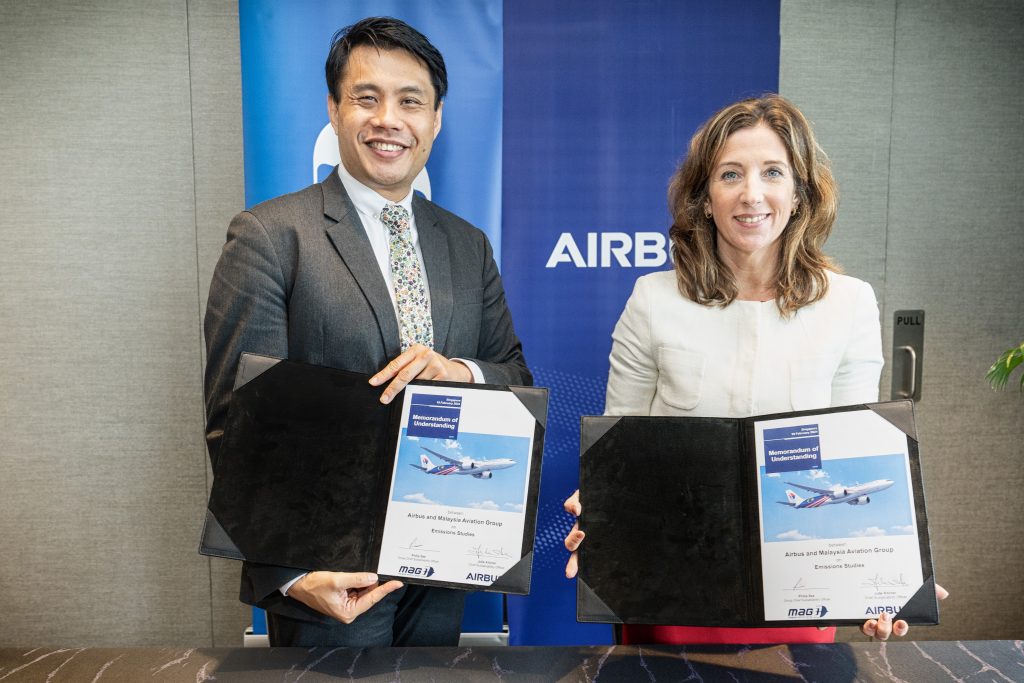
KUALA LUMPUR: French aircraft maker Airbus SE and Malaysia Aviation Group (MAG), the parent company of Malaysia Airlines, inked a memorandum of understanding (MoU) to conduct comprehensive studies on the carbon emissions of the airline group. The agreement was signed by MAG group chief sustainability officer Philip See and Airbus chief sustainability officer Julie Kitcher in Singapore ahead of the air show there. This significant step signifies the initiation of a two-year partnership between the two entities, dedicated to exploring various avenues for decarbonisation within MAG’s operations. The MoU between Airbus and MAG encompasses five key areas of focus. These include sustainable aviation fuel (SAF), carbon dioxide removal (CDR), assessment of financial implications associated with carbon dioxide (CO2) reduction, forecast and scenario planning and joint advocacy and communication efforts. A joint working group, comprising representatives from Airbus and MAG, has already been established and has been engaged in extensive deliberations on diverse decarbonisation strategies tailored to MAG’s unique requirements. Philip said this study with Airbus would strengthen the momentum MAG has on making its aviation units more sustainable. “Since the launch of MAG’s Sustainability Blueprint in 2021, the airline group has been committed to promoting socio-economic development and achieving net zero carbon emission by 2050. “This collaboration with Airbus is part of that initiative, and through the study, MAG will be better equipped to deliver on its environmental responsibilities and empower the global communities it serves,” he said. Julie said Airbus is committed to pioneering sustainable aviation, and this MoU showcases the aircraft maker’s commitment to increasing the development and adoption of decarbonisation tools such as SAF and CDR. “Airbus and Malaysia Airlines have a longstanding relationship, which will deepen when we celebrate the delivery of their new widebody fleet of A330neo later this year. “This agreement will provide an excellent foundation not only for MAG’s sustainability roadmap but also for Malaysia and the wider ASEAN region,” she said.

Property

MGB Posted Higher Net Earnings For Q4

KUALA LUMPUR: Property developer MGB Bhd saw its net profit surge three-fold, reaching RM51.1 million for the fourth quarter (Q4) ended December 31, 2023 (FY23) on the back of profit before tax (PBT) of RM69.2 million. Earnings per share improved from 2.55 sen to 8.25 sen for FY23, resulting in a price-to-earnings ratio of 10.6 times, based on the closing share price of RM0.87. After three consecutive quarters of positive financial performance, the growth momentum culminated in Q4 FY23, with revenue soaring by 109.7 per cent to RM305.3 million year-on-year (YoY). Higher contributions from the construction, trading, and property development segments drove this surge. The construction and trading segment recorded a 73.5 per cent increase in revenue, reaching RM241.5 million, while the property development segment recorded a nine-fold improvement, amounting to RM63.9 million. Consequently, the PBT and net profit surged 170.1 per cent and 259.9 per cent, reaching RM18.4 million and RM13.7 million, respectively. MGB recorded revenue of RM971.8 million for the full year, marking a 58.6 per cent increase from the previous year’s RM612.8 million. This substantial growth was primarily driven by a 45.4 per cent increase in revenue from the construction and trading segment, amounting to RM856.2 million. The surge was propelled by Idaman BSP, KITA Sejati, Prestige, and KITA Mekar projects. Furthermore, the property development segment’s revenue saw an impressive surge of 385.5 per cent to RM115.6 million, attributed to higher progress billings for the Idaman Melur and Idaman Cahaya Phase 1 projects, along with the delivery of vacant possession for Laman Bayu Phase 3 and Phase 4 projects. MGB group executive chairman Tan Sri Ir (Dr) Lim Hock San said this net profit is the highest the company has recorded thus far, thanks to its operational efficiency and strategic decision-making. “These positive results reflect the dedication and hard work of every member of the MGB family. Each individual, from our skilled workforce to our visionary leadership team, has been pivotal in driving the company’s success. “We are excited about the opportunities and confident in capitalising on them. With a solid track record of success, a strong team, and a clear strategic vision, we can navigate any challenges arising from uncertainties and seize the vast potential that awaits us,” Lim said in a statement. Moving into 2024, Lim said the company is cautiously optimistic about continue delivering commendable financial performance. He said this is supported by an outstanding order book of approximately RM1.2 billion and unbilled sales of RM0.7 billion from ongoing property projects with a gross development value (GDV) of approximately RM1.2 billion across the board. “Additionally, the two purchase orders that we received from Sany Alameriah totalling RM119.55 million for the supply and installation of 400 villas in Roshn Alarous development, north of Jeddah, is very encouraging to our performance and branding. “This should contribute positively to our revenue for 2024, and as our first international order, we look forward to applying our expertise in construction and  industrialised building system (IBS) precast technology to deliver the best product to our customers,” Lim said.

Experts

Fulfilling The Promise Of a Digital Future For All

Like it or not, the world is undergoing a massive transformation, which was accelerated when Covid-19 announced its presence. Digital transformation became necessary with lockdowns and working from home, turning this into a newfound reality. Expanding the digital talent pool became necessary to reap the full benefits of the digital economy. The buzzword of the moment then and now was ‘digitalisation’ and everyone wanted to jump on the bandwagon and ensure they had a piece of the pie. Then came the realisation that there isn’t enough digital talent in the region. There is an urgent need for a talent development ecosystem to be put in place to address the shortage of digital skills and prepare the next generation of digital talent. This cannot be done in silos. Industry, government and academia must tie up for a holistic, sustainable and inclusive learning ecosystem. I.C. The Future Huawei’s vision is to ‘bring digital to every person, home and organisation for a fully connected, intelligent world.’ Therefore, we continue to push boundaries to ensure digital inclusion and walk the talk by investing in training. Huawei aims to provide students with a platform to compete healthily and exchange ideas, thus enhancing their information, communication and technology (ICT) knowledge and practical skills and increasing their ability to innovate using new technologies and platforms. We have programmes such as our global flagship corporate social responsibility (CSR) programme, Seeds for the Future, with 145 local students participating since its inception in 2014, our ICT Academies in 34 public and private institutions of higher learning in Malaysia and our Huawei ICT competitions provide students with the experience of competing on an international stage as well as the opportunity to apply knowledge, think on their feet, apply problem-solving skills and increase their confidence. We believe that training provides the foundation but that applying that knowledge and being provided the opportunity to apply it are equally important. These programmes leverage our decades of ICT experience and expertise to help tackle ICT workforce challenges. We must ensure that digital skills evolve as quickly as industry opportunities. Mismatches and a glut of talent in a particular expertise must also be avoided. That is why the needs of the industry and the cultivation of talent need to be aligned. Hence, programmes such as the Huawei ICT Academy comes into play, which assists in empowering universities to cultivate ICT talent that meets industry requirements through advanced courseware and hands-on training. Digital leadership excellence While cultivating talent is crucial, equally important is the upskilling and cross-skilling of existing talent. Hailing the call from Prime Minister Datuk Seri Anwar Ibrahim, during his closing address at the Malaysia ICT Summit organised by Huawei in September last year, Huawei Malaysia and the Malaysian Communications and Multimedia Commission (MCMC) are embarking on a training programme for the C-suites and upper management across the public and private sectors to ensure they are up-to-date with the latest advancements in the ICT arena. Named ‘Digital Leadership Excellence’, the programme aims to empower change from the top down, targeting business leaders, senior managers and future digital leaders as trainees. The initial target number of trainees for the programme, which spans over three years, is 300 with 50 trained this year, followed by 100 the following year and 150 in 2026. The training will also encompass a one-month attachment stint with Huawei, a capstone presentation and a two-week industry visit to China. With sustainability and carbon neutrality an important focus and target for the nation, nurturing, training, upskilling and reskilling green talent should also be of utmost priority. That is why green tech will also be a part of the Digital Leadership Excellence programme syllabus. Huawei Malaysia also works with the Centre of Technology Excellence Sarawak (CENTEXS) to train and develop local talents to support growth in the clean energy industry. These skills are required to build a sustainable and environmentally responsible future. Talents with a combination of these skills can address environmental concerns, decrease our environmental footprint and contribute to a more sustainable and environmentally conscious Malaysia. Huawei Malaysia, through the Huawei ASEAN Academy, has also pledged to train 50,000 ICT talents over the course of five years, beginning in 2020, with over 48,000 talents trained thus far. Inclusivity has always been a key factor for us and we also work with the Women Leadership Foundation to train the digital talent pool in the country and to help contribute towards the progress of the development of the women workforce and leadership. Interlinked Digital talents are the key enablers for digital readiness, ergo, the digital transformation of a nation. All these are interlinked. For example, ICT infrastructure is key to attracting as well as retaining digital talents. Without digital talents to develop applications, telecom infrastructure investments will be wasted. That is why the ecosystem is emphasised. The balance between the industry, government and academia are fluid and will continually be subject to change. The question will no longer be about the right talent with the right capabilities, but the right talent with the potential to learn new capabilities, be agile enough to adapt to new changes, be able to grow and be able to adapt to new scenarios continuously. What we need is a holistic digital talent system which not only caters to training, reskilling, cross-skilling and upskilling but also one that takes into account the needs of an ever-evolving industry. This can only be accomplished via a collaboration between industry-Government-academia for professional competence standards for digital talent to be drawn up that guide the development of academic and continuing education courses. Only then can we chart the paths and find the pilots to fly into our digital tomorrow.

News

Domestic Banks To See Muted Earnings For Q4, Due To NIM Pressure, Higher Opex And Credit Cost

KUALA LUMPUR: Domestic banks’ net interest income (NII) for the fourth quarter (Q4) could be flattish, with the expansion in the loan base offset by net interest margin (NIM) pressure due to the seasonal competition for deposits and from the lagged impact of May’s overnight policy rate (OPR) increase. RHB Research said while some banks offered deposit rates of more than 4 per cent, this does not appear to have been a widespread practice, and the banks expect an easing in competitive pressure in the first quarter (Q1) of 2024. “On non-II, fees could stay healthy on strong loan- and card-related fees, but market-related (ie trading and investment)and foreign exchange (FX) income may be lumpy and harder to forecast. “The 10-year Malaysian Government Securities (MGS) yield contracted by 24bps quarter-on-quarter (QoQ), which should be positive for trading activities, even though some banks may be inclined to rebuild their bond portfolios or hold on to the higher yields,” the bank-backed research firm said in a note today. RHB Research also noted that the Q4 2023 banking sector’s profit before tax (PBT) could be muted QoQ due to NIM pressure, higher operation expenditure (opex) and credit cost, with markets-related non-II being a swing factor. “CIMB Group Holdings Bhd’s results maybe slightly ahead of our estimates on higher- and lower-than-expected non-II and credit cost QoQ, but Affin Bank Bhd’s numbers may miss projections on NIM pressure. “What is more pertinent is the outlook – positive guides on return on equities (ROEs) and capital management initiatives are likely to be well-rewarded by investors,” RHB Research noted. Further, RHB Research sees the domestic banking sector is likely to report higher opex and loan impairments QoQ – a reflection of seasonality (opex) and base effect (credit cost). Larger banks such as CIMB and Malayan Banking Bhd reported lower credit costs in the third quarter (Q3) due to writebacks and model changes, which may not recur this quarter. Also, there could be provision top-ups to lift coverage for CIMB and AMMB Holdings Bhd), RHB Research noted. “Generally, we do not expect adverse developments in asset quality, but we would be keen to hear more on the small and medium enterprises (SME) segment. “Hence, sector PBT could be muted QoQ but the profit after tax and minority interests (PATMI) trend could be boosted by AMMB, depending on the extent it utilises its tax credits,” RHB Research said. Maintaining a Neutral call on the sector, and with several banks approaching the tail-end of their mid-term plans, RHB Research thinks investors would be keen to hear more about what would be next in the upcoming and future briefings. “We see investors ending up with a spread of choices – banks that will be investing for growth, banks in a steady state, banks with room to further optimise their capital and balance sheets, and banks that could offer a combination of the above,” the research firm noted.

Scroll to Top

Subscribe
FREE Newsletter