News

Energy & Technology, News

Equinix Acquires Land to Expand Digital Infrastructure in Malaysia

HONG KONG: Malaysia’s digital landscape is witnessing a surge in demand for data centres across diverse industries. Responding to this trend, Equinix, Inc., the global leader in digital infrastructure, announced today an investment of RM23 million (approximately US$5 million) to acquire land from Cyberview Sdn Bhd (Cyberview) in Cyberjaya. This investment aims to expand Equinix’s data center capacity in Malaysia, following the successful launches of its International Business ExchangeTM (IBX®) facilities in Kuala Lumpur (KL1) and Johor (JH1). The additional land acquisition in Cyberjaya, Malaysia’s Global Tech Hub, situated less than one kilometre from the existing KL1 facility, spans 14,300 square meters. This strategic move will bolster Equinix’s ecosystem in Malaysia, facilitating enhanced services for network and cloud providers, as well as enterprises across various sectors. Malaysia’s strategic location, supportive government policies, and increasing digital infrastructure demands are driving its emergence as a pivotal player in Southeast Asia’s digital transformation. The country aims to evolve into a digitally driven, high-income economy, leveraging factors like geopolitical stability, a skilled workforce, enhanced connectivity, and a focus on renewable energy. Chief Minister of Selangor, Dato’ Seri Amirudin Shari emphasised the significance of data centres in accelerating Selangor’s digital economy, praising Equinix’s expertise in building resilient digital infrastructure. He highlighted the company’s role in promoting cloud technology adoption among Malaysian enterprises. Meanwhile Equinix Malaysia Managing Director, Cheam Tat Inn underscored Malaysia’s robust digital engagement, with 96.8% of the population actively participating in digital activities. This consumer demand is driving businesses to seek secure and scalable data centre solutions, where Equinix’s global expertise and strategic advantages make it a preferred partner. Additionally, Cyberview CEO, Kamarul Ariffin Abdul Samad highlighted Cyberjaya’s pivotal role in Malaysia’s digital economy, noting its concentration of tech companies and recent surge in data centre investments. He affirmed Cyberview’s commitment to fostering innovation and positioning Cyberjaya as a prime destination for tech investments. Equinix currently operates two data centres in Malaysia: JH1 in Johor offering 500 cabinets and 1,960 square meters of colocation space, and KL1 in Kuala Lumpur set to provide 900 cabinets and 2,630 square meters upon completion. These facilities have already attracted a diverse array of companies, including network providers, content creators, fintech firms, and AI developers. With 56 data centres across key Asia-Pacific markets and a global network spanning 260 centres in 71 metropolitan areas, Equinix continues to support over 10,000 leading businesses worldwide, reinforcing its position as a cornerstone of digital infrastructure globally.

Investment & Market Trends, News

ASEAN on Positive Trajectory to Become World’s 4th Largest Economy by 2030

KUALA LUMPUR: ASEAN is on a positive trajectory to emerge as the world’s fourth-largest economy by 2030 from its current fifth, given its progressive and significant macroeconomic environment. ASEAN Economic Community (AEC) Deputy Secretary-General Satvinder Singh said this includes its gross domestic product (GDP) which soared 51% to US$3.8 trillion last year versus US$2.5 trillion in 2015. This was further reinforced by regional trade which rose to US$3.5 trillion in 2023 from US$2.3 trillion in 2015, which helped raise per capita income significantly. This reflects ASEAN’s persistent commitment to becoming an open economic region for global trade and investment, which has improved significantly, he said. “The important thing is, we are one of the very few regions in the world where our trade is almost as large as our GDP and the biggest component of trade is not our trade with China or the US, but our intra-Asian trade, which is somewhere close to US$800 trillion. “What we are trying to say is, as much as we have grown as the largest trade Component, we have also grown a lot in terms of our trade with the rest of the world,” he said. This is the uniqueness of economies within the ASEAN bloc, unlike the European Union or the North American Free Trade Area where “they like to trade with each other.” For Canada, Mexico and the European Union (EU), most of the countries trade with each other and not with the rest of the world. “So, this is the uniqueness of ASEAN. We are strong in Asia, and at the same time, we are (also) strong globally trading in goods and services,” he said. Satvinder said in the global south, ASEAN is also the largest recipient of foreign direct investments totalling about US$230 billion, to date. He said the global supply chain of companies with low carbon footprints and high-value activities is more likely to be in ASEAN countries in the coming years. Some of the sectors to see significant growth include semiconductors, agriculture, data equipment as well as minerals and the metals industries. Besides this, “the sweet spot for ASEAN is technology transformation and that frontier technologies such as 56, artificial intelligence, Internet of Things, are going to create another US$8 trillion, he said. Nonetheless, ASEAN should work hard to reduce the cost of technology across their economies and ensure regional economies have access to technological devices and solutions. Despite these economic positives, Satvinder expressed concern that the region’s young workers are expected to decrease while ageing workers are estimated to increase marginally, presenting the risk of skills mismatch. Across member countries, automation will also affect the different types of occupations. “Therefore, reskilling young workers in technology and innovation through technology management hubs, online education platforms for science, technology and innovation and upskilling the elderly will instil productivity and help strategic industries to move up,” he said. — BERNAMA

Investment & Market Trends, News

UOB Survey Shows Businesses Positive on Malaysia’s Prospects

KUALA LUMPUR: Malaysian and overseas small and medium enterprises (SMEs) as well as large enterprises, are optimistic about the country’s business landscape and prospects, according to the UOB Business Outlook Study 2024. The annual study revealed that Malaysia has emerged as the most important country for businesses in ASEAN and Greater China to venture into over the next 3 years. UOB Malaysia Chief Executive Officer Ng Wei Wei said the study indicates that local businesses are gearing up for growth and are bullish on Malaysia’s economic potential, while overseas businesses are looking to expand into the country. “This is due to Malaysia’s strong economic fundamentals and attractiveness as a regional business hub, driven by the China+1 strategy, the upcoming Johor-Singapore special economic zone, the upcycle of the global semiconductor industry and the rising adoption of sustainability among businesses and states. “UOB Malaysia remains committed to leveraging our extensive regional network, strong sector expertise and local market knowledge to support the growth of local businesses and facilitate more foreign direct investment and trade into the country,” she said. The survey aimed to understand the business outlook and key expectations among SMEs and large enterprises in Malaysia, Hong Kong, Indonesia, Mainland China, Singapore, Thailand and Vietnam. Among the key findings of the survey, more than 7 in 10 Malaysian businesses are positive about the current business environment, with 76% expecting business performance to improve this year. The sectors most positive about the current business environment are industrials, oil and gas (90%) and manufacturing and engineering (80%). The survey also showed that the top 3 priorities for local businesses in the next 1 to 3 years are reducing costs, adopting digital solutions to improve productivity, and sourcing new customers. “Almost 80% of Malaysian businesses want to expand overseas to boost their profits, grow revenue and build their reputation as international businesses. “Businesses also want to incorporate sustainability practices into their operations to attract investors, collaborate more easily with multinational corporations with sustainability goals, and improve their brand and reputation,” the survey reported. — BERNAMA

Investment & Market Trends, News

Malaysia’s Digital Investment Soars to RM66.22 Bil in 1H 2024

KUALA LUMPUR: Malaysia’s digital investment soared to RM66.22 billion in the first half of this year (1H 2024), demonstrating robust growth and resilience of the digital economy despite global geopolitical tensions. Digital Minister Gobind Singh Deo said this was a significant achievement, noting that the amount has already surpassed the full-year digital investment for 2023 which stood at RM46.2 billion. He attributed the strong upward trajectory to stronger investor confidence and the economy’s forecasted growth of 4%-5% this year. “This investment inflow created 25,498 jobs in 1H 2024, surpassing the 22,258 tally recorded in 2023. The digital sector continues to be a powerhouse for high-skilled, high-income employment,” he said. As for digital exports, Gobind said the ministry’s efforts via the Malaysia Digital Economy Corporation’s (MDEC) partnerships and business matching programmes generated export opportunities worth over RM1.93 billion. These involve 228 companies from 11 countries, namely Indonesia, the Philippines, Cambodia, Turkiye, Spain, Saudi Arabia, Japan, Taiwan, Kenya, Tanzania and the United Kingdom. “This represents an increase of over 43% from the export opportunities worth RM1.35 billion generated in 1H 2023,” he said. Gobind said MDEC’s DEX Connex initiatives in the Philippines and Indonesia as well as business missions have significantly contributed to the export opportunities in the first half of 2024. “It is worth noting that data centres and cloud companies collectively contributed the lion’s share of digital investment value across all sectors. “Information Technology (Infotech) and Global Business Services (GBS) companies took the lead in digital job creation, as they race to set up their centres of excellence and high-value GBS operations in Malaysia,” he said. He added that 451 tech companies have been awarded the Malaysia Digital (MD) Status in 1H 2024 (2023: 256 companies). “Of these, 39% are foreign companies contributing to foreign direct investments, while 61% are local companies,” he said. Gobind said companies with MD Status are entitled to many incentives, rights and privileges from the government, subject to necessary approvals and compliance with applicable conditions. The benefits include competitive tax incentives and duty import and sales tax exemption on the importation of multimedia equipment, access to local and foreign knowledge workers, exemption from local ownership requirements and access to funding facilitation. — BERNAMA

Energy & Technology, News

Power Outage Incident Might Be Sign to a Bigger Threat

KUALA LUMPUR: With data volumes surging, organisations must prioritise the resiliency of their data infrastructure. According to Hitachi Vantara Chief Technology Officer for APAC, Matthew Hardman, the evolving digital environment demands robust measures to protect critical information, necessitating a proactive data management and security approach. “Many organisations are not fully prepared for the risks posed by cyberattacks and outages. The key to prevention and business continuity lies in having a well-defined data resiliency strategy in place,” he said, following the major information technology (IT) outage on July 19, which affected a large number of businesses and governments worldwide, as it involved 8.5 million devices throughout the globe. “We saw disrupted services and operations across multiple industries, but those hit hardest would have been the businesses that are heavily reliant on uninterrupted computer functionality,” he opined, adding that the businesses in question include banking, healthcare, airlines, emergency services and retail. Hardman provided an example of financial services and online banking services that were taken offline, which would cause delays in patient care in settings where patient records were not accessible – not to mention the flight delays and cancellations worldwide. Explained further, Hardman said the interconnectedness of these industries meant that the outage had a domino effect, whereby one firm going offline meant that other organisations reliant on them also had to stop operations. “Suffice to say, the impact was already significant and we may only be seeing the tip of the iceberg of what the real overall impact of the outage has been (or could be). “Ultimately, the incident underscores just how reliant the world is on interconnected technologies and the need for more robust cyber resilience strategies,” he added. Preventing future incidents Hardman said data resiliency is an organisation’s ability to recover from data breaches and other losses, enact business continuity plans quickly, and implement stronger data protection measures moving forward. “It is critical to prioritise data resiliency by implementing best practices in this area,” he said. Businesses can fortify their defenses and warrant service steadiness through several key strategies and should take stock of their current level of cyber resilience, data protection, and overall operational resilience. This, he said, might involve working with internal experts or a trusted partner to assess their on-premises, hybrid cloud, or fully cloud-based environments. Other than the said strategies, he said that having a backup and recovery plan with security measures in place is ‘a good start’, but it is not enough for data resiliency. “A truly resilient infrastructure requires data immutability, consistent deployment processes, and the ability to withstand unexpected system failures,” he said. Organisations need a data resiliency plan encompassing their entire environment both on-premises and in the cloud. Collaboration across the organisation is essential, including addressing shadow IT (unauthorised use of IT applications and devices). “While there is a lot to consider, a trusted data infrastructure expert can support businesses in implementing strategic solutions to improve current data resiliency posture at any stage. Regularly refreshing and rehearsing IT outage response plans are crucial in the digital age,” he said. “Hence, partnering with such an expert allows businesses to identify vulnerabilities and determine the necessary steps to ensure proper data protection, compliance and cyber resilience,” Hardman concluded. Cybersecurity Should Not Be Underestimated Meanwhile, BMI Senior Power and Renewables Analyst, David Thoo said that the power sector should not be undermined when it comes to cybersecurity, given the implications. Whether in renewables or traditional energy, Thoo emphasised that the power sector would always be a target of cyberattacks and as the adoption of renewable energy increases, this could mean that more plants and systems are being targeted. “The main targets of cyberattacks are critical infrastructure including utility networks and power plants. If these attacks can bring networks or power plants offline by infiltrating controls, it will result in major blackouts,” Thoo said. The world is rapidly ramping up its renewable energy capacity in line with ambitious climate pledges. The accelerated transition to green energy comes with new challenges, including concerns about the increasing use of electricity use from renewable sources, which could create new opportunities for cyberattacks. The Malaysian government, through the Malaysia Cyber Security Strategy 2020-2024, has identified 11 Critical National Information Infrastructure (CNII) sectors – including the energy sector – that must be protected and preserved to ensure the security of the nation, its economy and the public’s health and safety.

Energy & Technology, News

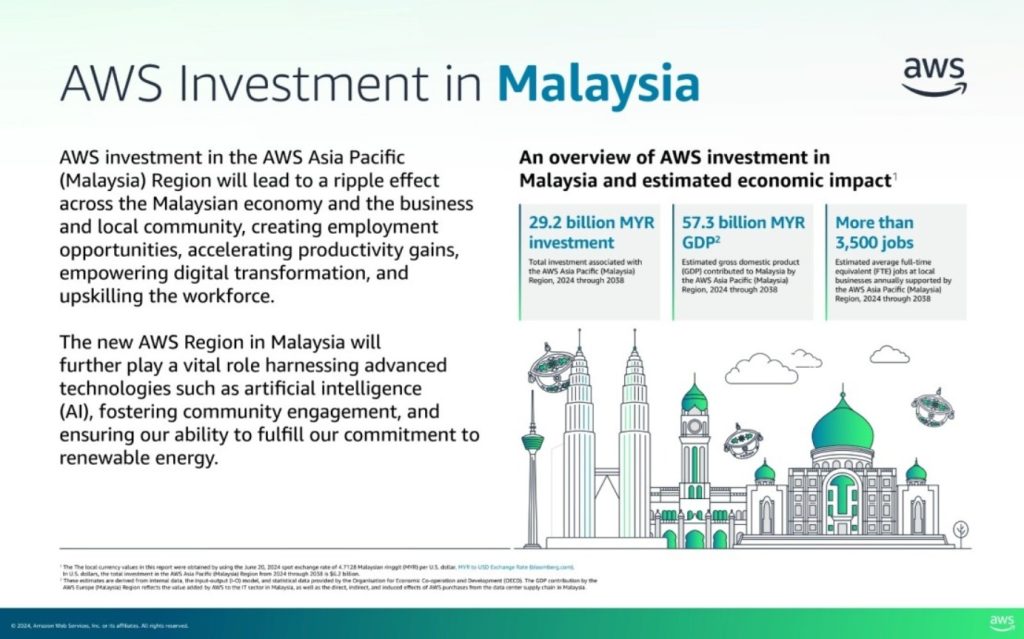
Amazon Launches AWS Asia Pacific (Malaysia) Region, Potential RM29.2 Bil Investment

KUALA LUMPUR: Amazon Web Services (AWS), an Amazon.com Inc company, recently launched the AWS Asia Pacific (Malaysia) Region with plans to invest about US$6.2 billion (about RM29.2 billion) in Malaysia through 2038. In a statement issued in Seattle, it was said that starting 22 August, developers, startups, entrepreneurs and enterprises as well as government, education and non-profit organisations will have greater choices for funning their applications and serving end users from AWS data centres located in Malaysia. “The construction and operation of the new AWS Region is estimated to add approximately US$12.1 billion (RM57.3 million) to Malaysia’s gross domestic product (GDP) and will support an average of more than 3,00 full-time equivalent jobs at external businesses annually through 2038. “These jobs, including construction, facility maintenance, engineering, telecommunications and others within the country’s broader economy, will be part of the AWS supply chain in Malaysia,” it said. With the launch of the AWS APAC (Malaysia) Region, AWS has 108 availability zones across 34 geographic regions, with announced plans to launch 18 more availability zones and 6 more AWS Regions in Mexico, New Zealand, Saudi Arabia, Taiwan, Thailand and the AWS European Sovereign Cloud. It said the AWS APAC (Malaysia) Region consists of 3 availability zones located far enough from each other to support customers’ business continuity but near enough to provide low latency for high availability applications that use multiple availability zones. “Each availability zone has independent power, cooling and physical security and is connected through redundant, ultra-low-latency networks,” it said. AWS customers focused on high availability can design their applications to run in multiple availability zones to achieve even greater fault tolerance. “With the launch, AWS is proud to support Malaysia’s digital transformation and help accelerate its role as a regional hub for artificial intelligence (AI),” said AWS Vice-President of Infrastructure Services, Prasad Kalyanaraman. Meanwhile, Investment, Trade and Industry Minister Tengku Daruk Seri Zafrul Abdul Aziz said the launch of an AWS infrastructure region in Malaysia provides access to new and emerging technology for Malaysian entities and businesses of all sizes, boosting our country’s capabilities for digital innovation. He said this milestone is a significant step towards fulfilling the vision of Malaysia’s New Industrial Master Plan (NIMP) 2030 to build a highly skilled, innovative, prosperous, inclusive and sustainable economy. “We recognise the transformative power of digitalisation, cloud computing and AI as key drivers in Malaysia’s effort to become a manufacturing and services hub within Asia. “As the largest investment made by an international technology company in Malaysia, the AWS infrastructure region will help ensure Malaysia remains competitive on the global stage,” the minister said. AWS offers the broadest and deepest portfolio of services, including analytics, computing, database, Internet of Things, generative AI, machine learning, mobile services, storage and other cloud technologies. Customers from startups and enterprises to public sector organisations and non-profits would be able to use advanced technologies from the world’s leading cloud provider to drive innovation, meet data residency preferences, achieve lower latency and serve the demand for cloud services in Malaysia and across APAC. — BERNAMA

Investment & Market Trends, News

Malaysia on Track for High-Income Status, Says Economist

KUALA LUMPUR: Malaysia’s target to achieve high-income status is realistic, given its solid growth trajectory, economic stability and strong investor confidence. Its economic growth will continue to be driven by contributions from key states such as Selangor, Sarawak, Kuala Lumpur and Penang over the next 3 to 6 years, said Juwai IQI Global Chief Economist Shan Saeed. “Selangor currently contributes 25% to the nation’s gross domestic product (GDP), Sarawak is set to rise strongly and become a major contributor to the economy while Penang remains as the manufacturing hub,” he said. Overall, he expects Malaysia’s GDP growth to be around 4%-5% in the next 3 to 5 years, supported by a stronger ringgit, as the local note is expected to range between RM4.10 and RM4.40 versus the US dollar. “The budget deficit target remains under 3.5% with disciplined fiscal policy,” said Shan. He opined that growth in information and communication technologies (ICT), oil and gas (O&G), real estate, electrical and electronics (E&E), e-commerce, and logistics sectors will support Malaysia’s bid for high-income status. Malaysia is already a significant player in the E&E market, exporting to countries like China, the United States, Singapore, Hong Kong, and Japan. At the same time, the O&G sector continues to be crucial to the nation’s economy, with a strong ecosystem supporting both domestic and regional value chains. Recently, World Bank Malaysia lead economist, Apurva Sanghi said five Malaysian states, namely Selangor, Sarawak, Penang, Labuan and Kuala Lumpur, have surpassed the 2023 high-income threshold of US$14,005. According to his posting on X, Kuala Lumpur has the highest US$29,967 gross national income (GNI) per capita, followed by Labuan (US$19,17), Penang (US$16,660), Sarawak (US$16,650) and Selangor (US$14,29). Meanwhile, states with the lowest GNI per capita are Kelantan (US$3,850), Perlis (US$5,490) and Kedah (US$6,027). He noted that Malaysia could reach high-income status by 2030, emphasising the need for faster reforms to speed up the transition. Economy Minister Rafizi Ramli recently said Malaysia could attain high-income nation status from 2027 if the national economy grows 4%-5% every year and the ringgit strengthens to around RM4.20 against the US dollar. — BERNAMA

Energy & Technology, News

EV Sales in ASEAN Surges, Malaysia Among the Top Performers

KUALA LUMPUR: ASEAN is witnessing a pick-up in electric car (EV) sales in Malaysia, Indonesia and Vietnam whereas Thailand is a mixed bag, said Maybank Investment Bank Bhd. The investment bank said that favourable regulations, local brands and penetration of Chinese carmakers will drive sales higher. “We prefer ASEAN companies that partner Chinese car makers for manufacturing and sales and battery value chain companies,” it said. Maybank Investment said that EV sales in ASEAN rose from a low base in the first half of 2024 (1H 2024) in most markets. “Malaysia Reported that EV car registrations rose 142% year-on-year (YoY) to 10,663 fully electric cars in 1H 2024. “Indonesia reported a 104% surge in sales to 11,943, Singapore a 218% YoY jump to 6,019 EVs, surpassing its 2023 numbers. Meanwhile, Thailand reported a strong start in January 2024,” it added. On a global basis, it said EV sales rose 24% to 6.7 million in 1H 2024 or 21% of total car sales. “Sales of full EVs slowed to +13.9% YoY whereas plug-in hybrids accelerated by +59% YoY. “Hybrid sales witnessed faster growth due to saturation and the end of EV subsidies in Europe, weaknesses in the US, lack of charging infrastructure and range anxiety. Recent tariff increases on China-made cars in the US and Europe will have a further impact,” it said. — BERNAMA

News

7-Eleven buyout likely to be a watershed moment

TOKYO: Alimentation Couche-Tard Inc’s proposed acquisition of Seven & i Holdings Co, if successful, wouldn’t just be the largest takeover of a Japanese company, it would also be extremely rare. The Canadian convenience store chain operator’s preliminary proposal to buy 7-Eleven owner Seven & i Holdings Co could be worth more than 5.63 trillion yen (US$38.4bil), based on the Japanese company’s market value after news of the potential deal was disclosed. Until now, an attempt to acquire such a well-known Japanese business at such scale would have been dismissed as audacious and unlikely, given the protectionist tendencies of the government and corporate boards prioritising stability over shareholder value. But the tide may be turning, with new corporate guidelines aimed at injecting more vigour into corporate Japan through improved governance and protections for investors. It’s not clear yet how much Couche-Tard, which is smaller than Seven & i, may propose to pay and structure any potential deal, or whether it is seeking a partial stake or buyout. Still, the Canadian company’s plan will benefit from a potential ally – ValueAct Capital Management LP. The activist fund has been pushing Seven & i’s management to narrow its focus to 7-Eleven stores, and said last year that they would be worth more as a standalone listed company, and sought to replace chief executive officer Ryuichi Isaka. In response, he has taken restructuring measures and initiated a buyback. But given the reaction among investors who bid up the company’s shares by 23% on Monday when the news broke, a record one-day gain for the stock, it may be hard to justify any pushback to a takeover proposal. “The main implication is that the stock is clearly undervalued,” said Rafael Nemet-Nejat a senior portfolio manager at Jin Investment Management Pte. The proposal “may also put pressure on the company to speed up restructuring as well, as the management is likely reluctant on foreign buyouts.” If Couche-Tard ends up making a partial bid, gains could be limited and the shares could even drop, Nemet-Nejat added. In a sign of investor scepticism, Seven & i fell as much as 12% in early morning trading yesterday, paring Monday’s record gain. It’s not clear whether ValueAct still holds any stock in Seven & i, based on data compiled by Bloomberg, which showed that they no longer own a stake. The investor, which had previously disclosed a 4.4% holding in the Japanese company, may still have significant positions in part or in full through swap arrangements with brokers, which do not require stock exchange disclosure. If successful, a Couche-Tard takeover of Seven & i would eclipse KKR & Co’s 670 billion yen deal in 2022 to buy Hitachi Transport System Ltd, which at the time was the biggest full takeover by a listed Japanese business by a foreign entity. In that transaction, the private equity firm benefited from parent Hitachi Ltd’s desire to divest assets to focus on its core businesses. But the history of attempted takeovers of Japanese companies by outsiders is messier. KKR, CVC Capital Partners and Blackstone Inc walked away from a buyout of Toshiba Corp after meeting stiff resistance from the board. Concerns about the valuation, complexity and political nature of the deal were behind their decision. Eventually a consortium led by a domestic fund prevailed in the negotiations last September. — Bloomberg

Energy & Technology, News

Climate Finance is Key to Achieving a Sustainable Future, Says DPM

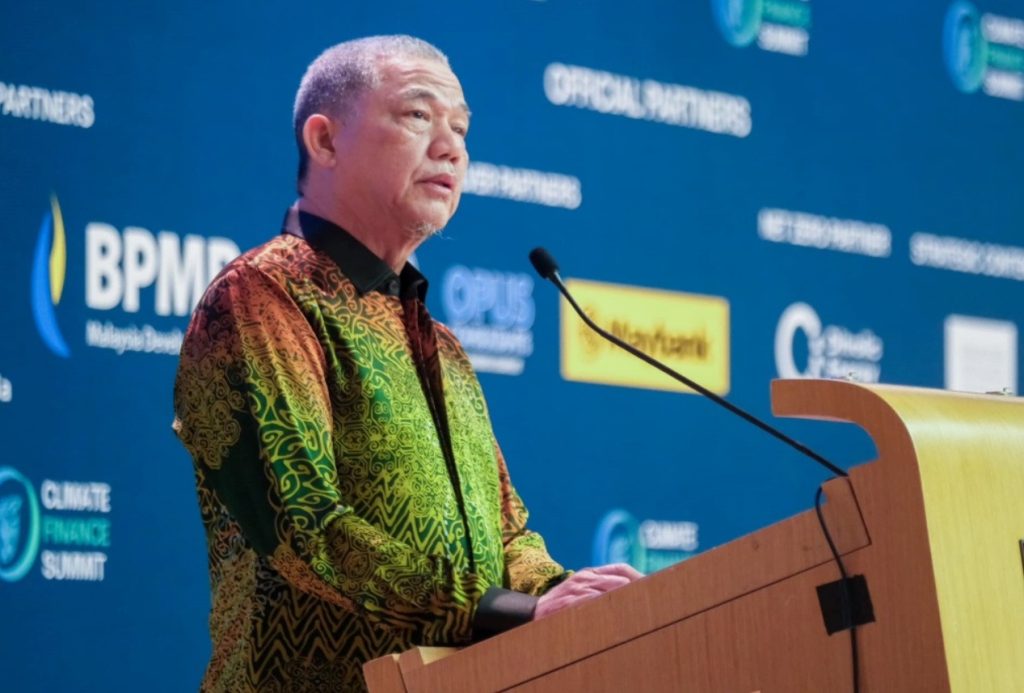
KUALA LUMPUR: Climate finance is crucial for meeting ambitious targets and fostering positive changes, thereby ensuring a more sustainable and equitable future. Deputy Prime Minister Datuk Seri Fadillah Yusof, who is also the Minister of Energy Transition and Water Transformation said that Malaysia welcomes international partnerships and investments supporting the country’s energy transition and broader climate objectives. “We are open to cooperating with various parties, including international financial institutions and private investors to mobilise the necessary resources for sustainable development projects,” he said. According to Fadillah, mobilising capital for a just transition offers a unique opportunity for long-term economic growth, enhanced social equity and increased investor confidence. “The scientific consensus is clear. We must act decisively and swiftly to mitigate these impacts. Central to this effort is the transition to sustainable energy systems,” said Fadillah. He also reiterated the government’s commitment to steering Malaysia towards a more sustainable future, including raising the renewable energy (RE) capacity target to 70% by 2050, up from the previous 40% target by 2035. Additionally, the government plans to introduce a ‘Corporate RE Supply Scheme’ in September, allowing corporate entities to directly source green electricity from third-party RE generators. Furthermore, the government is developing its second National Energy Efficiency Action Plan for 2026-2035 to enhance efforts in reducing national energy consumption. “By 2026, we aim for at least 50% of new bank financing to support climate or energy transition activities,” he said, referring to the integration of climate resilience into financial strategies outlined in the Malaysia Financial Sector Blueprint. — BERNAMA

Scroll to Top

Subscribe
FREE Newsletter