News

Lifestyle, News

Proton Aims to Sell Up to 2,000 Units of 2025 X70 Per Month

PUTRAJAYA: Proton Holdings Bhd aims to sell up to 2,000 units of the newly launched 2025 Proton X70 per month, given the strong demand for the current model. Its Deputy Chief Executive Officer Roslan Abdullah said the Proton X70 has been a crowd favourite, with sales of over 1,000 to nearly 2,000 units per month. “For the 2025 Proton X70, we are targeting sales figured in the same range, which is more than 1,000 and up to 2,000 units, based on the enhancements and competitive pricing we have introduced,” he said after the launch of the latest Proton X70 model. Roslan added that aside from the existing markets, the automaker also plans to export the model to over 10 new countries. Meanwhile, Proton Chief Executive Officer Dr Li Chunrong said the launch of the new model marked a new milestone in the Proton-Geely partnership. “With so many milestones over the past 18 months, including the introduction of electric vehicles, the company has come quite far since the launch of our first sport utility vehicle (SUV) in 2018,” he said. Proton’s updated B-segment SUV is available in the Standard, Executive, Premium and Premium X variants, with prices ranging from RM98,800 to RM126,800. In conjunction with the launch, Proton is offering up to RM23,500 worth of added-value features at no extra cost for the first 3,000 customers to register their 2025 Proton X70. The new model also comes with a 5-year unlimited mileage warranty, a 5-year data package with 1GB per month and 6 complimentary labour services. — BERNAMA


News, Property

Lexis Hotel Group Launches KL’s Latest Iconic Landmark, Imperial Lexis

KUALA LUMPUR: Imperial Lexis Kuala Lumpur by Lexis Hotel Group has officially opened its doors, setting a new standard for opulent living and world-class hospitality and is poised to become the city’s latest iconic landmark. In a statement, the group said that the 53-storey hotel is the only one in Kuala Lumpur to feature a private pool in each of its 275 serviced rooms and suites. The property integrates eco-friendly materials in its amenities and packaging, while also incorporating energy-efficient technologies, allowing guests to indulge in luxury with a minimal environmental footprint. “Embracing innovation, Imperial Lexis Kuala Lumpur champions the use of technology in its daily operations, offering seamless mobile check-in via tablets and mobile devices, effectively reducing the reliance on printed materials. “This forward-thinking approach ensures a stay that is both sophisticated and sustainable,” Lexis Group said. — BERNAMA

News

Computer giant IBM will end research and development work in China

BEIJING: US computer giant IBM confirmed Monday (Aug 26) it would close its research and development arm in China. Multiple employees told AFP they had been informed during a brief meeting with US executives on Monday that the company would gut its research and development team in China and move operations to another country. When asked about the cuts, an IBM spokesman told AFP: “IBM adapts its operations as needed to best serve our clients, and these changes will not impact our ability to support clients across (the) Greater China region”. The employees said more than 1,000 jobs in China could be cut and it was unclear where the company would move its operations. “Today it was just officially announced,” said one employee, who declined to give his name. The employee, who said he had worked for IBM for 10 years, said “Everyone remained relatively calm … it feels more like a peaceful separation”. The firm has operated in China for decades and employs thousands of people in the country. Its research and development teams are based in several cities including Beijing, Shanghai and Dalian. Members of those teams said they were blocked from accessing the company’s server over the weekend. US-China tensions have led to numerous international companies either laying off employees or relocating some of their China operations elsewhere. The Wall Street Journal reported in May that tech giant Microsoft had this year asked hundreds of China-based employees in its cloud computing and artificial intelligence operations to transfer out of the country. The move was motivated by increasing scrutiny over its China presence, the paper said. US firms in China have increasingly complained about what they see as an unfair business environment, with limited protection for intellectual property and preferential treatment afforded to domestic competitors. Those fears were compounded last year by a broad crackdown on US consulting firms operating in China.-CNA

Energy & Technology, ESG, News

Telecom Industry Struggling to Secure Sustainable Renewable Energy

KUALA LUMPUR: The telecommunications industry is grappling with challengesin securing renewable energy (RE) supply, largely due to the limited availability of sustainable green energy sources. Edotco Group Sdn Bhd Chief Executive Officer Mohamed Adlan Ahmad Tajudin emphasised that having a sufficient supply of RE is crucial to support a smooth transition to the green economy. One of the major challenges in RE supply is the lack of supporting infrastructure, noting that some South Asian countries – including Pakistan, Bangladesh and Myanmar – are facing power grid issues. “Some of them have an unstable power grid system while some areas to not even have a power grid,” he said. “While some countries offer mechanisms to ensure that power drawn from the grid is renewable, the supply remains limited,” said Mohamed Adlan. In Malaysia, businesses can subscribe to Renewable Energy Certificates (RECs), benefit from Feed-In Tariff (FIT) schemes, or install solar panels under the Net Energy Metering mechanism. “However, the supply of RE is still limited at this time and it is on a first-come-first-serve basis,” he said, adding that generating clean energy can be a costly endeavour, leading to premium pricing. Given Malaysia’s sunny disposition, solar energy has become a key player in the nation’s green energy transition, helping to reduce carbon emissions and fuel consumption. “In some of our (foreign) markets where we operate, solarisation helped Edotco to cut fuel consumption by about 50% and reduce carbon emissions by 49% annually, in addition to lowering our operating expenditure,” he said. He also highlighted customer readiness to adopt sustainable energy as another challenge, underscoring the importance of close collaboration and transparent communication for successful outcomes. “It is crucial to work closely with our customers throughout this journey, ensuring transparency and open discussions on all matters,” he added. — BERNAMA

Investment & Market Trends, News

Manufacturing Sales at RM921.5 Bil in First 6 Months of 2024

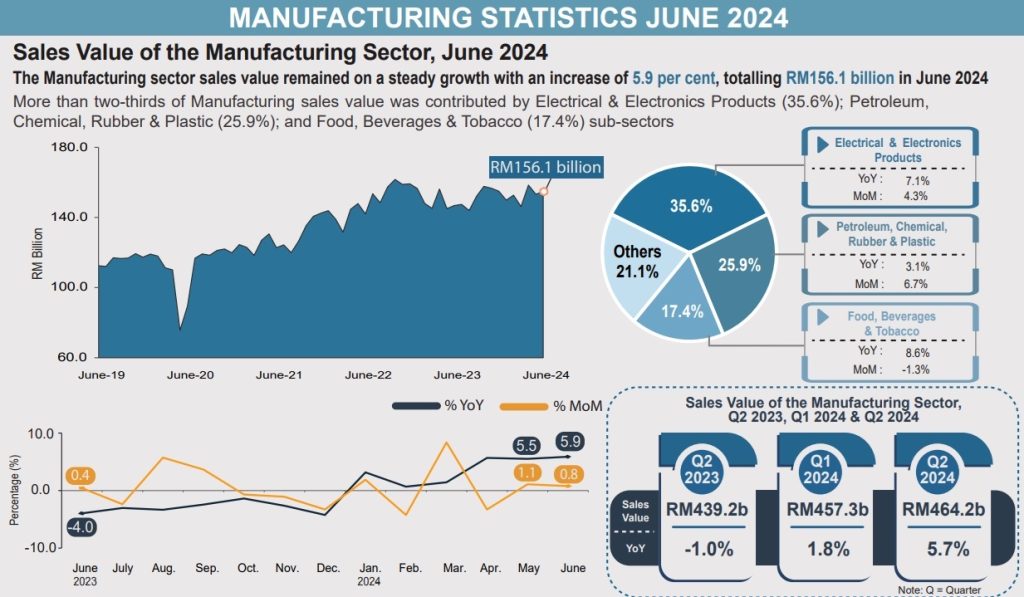
KUALA LUMPUR: Malaysia’s manufacturing sector sales reached RM921.5 billion in the January-June 2024 period, increasing by 3.7% versus the 3.5% in the same period a year ago. Department of Statistics Malaysia (DOSM) Chief Statistician Datuk Seri Mohd Uzir Mahidin said the sector’s headcount was up by 1% to a total 2.37 million while salaries and wages grew by 1.3% to RM49.3 billion. “Sales value per employee was RM388,904, which is a 2.7% growth,” he said. The second quarter of 2024 (2Q 2024) registered sales of RM464.2 billion, reflecting a growth of 5.7% (1Q 2024: 1.8%) which was attributed to the electrical and electronics (E&E) products (7.3%) and the food, beverages and tobacco (8.2%) sub-sectors. “Furthermore, the number of employees and salaries and wages paid during the quarter went up by 1% (1Q 2024: 0.5%) and 1.4% (1Q 2024: 1.2%) respectively,” he added. Mohd Uzir said sales for the sector remained on steady growth with a 5.9% rise to reach RM156.1 billion in June 2024, primarily driven by the E&E products sub-sector, which grew 7.1% after registering 12.2% growth in May 2024. “The growth was also supported by the food, beverages and tobacco sub-sector with an increase of 8.6%, and non-metallic mineral products, basic metal and fabricated metal products which rose by 11.1%. “On a month-on-month (MoM) basis, the sales value grew by 0.8% from RM154.9 billion in May 2024,” he said. Additionally, the sales value for export-oriented industries, which accounted for 73.1% continued to expand at a faster pace of 6% in June 2024 (May 2024: 4.6%) while domestic-oriented industries grew a modest 5.5% (May 2024: 7.9%) due to 5.2% decline in motor vehicles, trailers and semi-trailers sales. “There were 2.37 million employees in the manufacturing sector in June 2024, a 1% increase compared to 0.9% in May 2024,” Mohd Uzir said, adding that salaries and wages rose by 1.8% to a total of RM8.20 billion in June 2024.

Investment & Market Trends, News

Malaysia’s Care Economy Set for US$25.5 Bil Boom

KUALA LUMPUR: The care economy is flourishing in Southeast Asia, with Malaysia’s market potential reaching US$25.5 billion. According to Deputy Economy Minister, Datuk Hanifah Hajar Taib, the country’s ageing population has presented an optimistic economic opportunity. “The global market potential from the ageing population is projected to be US$4.56 trillion by 2025. “Malaysia can leverage this trend to enhance societal well-being and productivity through new economic sectors such as the caregiver economy,” he said. Hanifah also noted that Malaysia’s industries could benefit from the growing demand for healthcare services, both domestically and internationally. This includes opportunities in healthcare and long-term care tourism, medical equipment supplies and advanced medical technologies employing artificial intelligence (AI) and robotics. Additionally, Hanifah encouraged private companies to develop products and solutions targeting the elderly and the caregiver economy. — BERNAMA

News

Bank of China appoints Ge acting president after Liu resigns

CHINA: Bank of China said that President Liu Jin has stepped down after a little more than three years in the job. Liu, born in 1967, resigned from his roles including as executive director due to personal reasons, effective from Aug 25, the state-owned bank said in a stock exchange filing on Sunday (Aug 25), days after he was absent from a board meeting. Chairman Ge Haijiao will be the acting president of the bank, according to the statement. There was no disagreement with the board, and Liu confirmed that there are no matters that need to be brought to the attention of shareholders, a filing to the Hong Kong exchange said. President Xi Jinping has been tightening his grip over China’s US$66 trillion financial sector with sweeping crackdowns on corruption and violations. In April, China kicked off new anti-graft inspections of some of its largest lenders, the central bank and regulators, the first broad probe since a round in 2021 that sent shock waves through the industry. More than 100 top executives have been ensnared in the probes, with several handed suspended death sentences and one executed. Liu Lange, Bank of China’s ex-chairman, was put on trial earlier this year for taking more than 121 million yuan (S$22 million) of bribes from 2010 to 2023, according to prosecutors. He was put under a probe by the Central Commission for Discipline Inspection in March 2023. Liu Jin joined the bank in 2021. Before that, he held various roles at other Chinese lenders including China Everbright Bank and Industrial & Commercial Bank of China. Bank of China reported a 2.9 per cent year-on-year decline in first-quarter net income to 56 billion yuan. The lender is scheduled to release its half-year earnings next week. -BLOOMBERG

News

Low tax a boon for India

NEW DELHI: India is making new efforts to ignite interest in its green debt as the category misses out on a torrent of foreign flows into local sovereign bonds. The nation will allow the trading of sovereign green debt from its newest finance hub in Prime Minister Narendra Modi’s home state of Gujarat by March. But lower taxes may not be enough to lift their appeal amid a lack of supply and small issuances. “The tax advantage won’t necessarily be a game changer unless the liquidity of the market improves,” said Kenneth Akintewe, head of Asian sovereign debt at abrdn plc. Foreign investors “can access supranational bonds, many of which are also sustainable or green, with higher ratings and improved liquidity and free of domestic taxes.” Green issuances aren’t among the 20 most popular Indian government bonds with foreign investors, according to Clearing Corp of India data. Only about 14% of the planned issuance of US$1.4bil for the April-September period hit the market as officials scrapped auctions that didn’t garner a premium. That hampers the government’s plan to lower financing costs to promote green growth in the world’s third-largest emitter. At US$15.6bil, India’s environmental, social and governance debt issuance is set to notch an annual record, but the volume remains a fraction of that of peers such as China and Japan, according to Bloomberg Intelligence. The lukewarm response for India’s green bonds contrasts with the enthusiasm seen for their conventional peers. Global funds snapped up Indian bonds at a rate not seen in seven years following a landmark index inclusion by JPMorgan Chase & Co. in June. Only a tiny share of about US$ 12 billion of such inflows has gone into green bonds. “Whether they can have sufficient liquidity is perhaps the most important thing for many foreign investors,” said Xuan Sheng Ou Yong, sustainable fixed income lead for Asia Pacific at BNP Paribas Asset Management in Singapore. He suggested allowing investors to swap green bonds with regular government debt as has been done in Germany, and building a yield curve by issuing shorter green bonds as those are more popular when interest rates fall. Concerns over finding a buyer when they want to trim holdings are keeping investors at bay – no green bonds have exchanged hands since Aug 16, according to data compiled by Bloomberg. Allianz Global Investors GmbH’s portfolio manager Giulia Pellegrini, who started trading in sovereign rupee bonds this year, is awaiting the next primary issuance as the secondary market remains illiquid. India’s got all the ingredients from a macroeconomic standpoint. “It’s a giant that seems committed to doing more about environmental issues, climate change,” she said. “But at the moment we’re lacking literally the paper.” While poor liquidity remains a talking point for green bonds globally, small sizes and the unpredictability of issuance compound the challenges for India. Only one of its green bonds cleared the issuance threshold for inclusion into JPMorgan’s gauge. The nation’s decision last month to remove future issuance of 14 and 30-year debt from the index-eligible securities will also limit green debt availability to investors. “The small size of a long-term bond typically bought by foreign investors leads to less liquidity in the secondary markets and wider bid-offer spreads,” said Gustavo Medeiros, head of research at Ashmore Group Plc. This “makes it a costly instrument to carry in portfolios. From that perspective, a feeble demand is not surprising.” — Bloomberg

Investment & Market Trends, News

MITI Unveils Initiatives for Stronger Industrial Supply Chain

KUALA LUMPUR: The Ministry of Investment, Trade and Industry (MITI) will implement preventive measures to address potential supply chain disruptions, including the development of a platform to enhance traceability, ensuring the resilience of Malaysia’s industrial supply chain. MITI also plans to establish initiatives that provide centralised access to guidelines, funding opportunities and support programmes while fostering knowledge sharing among industry players. These measures were decided at the Sixth National Investment Council (MPN) Meeting that focused on ‘Building Economic Security Through a Resilient Supply Chain’. Its minister, Tengku Datuk Seri Zafrul Abdul Aziz emphasised the need for responsive strategies to manage and recover from supply chain disruptions, citing findings from its engagement sessions with industry stakeholders and bilateral and multilateral cooperation. He said the global supply chain is the lifeline of the world economy with interconnected systems that complement one another. “Supply chain security ensures the smooth flow of goods, services and inputs across borders and fosters economic growth and universal prosperity. “The COVID-19 pandemic served as a wake-up call, exposing vulnerabilities and underscoring the importance of a resilient and efficient industrial supply chain,” he said. As an open economy, Malaysia is particularly sensitive to supply chain disruptions caused by global geopolitical events and natural disasters, MITI noted. “To maintain the competitiveness of the Malaysian economy, MITI is committed to ensuring that the national industrial supply chain remains resilient and secure against future disruptions,” the minister added. The ministry stressed the importance of a multi-pronged approach to bolster global supply chain resilience. “Collaboration between governments, businesses, and international organisations is crucial for facilitating information sharing, coordinating responses, and developing uniform standards. “This includes leveraging technology, diversifying sourcing options, fostering regional cooperation, and enhancing flexibility as key strategies to strengthen supply chains against disruptions,” MITl said. MITI also highlighted the need for digitisation to reinforce supply chain resilience and security, drive innovation, and provide a competitive edge in the increasingly complex global market. “By embracing digital technology, Malaysia can improve its ability to prevent and respond to disruptions, implement robust security measures, and streamline operations for greater efficiency and agility through digitisation, including systems, applications, and virtual centres of excellence,” the ministry explained. — BERNAMA

Investment & Market Trends, News

China Could Help Cushion US Recession Impact on Malaysia’s Economy

KUALA LUMPUR: A strong Malaysia-China economic relationship is expected to help the country face and overcome the adverse effects of a US recession. Capital Dynamics Asset Management Sdn Bhd Managing Director, Tan Teng Boo said that China is set to introduce aggressive policies to shore up its economy on the back of the latest development in the country and the US, helping to cushion the impacts of a possible global recession. Therefore, he believed Malaysia’s economy would still grow relatively better than other countries due to its links with China. Tan opined that Bursa Malaysia’s FBM KLCI would be able to end the year at the 1,600 level and the ringgit between 4.40 and 4.50 as US recession risks are set to induce monetary policy change in the world’s largest economy. “China has always been an important country to the world and Malaysia, not just for businesses and investments but also for the nation’s economy and foreign policies,” he said. Tan described the US recession as potentially unprecedented and very much different from previous crises, with the US government having limited policy space and may cut its interest rates significantly starting this year. “I will not be surprised if the US cuts interest rates to near zero again, he highlighted. Tan said that with a 2024 budget deficit estimated at 7% of GDP, the US has limited means to launch fiscal stimulus to boost its economy. He opined that Bank Negara Malaysia may retain its overnight policy rate at the current 3% to ensure that the monetary policy stance remains conducive to sustainable economic growth, amid a narrow rate differential should the US start cutting interest rates this year. According to Tan, China is in an excellent position to make use of fiscal measures to support the economy, and it has plenty of room to loosen its monetary policy. He added that with the decoupling already ongoing with the US, the resilient Chinese economy will be able to safely sail through another US-led financial crisis, just like 2008-2009. Tan said China saved the global economy in 2009 with her massive fiscal stimulus and again in 2022 to 2023 from a cost of living crisis, by not taking a fiscal-bazooka stimulus. “This time, we may see China saving the global economy for the third time, he said. China has been Malaysia’s largest trading partner since 2009, making up 14% of exports. Tourist arrivals from China reached nearly 1.2 million Chinese in five months of 2024, a 200% increase over the same period of last year. — BERNAMA

Scroll to Top

Subscribe
FREE Newsletter