Investment & Market Trends

Investment & Market Trends

Singapore’s GIC Looking To Offload US$1b Worth Of Private Equity Fund Stakes

SINGAPORE, Singapore’s sovereign wealth fund, GIC Pte Ltd, is reportedly seeking to sell stakes in a portfolio of private equity (PE) funds valued at more than US$1 billion (RM4.2 billion), as it continues to actively rebalance its investments through the rapidly expanding secondary market. According to people familiar with the matter, who requested anonymity due to the private nature of the discussions, GIC has initiated a process to divest holdings with a net asset value of at least US$1 billion. The proposed sale could include as many as 30 PE funds managed by global investment heavyweights such as Blackstone Inc, Apollo Global Management Inc, and TDR Capital. Sources added that the funds earmarked for sale have an average vintage year of around 2016 and roughly US$100 million in assets each. Global investment advisory firm Evercore Inc has been appointed to advise GIC on the transaction. Representatives from GIC, Blackstone, Apollo, and TDR declined to comment, while Evercore did not immediately respond to media queries. The move comes amid a sluggish dealmaking environment that has slowed private equity exits globally. Many institutional investors, including sovereign wealth funds and pension managers, have increasingly turned to the secondary market to manage their portfolios, unlock liquidity, and reinvest into newer opportunities. According to Jefferies Financial Group Inc, global secondary transaction volume for private markets surged to a record US$103 billion in the first half of this year — a clear sign of growing investor appetite for liquidity and portfolio rebalancing amid prolonged exit delays. For GIC, the potential divestment reflects a pragmatic approach to portfolio management rather than a strategic retreat from the asset class. Market observers said the sovereign wealth fund, one of the world’s most active and experienced private equity investors, routinely participates on both the buy and sell sides of the secondaries market. Indeed, GIC was a major buyer of secondary interests in 2023, reportedly acquiring positions in 50 private equity funds with exposure to more than 500 underlying companies. The current sale, therefore, aligns with its ongoing efforts to optimise exposure across vintages, geographies, and managers. However, sources cautioned that the structure of the transaction — including the number of funds, total value, and timing — remains fluid and may be revised depending on market conditions. The sale could also be postponed or cancelled entirely if GIC does not receive bids that meet its valuation expectations. GIC, which manages Singapore’s foreign reserves alongside Temasek Holdings and the Monetary Authority of Singapore, does not publicly disclose its total assets under management. Data platform Global SWF estimates that the fund oversees approximately US$936 billion in assets. As of March 2024, its five-year annualised nominal return stood at 6.1%, unadjusted for inflation. Analysts said the fund’s ongoing use of the secondary market underlines a growing trend among large institutional investors seeking flexibility and diversification amid an uncertain macroeconomic backdrop. “This is part of a broader shift toward dynamic portfolio management, where funds like GIC actively recycle capital to capture better risk-adjusted returns,” one investment banker familiar with sovereign funds noted.

Investment & Market Trends

KNM To Delist, Prioritises €270m German Unit Sale Over PN17 Appeal

KUALA LUMPUR, KNM Group Bhd has chosen to prioritise its financial recovery over maintaining its listing status, as it moves forward with the €270 million (RM1.34 billion) sale of its German subsidiary, Deutsche KNM GmbH (DKNM) — a transaction it deems critical to restoring stability. In a filing on Monday, the debt-laden engineering group said it has withdrawn its appeal against Bursa Malaysia’s rejection of its Practice Note 17 (PN17) regularisation plan. The withdrawal means KNM will be delisted on Nov 5, 2025, ending its 22-year tenure on the local exchange. Bursa had previously rejected the regularisation plan, citing the company’s inability to demonstrate long-term business sustainability. KNM explained that pursuing an appeal would have delayed regulatory processes and potentially jeopardised the completion of the DKNM sale. The company described the delisting as a strategic move to accelerate its turnaround and complete the disposal of DKNM to Japan’s NGK Insulators Ltd — the “highest and most credible offer” received. “KNM has endured some of its toughest years and is now on the verge of transformation. If delisting is what it takes to complete the NGK sale, eliminate debt, and restore growth, it is a necessary step forward,” said group chief executive officer Ravindrasingham Balasingham in a separate statement. KNM added that the current market value of its shares reflects “minimal value”, rendering the delisting largely symbolic. Remaining listed under PN17, it said, restricts fundraising and negatively impacts the group’s credibility with clients and investors. According to the company, delisting will allow it “to move faster, execute projects more effectively, and focus on restoring profitability without further delays.” KNM’s decision follows Bursa Malaysia’s warning to its major shareholder, MAA Group Bhd, on Oct 23 that convening a shareholder meeting on the proposed sale would breach listing rules. MAA, which owns a 19.37% stake, had planned to hold an EGM on Oct 30 after KNM rejected its earlier request, citing regulatory non-compliance. MAA had also stressed that the transaction with NGK Insulators must be completed by Oct 30 to avoid liquidation. As it moves toward delisting, KNM said it will proceed with the EGM on Oct 30 to seek shareholder approval for the sale. The disposal is expected to reduce the group’s RM1.3 billion debt burden and generate RM100 million in cash to fund operations and drive its turnaround. “KNM currently has nearly 33,000 shareholders and about 450 creditors, all of whom stand to benefit from the completion of the DKNM disposal. The upcoming EGM is a critical milestone in ensuring KNM’s recovery and financial sustainability,” it said. KNM added that the sale of DKNM, which holds its key asset Borsig GmbH, is essential to debt repayment and lowering gearing. Creditors have agreed to allow the group to retain RM100 million from the sale proceeds for working capital. The group emphasised that delisting does not equate to closure, noting it will continue to operate as an unlisted public company with shareholder rights preserved under the Companies Act 2016. KNM said it will focus on financial and operational recovery using the retained funds and may consider re-listing once its position improves. “The board is fully committed to KNM’s turnaround and believes this decisive action, though difficult, is the only responsible path to protect the company and create long-term value for stakeholders,” the statement said. KNM was classified as a PN17 company in October 2022 after auditors flagged going-concern issues. Before its suspension, the company’s shares last traded at half a sen, valuing it at RM20.23 million.

Investment & Market Trends

THMY Shares Nearly Triple On Strong ACE Market Debut

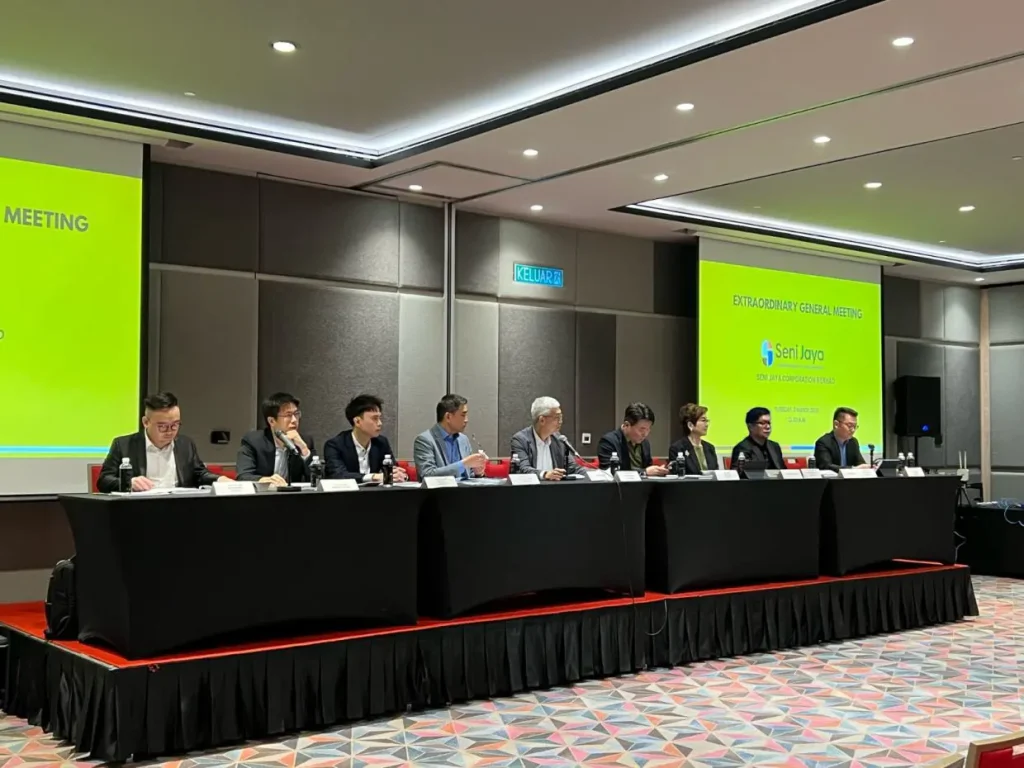
KUALA LUMPUR, THMY Holdings Bhd, a Penang-based test solutions engineering company, made an impressive debut on the ACE Market, with its share price nearly tripling from its initial public offering (IPO) price. The counter closed at 91 sen, marking a 194% increase from its IPO price of 31 sen per share. At market open, the stock began trading at 80 sen, representing a 158.1% premium, with 46.3 million shares changing hands. From left: Affin Hwang Investment Bank Berhad chairman and independent non-executive director Hasli bin Hashim, THMY independent non-executive director Aw Ee Leng, THMY executive director and chief operating officer Chew Yap Meng, THMY executive director and chief executive officer Ooi Can Nix, THMY independent non-executive chairman Datuk Dr. Mohd Sofi bin Osman, THMY independent non-executive directors Datuk Cheok Lay Leng and Chua Hooi Luan, and Affin Hwang Investment Bank Berhad chief executive officer, Hanif Ghulam Mohammed. THMY specialises in providing automated test solutions for the electrical and electronics (E&E) sector, serving industries such as technology, telecommunications, semiconductors, industrial automation, and healthcare. Speaking at a press conference following the listing ceremony, executive director and chief executive officer Ooi Can Nix expressed optimism about the company’s growth prospects, driven by the rapid expansion of artificial intelligence (AI) and data centres. “We have a number of strong multinational clients operating in these fast-growing segments. AI and data centres are connected to a wide range of industries, and we believe the momentum in these areas will directly benefit THMY,” Ooi said. He added that the company is well-positioned to capitalise on the global E&E uptrend, supported by increasing demand for advanced testing solutions and automation technology. On the group’s dividend policy, Ooi said there are currently no plans to introduce one, as THMY remains focused on reinvesting for growth. “Our priority is expanding the business, so dividends are not a key consideration at this stage,” he noted. Prior to its listing, THMY’s IPO was oversubscribed by 35.57 times, raising RM44.6 million from its public issue. The proceeds will be used primarily to fund its new factory in Batu Kawan, Penang, with RM25.9 million allocated for the construction and partial purchase of new industrial land. Other allocations include RM5.2 million for repayment of bank borrowings, RM3.7 million for new machinery and equipment, RM3.1 million for working capital, and RM1.9 million for design and research and development (R&D) expenditure. “We aim to unlock new opportunities with the construction of our new factory, which will increase production capacity and enhance our technological capabilities through investments in innovation and automation,” Ooi said. He added that THMY’s existing production facility is currently operating at about 85% utilisation, and the group plans to optimise and expand its capacity to meet rising demand. “With proper planning and a reorganised layout, we definitely have room to scale up,” he said. For the first quarter ended June 30, 2025, THMY recorded a revenue of RM14.2 million and a net profit of RM3 million. Ooi concluded that the successful listing marks a new chapter for the company. “Our team is motivated to build on this momentum, strengthen our market positioning, and create long-term value for our shareholders as we pursue opportunities in both domestic and regional markets,” he said.

Investment & Market Trends

Genting’s Resorts World Catskills Bond Plan Shelved Until 2026

KUALA LUMPUR, Genting Group’s plan to sell the hotel and other non-casino assets at its Resorts World Catskills property in Sullivan County, New York, has been postponed until early January, once again delaying a planned US$561 million (RM2.37 billion) municipal bond sale. The sale is being deferred as Genting Bhd (KL) seeks to buy out minority investors in its Genting Malaysia Bhd (KL) subsidiary, restricting the group from entering into new material transactions during the process. The update was disclosed in a letter by Resorts World US chief financial officer Walter Bogumil, which was read at a meeting of the Sullivan County Resorts Facilities Local Development Corp on Monday (Oct 20). The development corporation had planned to issue municipal bonds to acquire non-gaming components of the resort — including hotel rooms, an event centre, spa, and golf course. The deal had already been postponed twice to address investor concerns. A representative for KeyBanc Capital Markets, the lead arranger for the bond sale, declined to comment on the latest delay. Market observers say investors have grown increasingly cautious toward high-yield municipal bonds following the financial difficulties faced by projects such as Florida’s Brightline high-speed rail. “Investors are finally becoming more concerned with some of the deal structures,” said Jeffery Timlin, managing partner and lead portfolio manager for Sage Advisory Services’ municipal strategies. “They want a little more protection.” Genting, one of Malaysia’s largest leisure and gaming groups, is also a contender for one of three downstate New York City casino licences. The group has proposed a US$5.5 billion integrated resort next to the Aqueduct racetrack in Queens, competing against Bally’s Corp’s US$4 billion Bronx project and a US$8 billion proposal near Citi Field by Mets owner Steve Cohen. Analysts have mixed views on the potential impact of new downstate casinos on Resorts World Catskills. Genting expects to redirect a portion of its urban customer base to the Catskills property, projecting an additional US$200 million in annual revenue. The company has pledged to channel some player rewards earned in the city toward visits to its upstate resort. However, a separate report commissioned by Sullivan County consultants projects that the entry of three new casinos in New York City could cut Resorts World Catskills’ gambling revenue by as much as US$150 million, warning that “the viability of the resort as a major employer and economic anchor could be seriously threatened.” Proceeds from the postponed bond sale were intended to strengthen the resort’s balance sheet, preserve jobs, and fund future development. Fitch Ratings noted that while the sale of non-gaming assets could enhance profitability from 2026 onward, rising competition from downstate casinos may eventually weigh on earnings.

Investment & Market Trends

IGB REIT Reports RM95.6 Mil Profit In 3Q, Announces 2.77 Sen Distribution

KUALA LUMPUR, IGB Real Estate Investment Trust (IGB REIT) reported a higher net profit of RM95.62 million for the third quarter ended Sept 30, 2025 (3QFY2025), compared with RM79.58 million a year earlier, driven by increased rental income. The trust’s revenue rose to RM165.20 million from RM155.27 million in the same quarter last year, according to its filing with Bursa Malaysia on Wednesday. For the cumulative nine months of FY2025, IGB REIT posted a net profit of RM294.70 million, up from RM260.73 million in the previous corresponding period, while revenue climbed to RM496.72 million from RM467.80 million. In a separate announcement, IGB REIT declared an income distribution of 2.77 sen per unit for 3QFY2025, payable on Nov 20, 2025. The trust also said that the acquisition of The Mall, Mid Valley Southkey in Johor Bahru is expected to be completed by the end of November 2025. The property is anticipated to strengthen IGB REIT’s portfolio by enhancing diversification and regional presence. “Supported by developments such as the Johor-Singapore Special Economic Zone, the Rapid Transit System Link, and increased cross-border spending driven by a stronger Singapore dollar, the asset is expected to contribute positively to IGB REIT’s growth despite ongoing challenges in the retail market,” it added.

Investment & Market Trends

THMY Holdings Jumps On Debut Trading Day On ACE Market

KUALA LUMPUR, THMY Holdings Bhd (KL:THMY) delivered a strong debut performance on the ACE Market of Bursa Malaysia, surging 158% above its initial public offering (IPO) price amid buoyant investor demand and solid market sentiment. The counter opened at 80 sen, a sharp jump from its IPO price of 31 sen per share, making THMY one of the standout listings on the ACE Market in recent months. Shortly after opening, the stock eased slightly before regaining momentum to trade back at 80 sen at 9.10am, with more than 87 million shares changing hands in early trade. At that price, the company commanded a market capitalisation of over RM710 million, reflecting strong investor confidence in THMY’s growth potential and business prospects. Analysts noted that the strong debut reflects renewed interest in small- and mid-cap counters, particularly those in sectors seen to benefit from Malaysia’s ongoing economic recovery and digitalisation efforts. The company’s robust listing performance also signals encouraging sentiment in the local equity market, as more retail investors return to participate in IPO opportunities.

Investment & Market Trends

EPF No Longer A Major Shareholder In 99 Speed Mart

KUALA LUMPUR, The Employees Provident Fund (EPF) has ceased to be a substantial shareholder in 99 Speed Mart Retail Holdings Bhd following the disposal of a small portion of its equity in the homegrown minimart chain operator. In a filing with Bursa Malaysia, 99 Speed Mart said the EPF disposed of 11.61 million shares, equivalent to a 0.14% stake, on Oct 16. The sale reduced the retirement fund’s shareholding to 4.89%, below the 5% threshold that defines a substantial shareholding under Bursa Malaysia’s listing requirements. While the filing did not disclose the transaction value, based on 99 Speed Mart’s closing price of RM3.13 on Oct 16, the divested shares were worth approximately RM36.33 million. Following the disposal, 99 Speed Mart’s founder and chief executive officer Lee Thiam Wah remains the company’s only substantial shareholder, maintaining a controlling 79.68% stake. The EPF first appeared as a substantial shareholder in June this year after accumulating a 5.02% stake. Since then, it has actively traded the counter, with its holdings peaking at 5.52% in early October before gradually reducing its position. 99 Speed Mart’s shares have shown a strong performance in recent months, buoyed by investor confidence in the company’s steady earnings growth and expansion strategy. From RM2.09 at end-June, the stock has surged nearly 58% to reach an all-time high of RM3.30 on Tuesday. At the close of trading on Wednesday, 99 Speed Mart’s shares eased six sen or 1.82% to RM3.24, valuing the retail group at RM27.2 billion. Founded by Lee Thiam Wah, 99 Speed Mart operates more than 2,500 outlets nationwide and has become one of Malaysia’s leading neighbourhood convenience chains, focusing on affordability and accessibility for consumers.

Investment & Market Trends

Sin-Kung Subsidiary Partners With Pos Malaysia Unit For Aviation Support Services

KUALA LUMPUR, Sin-Kung Logistics Bhd’s air cargo and private jet charter arm is teaming up with Pos Malaysia Bhd’s aviation units to strengthen its operational capabilities ahead of its commercial launch this quarter. The company’s wholly owned subsidiary, Sin-Kung Airways Sdn Bhd, has signed a series of service agreements with Pos Aviation Sdn Bhd and Pos Aviation Engineering Services Sdn Bhd (PAES), covering ground handling, in-flight catering, and aircraft engineering services, the company said in a statement on Tuesday. From left: Pos Aviation Engineering Services Sdn Bhd general manager Akbar Ali and CEO Saravanan Ramasamy, with Sin-Kung Logistics Bhd managing director Alan Ong and executive director Angeline Ong. Sin-Kung Logistics managing director Alan Ong said the collaboration forms part of the airline’s strategy to build a strong operational framework to support its upcoming service rollout. “Partnering with Pos Aviation and PAES allows us to tap into their nationwide infrastructure and technical expertise, ensuring our operations meet international standards for safety, quality, and reliability,” Ong said. Pos Aviation CEO Saravanan Ramasamy added that the partnership reinforces the company’s role as a comprehensive aviation solutions provider, offering end-to-end operational support for airline partners. Last week, Sin-Kung Logistics also appointed AeroDarat Sdn Bhd as its ground handling partner at key Malaysian airports, including Kota Kinabalu, Kuching, Miri, Labuan, Tawau, Sandakan, and Penang, with Kuala Lumpur International Airport as an alternate hub. The three-year agreement covers aircraft ramp operations, load control, flight operations, cargo and mail handling, and related technical support. Shares of Sin-Kung Logistics closed unchanged at 11.5 sen, giving the company a market value of RM132.25 million. Pos Malaysia shares ended 1.5 sen or 5% higher at 31.5 sen, valuing the group at RM246.57 million.

Investment & Market Trends

Straits Energy To Offload Two Tugboats For RM8.5m To Related Party Due To Project Shortage

KUALA LUMPUR, Straits Energy Resources Bhd is set to sell two tugboats to related party Sealion Ltd for a total of US$2.01 million (RM8.5 million) as part of efforts to streamline non-core assets and cut operating costs. The company said the Labuan-based unit Victoria STS has faced a shortage of viable projects since early 2023, and the tugboats are no longer essential to current or foreseeable operations. The sale is expected to reduce operating, licensing, and insurance expenses. In a Bursa filing, Straits Energy stated that its indirect subsidiaries, Victoria 1 Ltd and Victoria 3 Ltd, signed separate memoranda of agreement with Sealion for the disposal of TG Victoria 1 and TG Victoria 3. The related-party transaction involves TG Victoria 1 being sold for US$826,500 (RM3.49 million) and TG Victoria 3 for US$1.19 million (RM5.01 million), reflecting the interest of major shareholder Datuk Seri Tiong Chiong Kui. Proceeds from the sale will primarily go towards repaying term loans with Orix Leasing Malaysia Bhd, to which the vessels are charged as security, and to settle amounts owed to suppliers and related companies. TG Victoria 1, built in 1992, has a gross tonnage of 230 tonnes and a length of 34.24 metres, while TG Victoria 3, built in 2001, has a gross tonnage of 199 tonnes and measures 32.82 metres. The disposal is expected to be completed by December 2025, barring unforeseen circumstances. Straits Energy operates in oil trading and bunkering services, land transportation and logistics, and port operations and facility management. Its shares closed unchanged at eight sen on Tuesday, giving the group a market capitalisation of RM79.56 million.

Investment & Market Trends

Verdant Solar Jumps 19% In Debut Trading On ACE Market

KUALA LUMPUR, Verdant Solar Holdings Bhd surged 19% in its first day of trading on the ACE Market on Wednesday, as investors snapped up shares of the solar panel installer ahead of its market debut. The stock opened at 37 sen, above its initial public offering (IPO) price of 31 sen per share, reaching an intraday high of 38.5 sen and trading at 38 sen at 9.10am, with more than 49 million shares changing hands. The strong debut comes after a highly oversubscribed IPO, where retail investors applied for nearly 40 times more shares than available, reflecting confidence in the growing demand for renewable energy solutions. “Every step of our mission has been clear: to reduce electricity costs through world-class solar solutions that promote sustainable living, while providing the best customer experience,” said managing director Lim Tzer Haur during the listing ceremony. Founded in 2015, Verdant Solar initially focused on marketing solar systems for residential properties before expanding into engineering, procurement, construction, and commissioning (EPCC), as well as operations and maintenance. The IPO raised approximately RM44 million for Verdant Solar, with an additional RM22.8 million gained by Lim, his spouse Ng Kel Mynn, and substantial shareholder Ong Hsiao Loong from partial share sales, bringing total proceeds to RM66.8 million. The company, valued at RM311 million based on its last traded price, plans to reinvest earnings into growth and does not intend to pay dividends in the near term. Mercury Securities acted as the principal adviser, sponsor, underwriter, and placement agent for the IPO.

Scroll to Top

Subscribe
FREE Newsletter