Investment & Market Trends

Investment & Market Trends

AFFIN Group Announces Profit Before Tax of RM293.1 Million in 1H2024

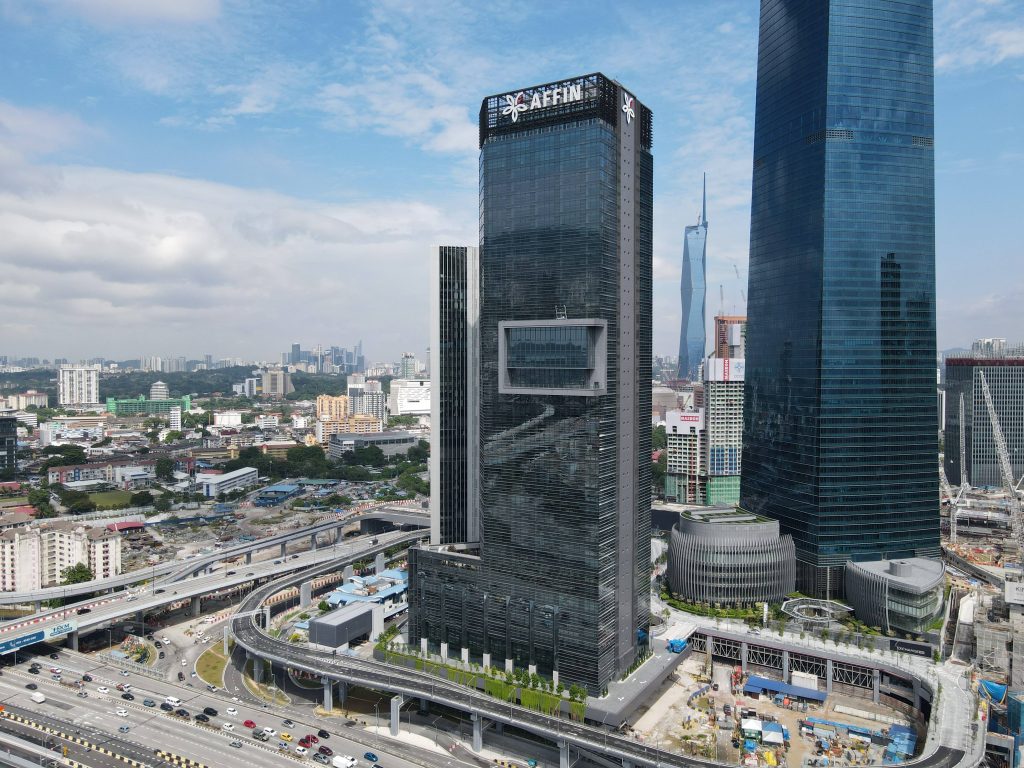
KUALA LUMPUR: AFFIN Group achieved a Profit Before Tax (PBT) after zakat of RM293.1 million for the six months ended 30 June 2024 (1H2024), marking a 15.2% decrease from RM345.7 million in the same period last year (1H2023), primarily due to Net Interest Margin (NIM) compression. Despite this, the Group demonstrated strategic growth with total assets increasing by 7.2% to RM108.2 billion, up from RM100.9 billion in the previous corresponding period, driven by a 10.5% rise in loan and financing portfolios, reaching RM69.0 billion. Datuk Wan Razly Abdullah, President & Group Chief Executive Officer of Affin Bank Berhad, stated that the Group expects NIM to normalize by the first half of 2025 under the AX28 Strategic Plan. This outlook is bolstered by anticipated Federal Reserve rate cuts and improving economic conditions in Malaysia. He emphasized the Group’s focus on optimizing operational costs, enhancing customer solutions, and maintaining high credit quality amidst soft economic conditions. In tandem with these efforts, the Group is advancing its digital transformation initiatives. Pending regulatory approval for Go-Live, the Digital Core enhancements include improvements to CASA, Deposits, and e-wallet capabilities, with a new Mobile Banking Platform scheduled for a December 2024 launch to bolster the deposit franchise. The Group remains committed to its AX28 strategic pillars: Unrivalled Customer Service, Digital Leadership, and Responsible Banking with Impact. Notably, achieving an NPS Score of +69 underscores its customer-centric approach. Affin Private Banking is set to launch in September 2024 to drive further expansion. Looking ahead, the Group anticipates achieving its Digital Leadership goals by end-2025, with potentially transformative impacts from the delayed entry of Sarawak State Shareholder, enhancing customer base and liquidity by end-2024. In recognition of its excellence, the Group received prestigious accolades including ‘Malaysia Domestic Cash Management Bank of the Year for AFFINMAX’ and ‘Best Retail Bank in Malaysia and Best Syndicated Loan in Renewable Energy’ by various industry awards. Financial Metrics Overview Net Interest Income (NII): RM386.0 million, down 11.5% from RM436.2 million. Islamic Banking: Affin Islamic Bank Berhad’s PBT increased by 12.0% to RM148.8 million, supported by a 13.9% growth in Gross Financing. Non-Interest Income: RM284.2 million, up 7.8% from RM263.6 million. Asset Quality: The Gross Impaired Loan (GIL) ratio stood at 1.89% in 1H2024 compared to 1.78% in 1H2023. Loan Loss Coverage (LLC) and Loan Loss Reserve (LLR): LLC at 100.06% and LLR at 130.12%. Operating Expenses: Increased to RM746.7 million, with a Cost-to-Income ratio of 74.7%. Loans and Deposits Growth: Total loans reached RM69.0 billion, with CASA ratio at 25.89% and customer deposits at RM71.2 billion, down 0.4% YoY. Capital Adequacy and Liquidity: Total Capital ratio at 16.84%, Tier 1 capital ratio at 14.27%, CET1 capital ratio at 12.84%, and Liquidity Coverage Ratio at 170.23%.  

Energy & Technology, Investment & Market Trends, News

Survey Reveals Over 35% of Enterprises Struggle to Retain Crucial AI Expertise

KUALA LUMPUR: In its latest survey, Expereo revealed that over one-third (35%) of global enterprises are struggling to retain or attract crucial skills in artificial intelligence (AI), data and automation, which is threatening their optimistic AI ambitions. According to the Technology Leaders Survey, there is a critically low supply of AI expertise, despite AI now being considered as the biggest priority for Chief Information Officers (CIOs) across the world. Its Chief Executive Officer, Ben Elms, “CIOs need to keep up with market innovations, customer expectations and fierce competition when it comes to AI, while ensuring they are adopting the technology responsibly and effectively without cutting corners. “Networking technology, data strategies and wider tech infrastructure are all key areas which run adjacent to AI initiatives, which must also not be ignored.” The research of 650 technology leaders in global enterprises across Europe, the United States and Asia Pacific showed that not only are enterprises struggling to attract or retain crucial talent, but their current external technology partners are not aligned with their AI ambitions either. In addition, 29% of global CIOs said their current external technology partners do not have the right capabilities in place to support AI initiatives and 28% of global respondents feel regional variations in ability to implement AI initiatives is a key challenge. The other leading obstacle to fulfilling AI ambitions includes navigating AI governance and ethics (36%), referring to ongoing challenges such as regulation, trust and data protection when it comes to using AI tools in a business setting. The survey also found that 42% of CIOs believe that training for new ways of working as a result of AI is one of the biggest information technology challenges in supporting remote and hybrid workers, with 39% saying that understanding how employees use AI is now a concern. In spite of these challenges, 32% of CIOs are moving forward with caution regarding AI implementation and 44% are excited and ready to take on AI intiatives. — BERNAMA

Energy & Technology, Investment & Market Trends, News

M’sia Must Be Strategic in Acquiring, Developing Tech to Join Developed Nations

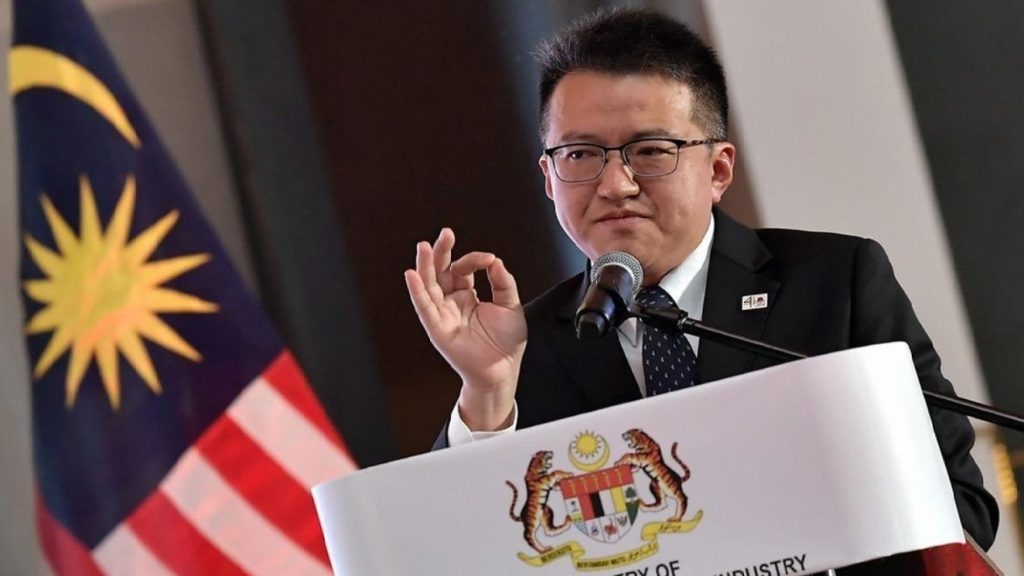
KUALA LUMPUR: Malaysia needs to strategically acquire and develop its own technology to be counted among develop nations. Deputy Investment, Trade and Industry Minister Liew Chin Tong said that while the foreign direct investment (FDI) is necessary, it’s not an end in itself and Malaysia needs to be strategic in its approach. “Malaysia thinks that FDI is almost everything and I think that mindset has to change,” he said. According to the deputy minister, the MADANI Economic Framework, Prime Minister Datuk Seri Anwar Ibrahim highlighted that for over 20 years, investment has constituted only about 20% of the gross domestic product (GDP). “In contrast, during the early days of economic growth, it constituted around 40% of GDP. At one point in 1997, it rose to about 45%. “While there were instances of overheating, the key takeaway is that investment is crucial and foreign investment is necessary, but we need to be strategic in our approach,” he added. Liew stressed that industrialisation cannot just be about exports but also has to have some form of mission to solve societal problems. “The New Industrial Master Plan (NIMP) 2030 lists 4 missions namely advance economic complexity, tech up for a digitally vibrant nation, push for Net Zero, safeguard economic security and inclusivity, which are all key to transforming Malaysia’s industry into one that is of high productivity, high skill, and most importantly. High wage,” he said. Liew also highlighted a comparison made by Seoul National University Professor of Economics, Prof Keun Lee on the semiconductor sectors in Taiwan, Shenzhen and Penang, where the sector is still mainly driven my foreign firms. “In comparison, the sectors in Taiwan and Shenzhen have acquired many more technologies and innovations,” he added. Meanwhile, Liew said he is glad to see government-linked investment companies (GLICs) paying more attention to the semiconductor industry in Malaysia. “The semiconductor industry used to be treated as a private-driven investment. Now, the industry has been thrust into the spotlight amid the current geopolitical fight between China and the US due to the growing necessity of having access to advanced chips to power everything from smartphones to electric vehicles (EVs). “Clearly, the ability to think critically about the way to position and accelerate advancements in semiconductors will have significant implications for trade, investment and geopolitics in the years to come,” he continued. It is also crucial, Liew said, to develop horizontal industrial linkages with Malaysia. “For example, the mature semiconductor industry in Malaysia should form a basis for developing the automotive industry, including EVs and agritech,” he said, adding that Malaysia is at the brink of a second economic takeoff built upon the development of a high productivity, high skills and high wage model. — BERNAMA

Investment & Market Trends, News

MIDF Maintains a Positive Stance on Oil and Gas Sector

KUALA LUMPUR: MIDF Amanah Investment Bank Bhd is maintaining its positive stance on the oil and gas (O&G) sector as the outlook for 2024 remains encouraging. However, the investment bank remained cautious about potential escalations in geopolitical tensions, significant production adjustments by the Organisation of the Petroleum Exporting Countries and its allies (OPEC+) and the US Federal Reserve’s monetary policy. It anticipates brent crude oil prices to remain relatively stable within the range of US$77-US$84 per barrel in August 2024 (year-to-date 2024 (YTD24): US$83.51 per  barrel), buoyed by the geopolitical tensions and OPEC+ production cuts through tempered by lower demand from China. Meanwhile, natural gas prices are expected to decline in the near term due to oversupply, settling at US$2.10-US$2.35 per million British Thermal Units (MMBtu) (YTD24: US$2.24 per MMBtu) in August. “We are highly optimistic about the upstream division, given that its contractual work basis provides operational stability, despite brent crude oil prices slipping to a maximum threshold of 20%-25% below the current spot price. “This is on top of Petronas’ expected capital expenditure (capex) of RM50-RM60 billion in 2024,” it said. However, it noted that the short-term downside risks include the uncertainty in the demand for crude oil, geopolitical risks and the OPEC+ production cut decision following the drop in brent crude oil daily spot price to below US$80 per barrel since the last week of July 2024. Similarly, investment bank holds a positive view on the midstream sector, particularly the ship tankers and storage facilities on the back of relatively stable and elevated short-term and long-term charter rates across ship sizes. It added that the recent decline in crude oil and natural gas prices in late July 2024 is expected to benefit tanker operators as lower prices may encourage the mobilisation and storage of crude and refined petroleum products, allowing sellers to mitigate charter costs while buyers take advantage of restocking opportunities. “While we are generally neutral on the downstream sector, we continue to anticipate a recovery in demand for petrochemicals as well as the increase in demand for biofuels and renewable energy (RE),” it said. Looking ahead, the investment bank expects the O&G services and equipment (OGSE) subindustry to show improved performance in the first half of 2024 (1H 2024). The upstream division is expected to remain resilient, given the higher capex both globally and domestically (global capex: +24% year-on-year (YoY) to US$600 billion, Malaysia’s capex: +23.3% YoY to RM31.2 billion) and relatively stable brent crude oil prices. “Immediate downside risks are sudden escalation in geopolitical tension, drastic changes to OPEC+ supply cut and unfavourable RM/US$ exchange rates. “We forecast brent to reach an average of US$82 per barrel and Henvy Hub to average US$2.20 per MMBtu in August,” it added, As for the downstream sector, MIDF noted that while uncertainties in petrochemicals persist, the diesel rationalisation initiative has started to yield positive results for end buyers of refined petroleum products. Demand for Jet A1 and Mogas is expected to remain strong during the upcoming holiday and travel season, barring any changes to the RON95 subsidy as anticipated following the diesel targeted subsidy rollout. Additionally, the bank expects demand for sustainable fuels to surge, driven by the increase in biomass projects across the nation in 1H 2024. This shift will create new revenue streams for downstream players as they refine and distribute these alternative fuels. — BERNAMA

Investment & Market Trends

Kelington 2Q2024 Net Profit Rose 39.9% to RM26.7 Million, Declares Dividend of 2 Sen

KUALA LUMPUR: Integrated engineering solutions provider, Kelington Group Berhad (“Kelington” or “Group”) (stock code:0151) today reported its second quarter (“2Q2024”) and six months (“1H2024”) financial results ended 30 June 2024. During the quarter, Kelington recorded a revenue of RM321.2 million, versus RM424.9 million in the preceding year’s corresponding quarter (“2Q2023”). The lower revenue was mainly due to several major projects in Singapore and Malaysia moving out of their accelerated phases and nearing completion. However, a favourable project mix, with a higher proportion of revenue from higher-margin projects, led to a 20.6% increase in gross profit (“GP”) to RM55.5 million, up from RM46.0 million in 2Q2023. This improvement resulted in the Group’s GP margin rising to 17.3% in 2Q2024, compared to 10.8% the previous year. Additionally, profit attributable to shareholders (“net profit”) increased by 39.9% year-over-year (“YoY”) to RM26.7 million for the quarter, compared to RM19.1 million in 2Q2023. For 1H2024, Kelington achieved a net profit of RM51.5 million on the back of RM660.5 million in revenue. This marked a 46.1% increase from RM35.3 million in the corresponding period of the previous year (“1H2023”). In terms of business segments, the Ultra High Purity (“UHP”) division remained the primary revenue contributor, accounting for RM427.6 million or 65% of the Group’s total revenue in 1H2024. Meanwhile, the Processing Engineering division and General Contracting division contributed RM38.8 million and RM128.2 million respectively, which made up 6% and 19% of Kelington’s 1H2024 total revenue. The Industrial Gases division maintained its strong performance in 1H2024, with revenue rising 33% YoY to RM71.3 million, driven by elevated demand for liquid carbon dioxide (“LCO2”) from Oceania countries and increased sales of other gases. Commenting on the Group’s financial performance, Ir. Raymond Gan, Chief Executive Officer of Kelington Group Berhad said, “We are proud of the solid results achieved in the first half of the year. As we look ahead, we remain confident in our growth trajectory, driven by our robust project pipeline and our active involvement in regional tenders. Our focus will be on maintaining this momentum and delivering value to our stakeholders.” “Kelington is well-positioned for sustained growth, supported by key developments. In the first half of 2024, the Group secured new contracts totalling RM564 million, bringing the total outstanding order book RM1.29 billion as of 30 June 2024.” “According to the SEMI World Fab Forecast report, the global semiconductor industry is significantly expanding production capacity to accommodate the growth of AI and various disruptive technologies. The report anticipates the launch of 103 new fabs between 2023 and 2027, presenting substantial opportunities for Kelington.” As of 30 June 2024, the Group’s equity (excluding non-controlling interests) increased to RM396.4 million, up from RM332.6 million at the end of December 2023. This growth was driven by the exercise of warrants and consistent quarterly profits. The Group has proposed a second interim tax-exempt dividend of 2 sen per ordinary share for the financial year ending 31 December 2024 (“FY2024”), totalling RM13.6 million. This brings the total dividend declared in FY2024 to 4 sen per ordinary share, equivalent to RM27.0 million. This represents a 52% payout of Kelington’s 1HFY24 net profit. The Group’s balance sheet remains strong with a cash balance of RM334.1 million exceeding total debt of RM197.7 million as of 30 June 2024.

Investment & Market Trends

SMRT Concludes FY24 with RM26.7 Mil Net Profit as a Pure Play Enterprise IoT Solutions Provider

CYBERJAYA: Pure play enterprise Internet of Things (“IoT”) solutions provider, SMRT Holdings Berhad (“SMRT” or the “Group”), has announced its fourth quarter (“4QFY24”) and full-year financial results for the period ended 30 June 2024 (“FY24”). SMRT had previously changed its financial year-end to 30 June 2023 from 31 December 2022, which means that comparative figures for the preceding year’s corresponding quarter and period are not available. For FY24, SMRT achieved a revenue of RM69.1 million and a profit after tax and non-controlling interest (“net profit”) of RM26.7 million, reflecting a robust net profit margin of 38.6%. Quarterly, the Group reported a revenue of RM17.9 million in 4QFY24, marking an 11.2% growth from RM16.1 million in the immediate preceding quarter (“3QFY24”). This growth was primarily driven by variations in the number and timing of deployments, as well as an increase in the cumulative number of managed sites. Meanwhile, the Group’s net profit stood at RM6.2 million in 4QFY24, compared to RM6.9 million in 3QFY24, which included a one-off gain on the disposal of a dormant subsidiary. Group Managing Director of SMRT, Mr. Maha Palan, commented, “We are pleased to conclude the financial year on an upbeat note, reinforcing SMRT’s position as a pure play enterprise IoT solutions provider. Our key markets in Malaysia and Indonesia continue to thrive, and our recent entry into the Philippines’ financial services sector is poised to drive future growth. Additionally, we have expanded into new verticals, with IoT deployments for the water utility sector already underway. As our deployment footprint expands, the addition of sites under our management will further bolster our recurring income, which now accounts for over 50% of our revenue. With a clear strategic vision, we remain committed to leading the provision of IoT services across ASEAN.”

Investment & Market Trends, News

Singapore Narrows 2024 GDP Growth Forecast to 2%-3%

SINGAPORE: Singapore has narrowed its gross domestic product (GDP) growth forecast for 2024 to 2%-3%, from the previous 1%-3%, after taking into account its economic performance in the first half of the year as well as the latest global and domestic economic situations. The Singaporean Ministry of Trade and Industry (MTI) said the country’s economy expanded by 2.9% year-on-year (YoY) in the second quarter of 2024 (2Q 2024), extending the 3% expansion in the previous quarter. “For the first half of 2024, Singapore’s GDP growth averaged 3% YoY,” it said in a statement in conjunction with the release of the 2Q 2024 Economic Survey of Singapore report. MTI said the 2Q 2024 GDP growth was primarily driven by the wholesale trade, finance and insurance, as well as the information and communication sectors. Among the sectors, the finance and insurance sector grew by 6.7% YoY, mainly driven by the banking and fund management segments, which saw net commissions surge during the quarter as global interest rates started to ease. In contrast, the manufacturing sector contracted by 1% YoY in 2Q, mainly due to output declines in the biomedical manufacturing and precision engineering clusters, with the former in turn weighed down by a sharp fall in pharmaceuticals output. Consumer-facing sectors such as the retail trade and food & beverage services sectors also shrank, partly due to an increase in outbound travel by locals. As for the outlook for 2024, MTI said that since the Economic Survey of Singapore in May, the GDP growth performances of Singapore’s major trading partners have largely been in line with expectations, with the United States (US), Japan and Malaysia being key exceptions. “Notably, the US and Malaysian economies performed better than expected in 2Q on the back of strong domestic demand. By contrast, GDP growth in Japan was weighed down by weak private consumption as real wages continued to decline,” the ministry said. It said that the US GDP growth is expected to ease gradually for the rest of the year as consumption growth slows in tandem with weakening labour market conditions, while China’s economy is projected to expand at a slightly slower pace in the second half of the year as investment growth tapers amid signs of overcapacity in some sectors. According to MTI, GDP growth in key Southeast Asian economies is projected to pick up slightly in the second half of the year in tandem with improvements in domestic demand, as well as the ongoing recoveries in global electronics and tourism demand. Singapore’s external demand outlook is expected to be resilient for the rest of the year, it said, amid that 2 downside risks in the global economy that still remain. These include an intensification of geopolitical and trade conflicts that could dampen business sentiments and add to production costs, which could weigh on global trade and growth. “Secondly, disruptions to the global disinflation process could lead to tighter financial conditions for longer and trigger market volatility or latent vulnerabilities in baking and financial systems,” it added. — BERNAMA

Investment & Market Trends, News

Manufacturing Sales at RM921.5 Bil in First 6 Months of 2024

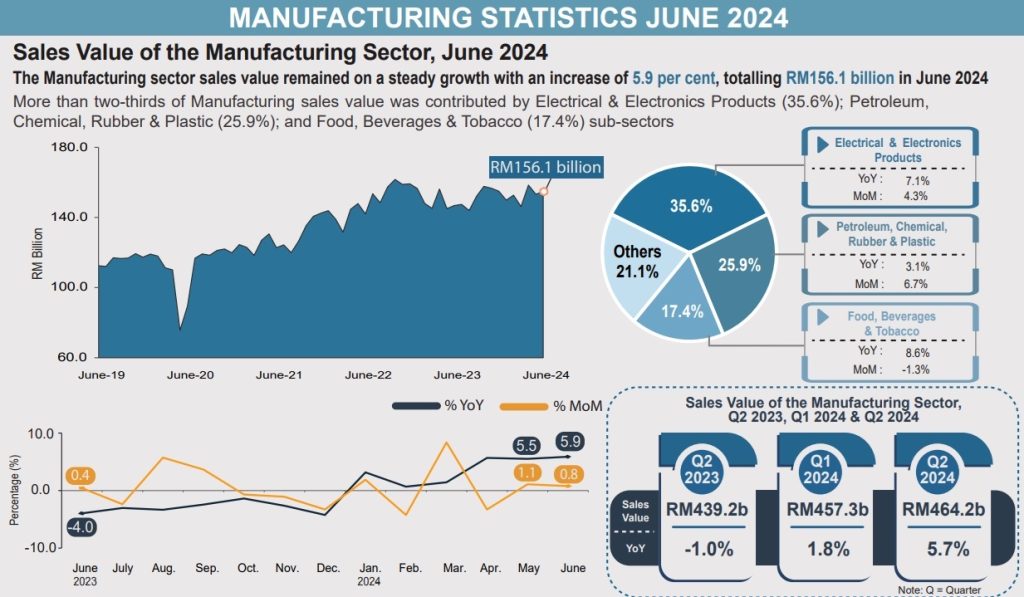
KUALA LUMPUR: Malaysia’s manufacturing sector sales reached RM921.5 billion in the January-June 2024 period, increasing by 3.7% versus the 3.5% in the same period a year ago. Department of Statistics Malaysia (DOSM) Chief Statistician Datuk Seri Mohd Uzir Mahidin said the sector’s headcount was up by 1% to a total 2.37 million while salaries and wages grew by 1.3% to RM49.3 billion. “Sales value per employee was RM388,904, which is a 2.7% growth,” he said. The second quarter of 2024 (2Q 2024) registered sales of RM464.2 billion, reflecting a growth of 5.7% (1Q 2024: 1.8%) which was attributed to the electrical and electronics (E&E) products (7.3%) and the food, beverages and tobacco (8.2%) sub-sectors. “Furthermore, the number of employees and salaries and wages paid during the quarter went up by 1% (1Q 2024: 0.5%) and 1.4% (1Q 2024: 1.2%) respectively,” he added. Mohd Uzir said sales for the sector remained on steady growth with a 5.9% rise to reach RM156.1 billion in June 2024, primarily driven by the E&E products sub-sector, which grew 7.1% after registering 12.2% growth in May 2024. “The growth was also supported by the food, beverages and tobacco sub-sector with an increase of 8.6%, and non-metallic mineral products, basic metal and fabricated metal products which rose by 11.1%. “On a month-on-month (MoM) basis, the sales value grew by 0.8% from RM154.9 billion in May 2024,” he said. Additionally, the sales value for export-oriented industries, which accounted for 73.1% continued to expand at a faster pace of 6% in June 2024 (May 2024: 4.6%) while domestic-oriented industries grew a modest 5.5% (May 2024: 7.9%) due to 5.2% decline in motor vehicles, trailers and semi-trailers sales. “There were 2.37 million employees in the manufacturing sector in June 2024, a 1% increase compared to 0.9% in May 2024,” Mohd Uzir said, adding that salaries and wages rose by 1.8% to a total of RM8.20 billion in June 2024.

Investment & Market Trends, The Executives

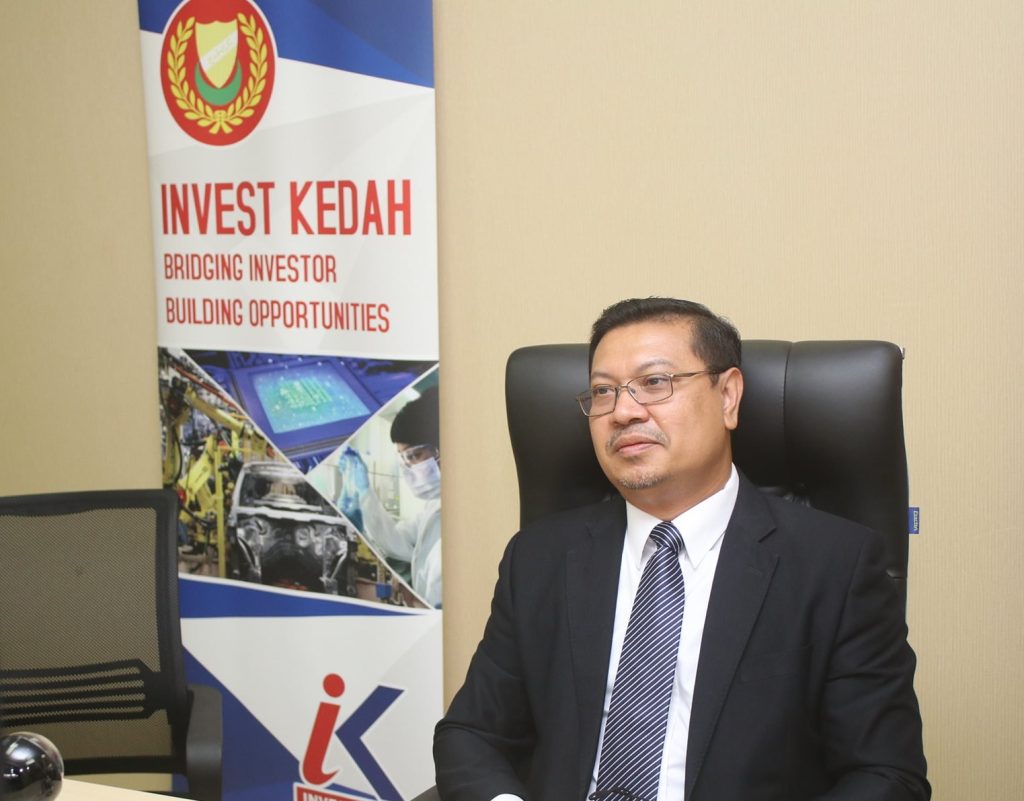
Invest Kedah to Propel State in Further Contributing to Country’s GDP

By Tara Yean Malaysia has been demonstrating commendable economic resilience in 2024, with the state of Kedah securing the top spot in approved investments among the other states within the country for the first quarter of 2024 (1Q 2024), with a total of RM31.3 billion of investments as of June. According to Menteri Besar Datuk Seri Muhammad Sanusi Md Nor, the figure was part of the total RM83.7 billion approved investments in Malaysia for the quarter. The approved investments in Kedah, he said, involved 51 projects and were expected to create 2,262 jobs. Meanwhile, in an exclusive interview with The Exchange Asia, Invest Kedah Chief Operating Officer Noor Ikhsan Abdul Aziz revealed that China-based solar panel supplier and energy storage solutions provider, Risen Energy invested a total of RM42.2 billion in Kedah last year, which became the major contributor for the state to achieve its highest-recorded investment. “Every year, the state’s investment target is to maintain at least a total of RM10 billion annually for both foreign direct investment (FDI) and domestic investments across all sectors. “However, in 2024, Invest Kedah is pushing hard to meet our level best to record a total of RM30 billion worth of investments in the state alone,” Noor Ikhsan said. He added that the state is focusing on a few sectors when it comes to investments, namely renewable energy (RE), semiconductor, automotive, data centres and Halal Park, as well as potentially exploring investments from foreign corporations to establish collaborations with local universities or learning institutions. “Corporations are also welcome to set up their own research and development (R&D) centre, training facilities or course faculties in the universities as it will contribute to the state’s talent force development and ultimately benefit the technology-sharing concept with the corporations,” Noor Ikhsan explained. With the state emphasising more investment opportunities, Noor Ikhsan said that the state is divided into 3 major parts where such investments could occur – namely the Northern, Central and Southern parts. Investing in Energy and Talent However, for energy-related projects and investments, Invest Kedah encourages several locations such as the Kedah Science Technology Park (KSTP), Gurun, Bukit Selambau and Delapan SBEZ in Bukit Kayu Hitam. The KSTP is also located in Bukit Kayu Hitam and it has 1,900 acres of land located around 4km to the Malaysia-Thailand border. “We are also planning to attract and bring in investors to collaborate with the state’s government to develop an Industrial Power Plant to cater to the electrical needs of these industries,” he added. When asked about other potential investment industries that Kedah would explore, Noor Ikhsan mentioned sectors such as construction, logistics, agriculture, aerospace and telecommunication, among others. However, Noor Ikhsan noted that potential investors tend to look into the supply of local talent pool to support their operations. Hence, Invest Kedah believes it is part of the state’s responsibilities to establish initiatives and develop the talent to cater for industrial needs. “It is commendable that the state government is focusing on creating a sustainable talent pool through initiatives such as the Vendor Development Programme – designed and developed to encourage ‘anchor tenants’ from their origin country and establish operation facilities – to increase the investment potential value of Kedah. “Additionally, Invest Kedah also established a department of ‘Talent and Social’ that is dedicated in making the effort of facilitating the needs for talent in Kedah,” he said. Placing Kedah as Top State for Investment Earlier in February, a local news article reported that Sanusi said that ‘Kedah would be the top state in terms of investment, if not for Kuala Lumpur and Selangor’, and that he doesn’t want Kedah to be known as a ‘feeder’ state for other more successful states, which is expected to be achieved through the Greater Kedah plan. In regard to this statement, Noor Ikhsan said that every state in Malaysia aspires to be the top state in investment. “Kedah has a very big potential to stand out as its own, among other added value to the state are having its own main trade gateways such as international cargo airport, the Kedah Aerotropolis (KXP) and seaport to function as support for the growing industry. The development of KXP is strategically located at the centre of ASEAN with a vision to become the Asia Pacific Aviation Hub equipped with regional integrated logistics and transhipment cargo hub; regional maintenance, repair and overhaul (MRO) and aerospace manufacturing; hajj and umrah hub for the northern region of Malaysia; as well as the Regional Centre of Excellence for Aviation and Aerospace Learning and Education, among others. Noor Ikhsan said that another high-impact project that Invest Kedah believes to increase investment attractiveness is through the data centre industry, which will contribute to providing the computing infrastructure that information technology (IT) corporations require, such as servers, data storage drives and network equipment. Currently, the Bukit Kayu Hitam is also being developed for data centre investments, which have been granted Free Industrial Zone and Free Commercial Zone status by the Ministry of Finance (MOF) with the early phase of setting up internet exchange facilities. Securing Kedah’s Future Noor Ikhsan further explained that the state is poised for long-term success, as outlined in the Kedah Development Plan 2035. “The Kedah Development Plan 2035 is a state vision that involves comprehensive socio-economic development to ensure that Kedah will become a viable and competitive state nationally and globally,” he pointed out. With Invest Kedah being the state’s principal investment promotion agency, it is up to the agency to implement the initiatives according to the policies outlined by the state. Among its functions and relations with the private industry, Invest Kedah is able to play its role in assisting the development of higher education, employability of locals and income generation to the state. Additionally, Noor Ikhsan noted that the Kulim Hi-Tech Park (KHTP) is maintained as the state’s investment magnet since its establishment in 1996. With ready infrastructure (NurPower – dedicated power supply in KHTP), quick intermodal logistics connectivity (BKE connecting North

Investment & Market Trends, News

Malaysia’s Care Economy Set for US$25.5 Bil Boom

KUALA LUMPUR: The care economy is flourishing in Southeast Asia, with Malaysia’s market potential reaching US$25.5 billion. According to Deputy Economy Minister, Datuk Hanifah Hajar Taib, the country’s ageing population has presented an optimistic economic opportunity. “The global market potential from the ageing population is projected to be US$4.56 trillion by 2025. “Malaysia can leverage this trend to enhance societal well-being and productivity through new economic sectors such as the caregiver economy,” he said. Hanifah also noted that Malaysia’s industries could benefit from the growing demand for healthcare services, both domestically and internationally. This includes opportunities in healthcare and long-term care tourism, medical equipment supplies and advanced medical technologies employing artificial intelligence (AI) and robotics. Additionally, Hanifah encouraged private companies to develop products and solutions targeting the elderly and the caregiver economy. — BERNAMA

Scroll to Top

Subscribe
FREE Newsletter