More

News

Symbio Launches Enhanced API Stack and Connect Portal in Singapore

SINGAPORE: Symbio Holdings Limited, a subsidiary of Aussie Broadband Group (ASX: ABB), has unveiled a new API stack in Singapore, marking a significant expansion of its cutting-edge digital experience capabilities across the Asia-Pacific (APAC) region. The rollout builds on the January launch of Symbio’s Connect Portal in Singapore — a self-service, customer-centric platform designed to simplify number management for communication service providers. Together, the V4 API stack and the Connect Portal provide a unified workflow that enables bulk number ordering, number reservation, and assignment to SIP trunks, thereby reducing risk and enhancing operational transparency. This development positions Symbio as a leader in cloud-native communications infrastructure by offering both flexible self-service options and automated API integrations, enhancing autonomy for users and minimising delays or manual errors. “By combining Tier 1 infrastructure with flexible tools set to scale with the industry, Symbio delivers the first consistent number management experience across Australia, New Zealand, and Singapore,” said Dylan Brown, CEO of Symbio’s Connect Division. This expansion is part of Symbio’s broader regional innovation strategy, which includes the SEA Regional Hub, secure SIP protocols, and integrations with Microsoft Teams (Operator Connect) and Cisco Webex Calling via Cloud Connected PSTN (CCP). These initiatives underscore Symbio’s role in supporting the evolving communication needs of service providers while meeting regulatory standards. With its strengthened capabilities in Singapore, Symbio aims to offer a new benchmark for automation, compliance, and customer experience in number provisioning across the APAC region.
News

Japanese Automakers Turn to Chinese EV Tech to Regain Market Share

SHANGHAI: Japanese car manufacturers are increasingly embracing Chinese electric vehicle (EV) technologies to recover lost ground in the world’s largest car market, China. At the Auto Shanghai motor show, Toyota Motor Corp revealed that its upcoming bZ7 electric vehicle will be equipped with an operating system developed by Chinese tech giant Huawei. The car is expected to launch within a year, with Toyota also announcing plans to appoint young Chinese engineers to lead model development in the country. “To deliver cars people want in China, we need Chinese brains and hands involved in development,” said Li Hui, General Manager of Toyota China. Japanese automakers have seen a sharp decline in Chinese sales: Toyota fell by 6.9%, Nissan by 12.2%, and Honda by 30.9% in 2024. Their combined market share in China dropped from 24.1% in 2020 to just 13.7% in 2024, according to the China Passenger Cars Association. To counter this, Honda is collaborating with Chinese AI firm DeepSeek and co-developing driver assistance technology with another local startup. Meanwhile, Nissan plans to invest an additional 10 billion yuan in China-based R&D by 2026. The shift marks a strategic pivot as Japanese automakers acknowledge the need for localised innovation to compete with leading Chinese EV brands like BYD. — The Japan News/ANN

Investment & Market Trends

LG Energy Solution Posts 138% Profit Surge in Q1 on Weaker Won

SEOUL: LG Energy Solution (LGES), South Korea’s leading battery manufacturer, reported a 138% year-on-year increase in first-quarter operating profit, buoyed by favourable foreign exchange conditions and a significant tax credit under the US Inflation Reduction Act. The company, which supplies major global automakers including Tesla, General Motors, and Hyundai, posted an operating profit of 375 billion won (US$262 million) for the January to March period, up from 157 billion won a year earlier. Revenue rose 2.2% to 6.3 trillion won. LGES noted that without the US tax credit, it would have recorded an operating loss of 83 billion won, highlighting the ongoing pressure from slowing electric vehicle (EV) demand in key international markets. Despite the strong headline profit, shares of LGES slipped 2.1% in morning trading following the announcement, underperforming the broader KOSPI index, which edged up 0.1%. The result aligns with earlier guidance and reflects the broader challenges facing the EV battery sector amid currency volatility and shifting demand dynamics globally.

News

China Blames US Tariffs for Boeing Delivery Halt

BEIJING: China has attributed its suspension of new aircraft deliveries from Boeing to escalating US tariffs, citing major disruptions to the global industrial and supply chains. According to a statement from China’s Ministry of Commerce, the “United States’ wielding of tariffs has severely impacted the stability of the global industrial chain and supply chain,” resulting in halted deliveries and financial losses for both Boeing and Chinese airlines. This follows new US tariffs of up to 145% on Chinese imports, countered by Beijing with its own 125% duties on US goods. Boeing CEO Kelly Ortberg confirmed that Chinese customers have paused acceptance of around 50 aircraft planned for delivery in 2025, warning that the company may soon redirect the jets to other buyers if the situation remains unresolved. Former US President Donald Trump criticised China for backing out of its commitments, urging Boeing to “default China for not taking the beautifully finished planes.” China’s commerce ministry responded by stating its willingness to maintain normal business cooperation and urged the US to create a stable environment for bilateral trade and investment. The development adds further strain to US-China economic relations, highlighting the broader implications of protectionist trade policies on global aviation and cross-border commerce.–AFP

ESG

POSCO Raises $700 Million in Oversubscribed Green Bond Offering

South Korean steel giant POSCO Holdings has successfully raised US$700 million through a two-tranche green bond issuance, the company announced on Tuesday. The offering comprised a US$400 million five-year bond and a US$300 million 10-year bond, both of which were significantly oversubscribed. The five-year notes were priced at 137.5 basis points over US Treasuries—42.5 bps tighter than initial guidance—while the 10-year notes were priced at Treasuries plus 157.5 basis points, also 42.5 bps tighter than originally indicated. According to documents reviewed by Reuters, investor demand was strong, with over US$3.8 billion in orders for the five-year tranche and US$2.8 billion for the 10-year. POSCO stated that proceeds from the green bond issuance will be allocated toward financing or refinancing eligible green projects, in line with its sustainability goals. The move underscores growing investor appetite for ESG-linked instruments and highlights POSCO’s ongoing efforts to support the transition to low-carbon steel production.–REUTERS

Investment & Market Trends, News

Hainan Targets Growth in Low-Altitude Economy with New Investments

BEIJING: China’s low-altitude economy, seen as a strategic emerging sector crucial for developing new quality productive forces, is gaining momentum in Hainan province. Leveraging its tropical geography, multiple application scenarios for low-altitude aircraft, and the advantages of the Hainan Free Trade Port, the island aims to become a major hub for innovation and expansion in this field. The local government announced plans to intensify efforts to promote the low-altitude economy by attracting more enterprises and expanding business formats. So far this year, Hainan has launched 36 projects with a combined investment of 29.4 billion yuan (approximately US$4 billion), covering the entire value chain from aircraft research and development to smart logistics and high-end tourism. Jiang Hong, Deputy Director of the Hainan Provincial Development and Reform Commission, said that a three-year development plan (2024–2026) has been issued to support the sector’s growth. Additional policies are also being prepared to further accelerate development. At the recent China International Consumer Products Expo 2025, eight cooperation agreements related to the low-altitude sector were signed. These included projects such as the construction of a heavy-duty unmanned helicopter assembly line in Wenchang and a marine drone maintenance and support base in Ledong. The sector’s expansion is being driven by a combination of favourable local policies and national initiatives. The National Development and Reform Commission (NDRC) has established a dedicated low-altitude department responsible for formulating and implementing strategies for the sector’s growth. Zheng Shanjie, head of the NDRC, recently chaired a special meeting, highlighting plans to integrate low-altitude economic development into the 15th Five-Year Plan (2026–2030). According to the Civil Aviation Administration of China, the market size of the country’s low-altitude economy is projected to reach 1.5 trillion yuan in 2025, with forecasts suggesting it could grow to 3.5 trillion yuan by 2035. — China Daily/ANN

News

Japan and Vietnam Pledge Support for Free Trade

HANOI: Japan and Vietnam have reaffirmed their commitment to supporting free trade and strengthening bilateral ties as Japan’s Prime Minister Shigeru Ishiba met with Vietnamese leaders in Hanoi on Monday. The visit, Ishiba’s first to Vietnam since taking office, comes as both nations engage in crucial talks with Washington to avert crippling US tariffs. “The world economy is becoming more uncertain, and the impact on the Southeast Asian region is also becoming apparent,” Ishiba said during a joint press conference with Vietnamese Prime Minister Pham Minh Chinh. Journalists’ questions were not permitted during the briefing. The two leaders pledged to uphold the global rules governing the free flow of goods, emphasising the importance of maintaining an open international order based on the rule of law. Their meeting follows a series of high-level engagements across East Asia amid escalating trade tensions, including Vietnam’s hosting of China’s President Xi Jinping and visits from top South Korean ministers. Meanwhile, Japan recently conducted a trilateral summit with China and South Korea. In early April, the United States imposed “bilateral tariffs” of 46% on Vietnamese imports and 24% on Japanese goods. Although those duties were later paused until July pending negotiations, a blanket 10% levy currently applies to all imports into the US—one of the major export markets for both Japan and Vietnam. Economic ties between Japan and Vietnam are already extensive. Japanese firms, including Honda, Canon, and Panasonic, have invested approximately US$78 billion in Vietnam, according to the country’s finance ministry. Japanese banks also hold strategic stakes in several leading Vietnamese financial institutions. During Monday’s meeting, the two countries signed four cooperation agreements focused on boosting trade in energy transition products and advancing research and development in semiconductors. However, the details of the agreements were not disclosed, and it remains unclear whether they involve binding financial commitments. Vietnam’s top leader, To Lam, also met Ishiba on Sunday, urging Japan to further invest in infrastructure projects. Japan has previously conducted preliminary studies for Vietnam’s most ambitious infrastructure undertaking: a proposed US$67 billion high-speed railway connecting Hanoi to Ho Chi Minh City. However, the railway was not explicitly mentioned among the latest areas of cooperation. Ishiba’s next stop will be the Philippines, as Japan continues to strengthen its economic and diplomatic engagement across Southeast Asia during a period of growing global uncertainty.–REUTERS

News

Vietnam Airlines expands partnership with Adyen

SINGAPORE: Adyen, the global financial technology platform for leading businesses, today announced an expanded partnership with Vietnam Airlines, the country’s national flag carrier. Building on a collaboration that began in 2017 with Adyen’s gateway solution, Vietnam Airlines has now extended the partnership to include Adyen’s global acquiring capabilities, enabling seamless and efficient payment experiences across key markets such as Japan, Australia, the United States, and Europe. Through a single integration with Adyen, Vietnam Airlines can now process transactions faster and more reliably across both major credit cards and selected local payment methods, including Alipay and WeChat Pay. Adyen’s direct acquiring connections to global card networks like Visa and Mastercard enable businesses to benefit from local market conditions, leading to higher authorization rates and reduced transaction fees. Since the partnership expansion, Vietnam Airlines has recorded up to a 5% uplift in authorization rates. “Our strengthened partnership with Adyen represents a significant step forward in Vietnam Airlines’ digital transformation,” said Bui Tran Cuong, Deputy Director of Finance and Accounting at Vietnam Airlines. “With Adyen’s global reach and advanced payment solutions, we can offer travelers worldwide a smooth, secure, and flexible payment experience—supporting major card networks and emerging payment methods alike. This collaboration enables us to elevate the passenger journey while boosting operational efficiency and fostering innovation.” Warren Hayashi, President, Asia-Pacific at Adyen, added, “We’re honored to deepen our longstanding collaboration with Vietnam Airlines as their trusted payments partner. Our work together highlights how the right payment solutions can empower businesses to scale and serve a global customer base with ease.” Vietnam Airlines’ expanded partnership with Adyen marks a pivotal move to support its growth ambitions and commitment to delivering best-in-class service for travellers across the globe.

ESG, Events

TotalEnergies ENEOS Powers Samsung Electronics’ Green Future with Major Solar Installation in Vietnam

SINGAPORE:  TotalEnergies ENEOS has launched its largest rooftop solar power project in Vietnam, installing a nearly 28 MWp solar photovoltaic (PV) system at the Samsung Electronics HCMC CE Complex in Ho Chi Minh City. This ambitious initiative marks a significant milestone in the company’s renewable energy portfolio. The project, which will see the installation of over 45,000 solar PV modules, is set to generate more than 40,000 megawatt-hours (MWh) of renewable electricity annually. Once completed, it will supply 26% of Samsung Electronics’ onsite operations with green energy, while also reducing 26,000 tons of CO₂ emissions each year. In line with Samsung’s commitment to the RE100 initiative, which advocates for the use of 100% renewable electricity, this collaboration underscores the company’s ongoing dedication to sustainability. By sourcing green electricity for its operations, Samsung not only advances its environmental goals but also promotes sustainability within its workforce and broader community. Ingrid Jaumain, Zone Director for TotalEnergies Distributed Generation Asia Pacific, joined by Choonki Kwon, President of Samsung Electronics HCMC CE Complex, and Vo Van Hoan, Deputy Chairman of Ho Chi Minh City’s People Committee, attended a ceremony marking the awarding of the Investment Registration Certificate (IRC) to TotalEnergies ENEOS Renewables Projects Vietnam Project Co. Ltd. This marks a pivotal step in the industrial decarbonisation effort, aligned with Vietnam’s national sustainable development goals. Choonki Kwon shared: “This project goes beyond energy generation. It is the start of a broader transformation, where technology not only enhances operational efficiency but also fosters the sustainable development of people and society.” For Alexandru Buzatu, Director of TotalEnergies ENEOS Renewables Distributed Generation Asia Pacific, the project is a testament to the company’s expertise in accelerating the clean energy transition across Southeast Asia. “We are proud to support Samsung’s power needs in Vietnam, helping them achieve their clean energy targets while reinforcing our commitment to sustainability in the region.” With TotalEnergies ENEOS at the helm of this green energy initiative, the partnership is set to deliver not only a sustainable energy solution for Samsung but also a positive environmental impact for the local community and beyond.

News

South Korea’s Acting President Expects US Trade Talks to Yield Mutually Beneficial Outcome

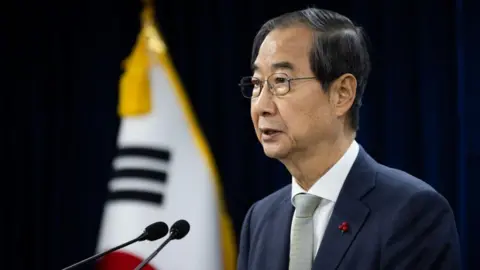
SEOUL: South Korea’s acting President Han Duck-soo expressed optimism on Tuesday that upcoming trade talks with the United States will result in a mutually beneficial agreement, amid rising geopolitical and economic pressures. Speaking at a Cabinet meeting, Han said the bilateral meeting scheduled for April 24 in Washington was arranged at the request of the US and will address critical areas of economic cooperation. Finance Minister Choi Sang-mok and Industry Minister Ahn Duk-geun will represent South Korea in the talks, which will involve US Treasury Secretary Scott Bessent and US Trade Representative Jamieson Greer. Choi, speaking to reporters before departing for the US, said he intends to “open the door to discussions that will strengthen the alliance between South Korea and the US.” Industry Minister Ahn is expected to depart on Wednesday. While the exact agenda remains unconfirmed, South Korea’s Industry Ministry stated that details are still being coordinated with US counterparts. This comes in response to a report from South Korea’s Maeil Business Newspaper, which suggested the talks could include discussions on Seoul potentially joining US-led efforts to curb trade with China. The backdrop to the meeting includes renewed friction between Washington and Beijing, with China on Monday accusing the US of abusing tariff policies and cautioning other countries against entering broader economic pacts that could undermine its interests. South Korean officials have indicated that cooperation on shipbuilding and potential involvement in an Alaska gas project could serve as bargaining chips in the negotiations. However, the government has firmly denied that defence cost-sharing for US troops stationed in South Korea is on the table. Han noted that although the discussions may present challenges, he remains confident that both sides can reach an agreement that reinforces the longstanding economic and strategic partnership. The high-stakes meeting highlights Seoul’s balancing act between maintaining strong trade ties with both Washington and Beijing, amid increasing global economic fragmentation and supply chain realignment.

Scroll to Top

Subscribe
FREE Newsletter